
All Blogs
A simple breakdown of Common Room pricing without the confusing fine print.

Evan Marshall
Senior AI Growth Strategist
Published On

You've seen the demo. You liked it. Now you need a number.
Most SaaS pricing pages are designed to get you into a sales call rather than providing a quote. Common Room is a partial exception because they actually publish a starting price, which is unusual enough to merit crediting. But that starting price is the floor, not the ceiling, and the gap between the two is where most buyers get surprised.
This article breaks down what Common Room actually costs in 2026: the three published tiers, what's included in each, the add-ons that don't come up in the demo, real-world contract benchmarks from procurement data, and a straight answer on who should buy it — and who should look elsewhere first.
The published plans
Common Room offers three tiers, all billed annually. Here's all the data we could gather from their pricing page, along with the numbers reported by third-party sources for 'custom' pricing.
Plan | Published Price | Contacts | Seats | IP Enrichments/yr |
|---|---|---|---|---|
Starter | $1,700/mo (≈ $20,400/yr, billed annually) | Up to 35,000 | 2 included | 240,000 |
Team | Custom (≈ $30,000/yr reported by third parties) | Up to 100,000 | 5 included | 480,000 |
Enterprise | Custom ($50,000–$80,000+/yr) | 200,000+ | Up to 10 | 960,000 |
One thing worth flagging: the official pricing page lists Team and Enterprise as 'Custom,' which means the $30,000/year Team figure is a reported estimate from third-party sources, not a confirmed list price.
What's included and what costs extra
The tier price is only part of the bill. Here's what you get across all plans, and where the add-on charges start.
Included across all plans
RoomieAI™ Capture — signal aggregation across community, social, and web
Unlimited alerts, workflows, and segments
Community and social engagement signals
News and hiring trend tracking
Job change tracking
Add-ons and upgrade triggers
Bombora intent topics: Starter gets 6 topics, Team gets 12, Enterprise gets 25. If you want broader intent coverage, you'll need a higher tier or a paid add-on.
Salesforce integration: Standard on Enterprise only. Paid add-on on Starter and Team. If Salesforce is your CRM, this is an extra line item on every plan below Enterprise.
Product activity integration: Add-on on Starter; included in Team and Enterprise.
Phone number enrichment (FullEnrich): Paid add-on across all plans.
Additional seats: 2 seats on Starter, 5 on Team, 10 on Enterprise. The moment a third person needs access to Starter, you're upgrading.
The billing structure to watch
Annual contracts only: There is no monthly billing option. You're locked in for 12 months from the day you sign.
Contact volume overages: Once you exceed your tier's contact cap, additional charges apply in the low-to-mid four figures per volume band. Contact counts inflate faster than most teams expect — enrichment runs automatically as signals fire, not just when reps are actively prospecting.
Annual price escalation clauses: Common Room contracts typically include 5–10% annual price increases. Negotiate a cap before you sign, not at renewal when your leverage is gone.
One gap that comes up consistently in Common Room reviews: there's no way to act on signals from within the platform. Common Room tells you a prospect visited your pricing page, engaged on GitHub, or just changed jobs, but reaching out, booking a call, or catching that visitor while they're still on your site requires a separate tool.
The full-stack cost: What you'll still need elsewhere
Common Room is a signal aggregation platform. It identifies and surfaces buying intent. It does not execute outbound. For most GTM teams, the Common Room contract is the beginning of the spend conversation, not the end of it.
Gap in Common Room | What you'll need instead | Typical additional cost |
|---|---|---|
Email sequences / outbound automation | Outreach, Salesloft, or Apollo | $50–$150/user/month |
Dialer/calling capability | Often bundled with outreach tools above | Included or separate |
Real-time inbound engagement | Breakout, Qualified, or Drift | $700–$2,500+/month |
Daily SDR action prioritisation | Manual process or dedicated ops | People cost |
Salesforce sync (Starter/Team) | Paid add-on required | Variable |
At $12,000–$30,000/year for Common Room plus $10,000–$30,000/year in outreach tooling, the full-stack cost for a mid-market team typically lands between $25,000 and $60,000 annually, and that's before Enterprise pricing enters the picture.
The inbound engagement row is worth reading twice. Some teams use this as the 'what happens after Common Room surfaces an account' layer. Common Room identifies the company as in-market; whereas a tool like Breakout engages the individual visitor in real time when they arrive on your website, qualifies them through an AI-driven conversation, and books them directly into a rep's calendar.
The two tools address adjacent moments — Common Room finds who's interested, Breakout converts them while the intent is live — and are increasingly paired for that reason.
Real-world contract benchmarks
According to Vendr, which tracks anonymised contract data from 61 Common Room purchases, the average contract value is $30,000/year, and buyers save an average of 27% off list. Contracts in their dataset range from $15,000 to $91,600 annually.
That spread tells you two things: there's no fixed price, and there's real room to negotiate. If your quote is sitting above $30,000 for a mid-market deployment, that's not a ceiling — it's a starting point.
Company profile | Typical annual contract | Discount range achievable |
|---|---|---|
5–10 seats, entry-level | $15,000–$30,000/year | 10–20% off list |
10–25 seats, mid-market | $20,000–$60,000/year | 15–30% (multi-year or competitive) |
50+ seats, Enterprise | $100,000–$200,000+/year | Negotiated case-by-case |
Source: based on 61 purchases, last updated February 2026.
How to negotiate a better price
Common Room pricing is more negotiable than its published tiers suggest. Buyers who go in prepared consistently land 15–30% below initial quotes.
Timing matters
Quarter-end (March 31, June 30, September 30, December 31). Sales teams face quotas and are measurably more flexible on pricing and terms at these moments.
Start the conversation 90–120 days before your intended start or renewal date. Short timelines remove your leverage.
What to ask for
Name competing tools during evaluation. Vendr specifically cites Orbit and Savannah as tools that prompt Common Room to get more flexible on price. Use them.
Request an annual increase cap — target maximum 5% per year. It's negotiable, and most buyers never ask.
Negotiate contact overage rates before you sign. Once your contact count has grown, you've lost that leverage.
Multi-year commitments unlock the largest discounts — typically 15–30% on two-year terms.
Demand a line-item quote before signing: seats, contact volume, enrichment caps, add-ons, and overage thresholds all itemised. If they won't provide it, that's a red flag.
Is Common Room worth the price?
Honest answer: It depends on your GTM motion, rather than your budget.
Worth it if:
You're running a PLG or community-led growth motion with active communities on Slack, Discord, or GitHub
You have dedicated RevOps capacity to configure scoring models and maintain workflows — without this, the platform is significantly underused
You're mid-market or above (50+ employees) with a rich enough cross-channel signal environment to justify the platform
You're already investing in outreach tooling and need a smarter signal layer on top of it
Skip it if:
You're under 50 people without dedicated ops — the configuration investment won't pay back
Your GTM motion is primarily outbound cold prospecting rather than inbound or community-driven
Your primary need is contact data and verified emails rather than behavioural signal aggregation
You're expecting the platform to include outreach execution. It sadly won't.
Teams that are on the fence about Common Room's price often discover that what they actually needed was a sharper inbound conversion layer, not a signal aggregator. If your website is already getting qualified traffic — from demand gen, events, content, or community activity — and your problem is that visitors are leaving before a rep can engage, that's not a Common Room problem.
Before committing $20K+ to signal aggregation, it's worth asking honestly whether visibility is the bottleneck or conversion.
Common Room alternatives worth comparing
If the pricing or the gaps above give you pause, these are the tools most commonly evaluated alongside Common Room in 2026.
Apollo.io
Best suited for outbound-led teams, it combines a 230M+ contact database with email sequencing, a built-in dialer, and conversational intelligence. There’s a free tier to get started, with paid plans beginning at $59 per month.
In March 2026, Apollo acquired Pocus, adding signal intelligence and rep workflow prioritisation to the platform. That makes Apollo a meaningfully stronger option for teams that want outbound execution and PLG-style signal intelligence in one place, at a fraction of Common Room's price.
6sense
Best suited for enterprise ABM, it offers deep intent data and strong account-level identification. However, it operates at the company level only, with no person-level resolution, and comes with a $50K+ minimum spend.
It’s a relevant choice for large enterprises running full-scale ABM programmes, but not a practical replacement for Common Room if you’re focused on PLG or developer-led growth.
Warmly
Best suited for website visitor engagement, it focuses on identifying who’s on your site in real time and alerting reps so they can act immediately. It also triggers outreach sequences across email and LinkedIn. There’s a free plan available, with Business plans starting at $700 per month.
While its signal coverage is narrower than Common Room, it’s far more actionable if your GTM motion is driven primarily by website traffic.
Breakout
Best for real-time inbound conversion. Rather than alerting reps to who's on your site and waiting for them to act, Breakout's AI SDR has the conversation itself: qualifying visitors, answering product questions, running live demos, and booking meetings directly into rep calendars, 24/7. Growth plan starts at $2,500/month. Covered in more detail below.
If conversion is your bottleneck, try Breakout
Common Room is built on the premise that if you know who's interested and when, your team can act on it. It's true, but it puts the burden of action on your reps. Someone has to see the signal, decide it's worth acting on, find the contact, write the message, and send it before the intent cools.
Breakout is built on a different premise: the best moment to convert a high-intent visitor is while they're on your site.
Not an hour later. Not the next morning when a rep sees the alert. Now.
Here's how it works in practice. When a visitor lands on your site, Breakout identifies who they are at the person and company level. It then initiates a contextual AI conversation that answers product questions, surfaces relevant case studies, handles objections, and runs live demos. When the visitor is qualified and ready, it routes them to the right rep and books the meeting directly into their calendar, with full context already logged in your CRM.
The result is that your website stops being a brochure and starts functioning as a rep that never goes offline.
Where Breakout sits in the stack
Breakout and Common Room are not competing for the same job. Common Room watches signals across community and product channels and tells you who to prioritise. Breakout converts the visitors who show up.
Teams that use both describe the workflow the same way: Common Room tells them which accounts are in-market; Breakout closes the conversation when those accounts arrive on the site.
For teams that are not yet running a community-led motion, or who are and want the inbound conversion layer to match, Breakout works as a standalone too. High-intent traffic is high-intent traffic regardless of how it arrived.
Pricing
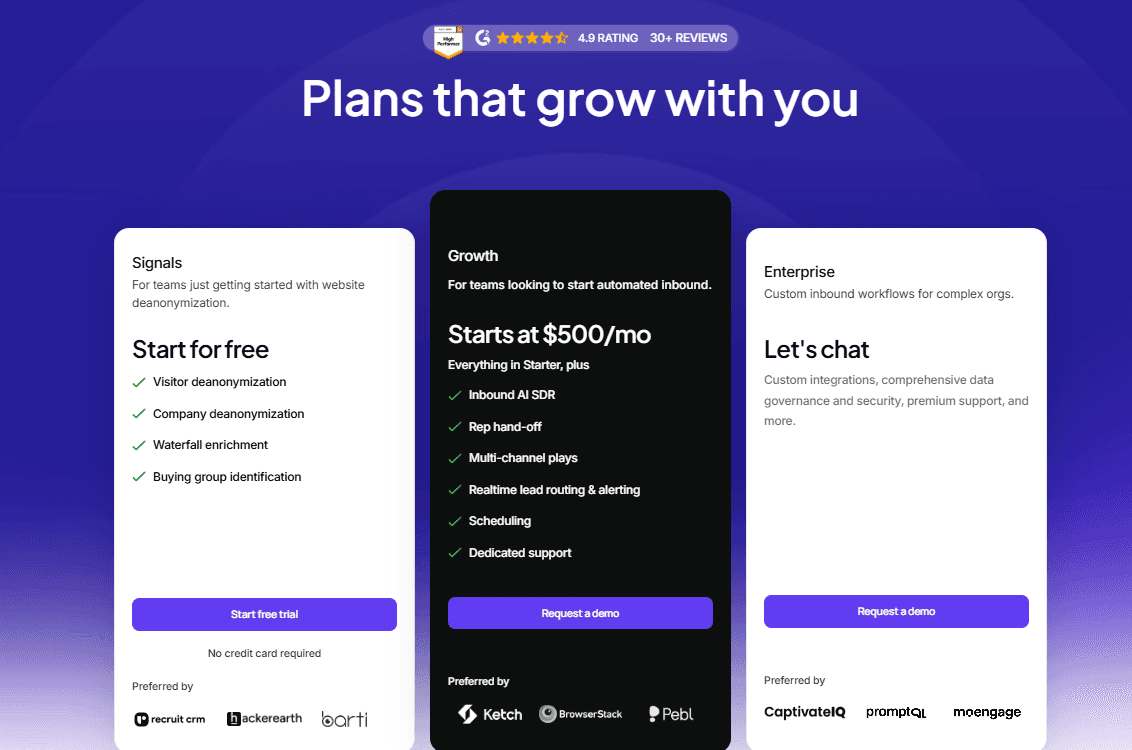
Starter — $1,500/month. Visitor deanonymization, enrichment, and warm outbound. Does not include the inbound AI SDR.
Growth — $2,500/month. Full inbound AI SDR with qualification, live demo delivery, rep routing, and calendar booking. This is the plan most teams are evaluating Common Room alongside.
Enterprise — custom pricing. SSO, custom integrations, data governance, and advanced CRM workflows.
Get all Breakout pricing details here.
What Breakout doesn't do
Breakout is not an outbound tool. It doesn't find new contacts, build sequences, or cold-prospect. It converts inbound intent.
If your primary problem is generating a pipeline from scratch, Apollo or ZoomInfo is the right category. If your primary problem is that qualified visitors are leaving without a conversation, Breakout is your go-to tool.
G2 rating: 4.9/5 across 30+ reviews. Early-stage review counts should be weighted accordingly, but the consistent themes of fast setup, genuinely contextual AI conversations, and a responsive team are worth noting.
The bottom line
Common Room is genuinely well-built for what it does. For PLG companies with rich community signals and the RevOps capacity to use them, $20K–$30K/year can deliver real pipeline impact. Notion's public case study attributes 16% of the total pipeline to the platform.
But the pricing calculus gets complicated fast. The published Starter price isn't the real price. The real price includes the seats you'll need, the CRM integration you'll have to pay for, and the outreach stack you'll still be running in parallel.
If you're evaluating Common Room, go into the demo with three specific asks: an itemised quote with all add-ons included, a price-cap clause for renewals, and a competitive alternative in hand. You'll get a better number.
And if the conversation reveals that your actual bottleneck is converting the visitors Common Room surfaces (not finding them), then you know you need a different tool. Breakout is that tool.
Come talk to us at getbreakout.ai.


