All Blogs
A quick guide to lead scoring tools and what they’re actually good at.

Evan Marshall
Senior Growth AI Strategist
Published On

Let's bring you a scene from a marketing meeting on MQLs.
It's a Tuesday morning presentation. Marketing has multiple slides and data that show MQL volume is up 34%. Lead scores are healthy. The scoring criteria agreed upon eight months ago — collaboratively, in a meeting not unlike this one — are still golden.
Marketing takeaway: The leads are fine. Sales just isn't working on converting them.
Sales concerns: Capacity crunch, no proper handoffs, and maybe different priorities.
In the corner of the screen, half-hidden behind the slide deck, RevOps has a spreadsheet open that nobody has asked about. It shows the average time between a lead hitting the MQL threshold and a rep making first contact. A single cell in a spreadsheet screaming "47 hours."
The meeting ends with an action item to revisit action items. It has ended this way before, and will probably go down that route again. The scoring criteria? Still golden.
The 47 hours? Uh, well.
Here's the thing nobody puts on a slide
The model probably isn't broken. The assumption underneath it might be.
Lead scoring was built to solve a prioritisation problem — too many leads, too few reps, someone needs to decide who gets called first. It solves that problem well. What it was never designed to solve is what happens in the window between a lead hitting the threshold and a rep picking up the phone. And that window — 47 hours on average — is where the pipeline goes to quietly expire.
Responding within five minutes makes you 21 times more likely to qualify a lead than responding at 30 minutes. 78% of B2B buyers purchase from the first vendor to respond. These numbers have been available for years. They are not, historically, in the MQL Quality Review slide.
This article covers the five tools that score leads well, what each one actually costs, and who each one is built for. It also covers the structural ceiling every single one of them shares — which matters more for your conversion rate than which one you pick.
Before you pick a tool, answer these 3 questions
Most lead scoring evaluations start with feature comparisons. That's the wrong place to start. We suggest you begin by asking yourself these 3 important questions.
What signals does your GTM actually generate?
Behavioural signals require traffic and instrumentation. Firmographic signals require enrichment. Third-party intent signals require budget and a TAM large enough to make them statistically meaningful. The right tool is the one that handles the signals you actually have — not the signals the demo assumed you had.
Do you have enough data to justify a predictive model?
Vendors will always sell you the AI-powered option. The honest answer: predictive scoring requires training data — typically 12+ months of closed deals with consistent attribution — to outperform a well-configured rule-based model.
HubSpot and Dynamics both refuse to generate a predictive model below their labeled-data minimums, which is either reassuring product integrity or a sign that the gap between Professional and Enterprise pricing is very much their friend. Teams under roughly 500 closed deals per year are often paying for machine learning sophistication they can't feed. A starved predictive model will lose to a well-maintained rule-based one every time.
Is prioritisation actually your bottleneck?
This is the question nobody asks before signing. Lead scoring improves the order in which reps work leads. It does nothing about how fast they work them, or what happens when a high-intent visitor arrives on your site while every rep is in a meeting. More on this after the tools.
Our top 5 lead scoring tools for 2026
1. MadKudu
Best predictive scoring for PLG SaaS teams — assuming you can feed the model
Pricing | ~$24,000/year (Growth). Custom above that. No published list price — budget time for the sales process just to get a number. |
Best for | PLG companies with 12+ months of deal history, product usage data, and dedicated RevOps |
Requires | Salesforce or HubSpot, clean CRM data, someone who actually owns the model |
MadKudu is the most technically serious tool on this list. It ingests CRM history, product usage signals, and firmographic data to build a predictive model trained on your actual closed-won deals — not industry averages, your data. The 2025 update added lead grade explainers that tell reps exactly why a lead scored the way it did: "scored high because they invited three team members, used the API, and matched your ICP firmographically." That's the difference between a rep trusting the score or ignoring it.
One MadKudu user on G2 reported saving $2M in headcount by shifting to an outbound motion based on the model's accuracy at identifying not just the best leads, but the worst ones. That's the version of MadKudu that works. It requires clean data, dedicated RevOps, and enough product usage signal to train on.
What we don't like about this platform:
MadKudu scores against historical patterns. However, it cannot tell you if one of those high-fit leads is on your pricing page right now. The model looks backward; it doesn't see what's happening in the present tense. Which is why a lead flagged as high-fit at 9 am can sit in a queue until the next morning. Plus, MadKudu's behavioral scores have a short half-life by design, because a pricing page visit today and one from six months ago are not the same signal.
2. 6sense
Best for enterprise ABM where "early warning" means 45 days, not 45 minutes
Pricing | $50,000–$100,000+/year. Custom only. No free tier, no trial, no self-serve path. A credits system on top of an already expensive contract. |
Best for | Enterprise sales teams, large TAM, 6–18 month deal cycles, mature ABM playbook |
Requires | Dedicated ops, Salesforce or HubSpot, and the patience for a multi-quarter implementation |
6sense aggregates third-party intent data — content consumption patterns, keyword research behaviour, G2 review activity — to identify accounts in an active buying cycle before they fill out a form. For an enterprise AE managing a list of strategic accounts with long cycles, knowing that a target account is researching your category 45 days before they contact you is genuinely valuable.
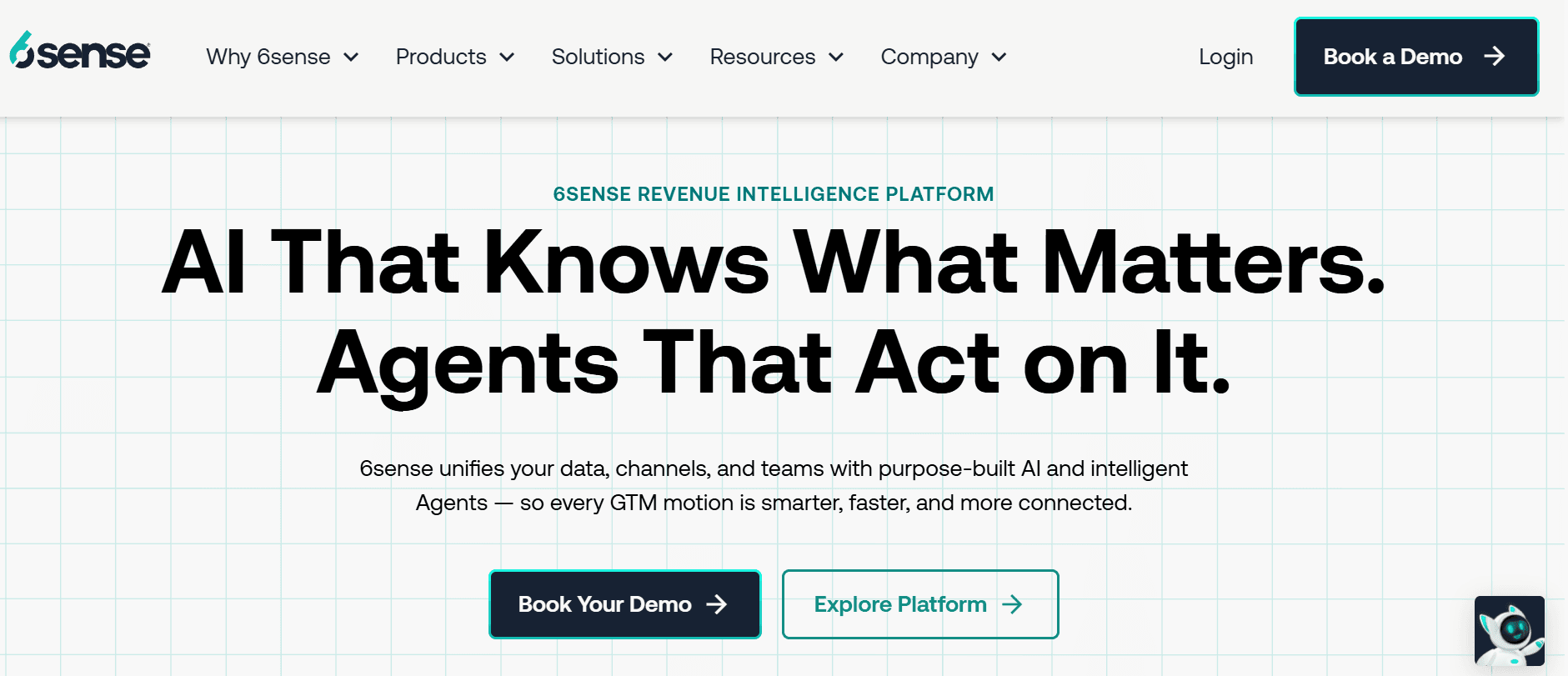
Two structural constraints worth naming plainly:
6sense operates at the account level. It tells you the company is in-market, not who within that company is doing the research. You've eliminated the question of whether to call. You still have to figure out who.
The intent data is lagged, reflecting research behaviour over the past 30–60 days. Useful for account planning. Not useful for the moment, someone from that account lands on your website today.
The credits system is worth flagging separately. 6sense charges credits to enrich data, trigger workflows, and access intent insights. Teams that don't manage usage carefully burn through them fast or lose them at the end of the cycle. It's pay-as-you-go disguised inside an already expensive contract, and it's a recurring complaint in G2 reviews that doesn't make it into vendor-written comparisons.
Reddit threads in r/b2bmarketing pushing back on "90-day go-live" claims are also common. If you need pipeline impact within a single quarter, 6sense is unlikely to be your fit, regardless of how good the product is.
3. HubSpot Lead Scoring
Best for teams fully inside HubSpot who want to start without adding a vendor, a contract, or a three-month implementation
Pricing | Manual scoring: Marketing Hub Professional ($890/month). Predictive scoring: Enterprise ($3,600/month, 10-seat minimum, $3,500 onboarding). The gap is significant and worth knowing before you get attached to the predictive tier. |
Best for | Teams running CRM and marketing automation in HubSpot, inbound-first motion, moderate lead volume |
Requires | Marketing Hub Professional minimum, clean CRM data, occasional auditing |
In August 2025, HubSpot overhauled its scoring infrastructure, replacing legacy scoring properties with a more capable system featuring advanced logic, multi-model support, score decay for inactive contacts, and explainability features showing which signals drove each score. For a tool that comes included rather than purchased separately, it's genuinely good.
For most teams at the "we should probably be scoring leads" stage, this is the right place to start. Not because it's the most sophisticated option, but because starting is more valuable than optimising — and this one doesn't require a separate contract, a three-month implementation, or a conversation with your CFO about a $40,000 tool that does one thing.
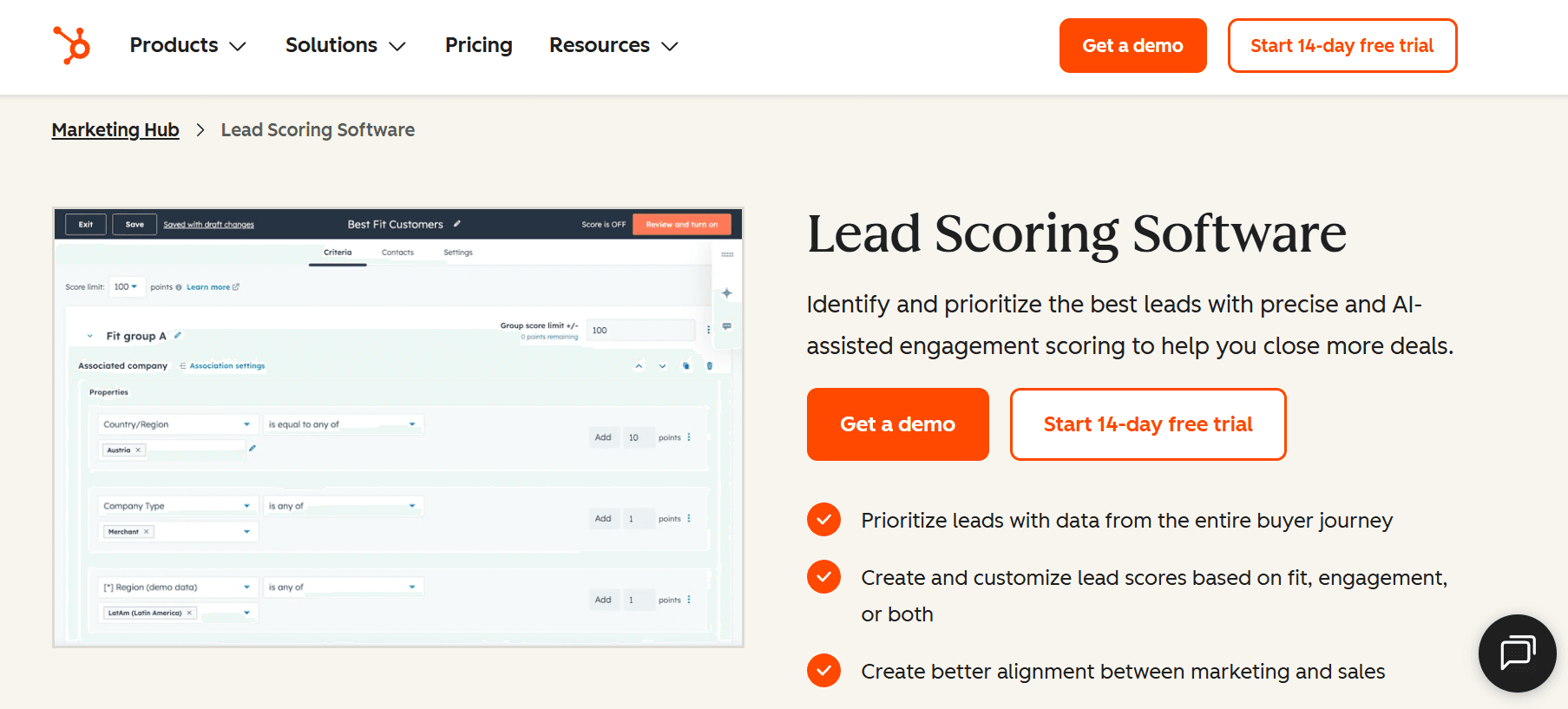
What we don't like about this option:
The predictive model requires Enterprise — a steep jump from Professional that catches many buyers off guard. HubSpot, to their credit, won't generate a predictive model until you've crossed their labeled-data threshold. If you haven't, it tells you that rather than generating a confidently wrong score. HubSpot scoring also has no native intent data, meaning anonymous high-intent accounts visiting your site are invisible to the model.
And like every tool on this list: a lead that crosses the threshold enters a workflow and a queue. It doesn't start a conversation.
4. Apollo.io
Best for teams who want scoring bundled with the prospecting tool they're already paying for
Pricing | Free tier (limited). Basic $59/user/month. Professional $99/user/month. Custom above that. |
Best for | Outbound-first teams that want lead scoring without a second contract |
Requires | HubSpot or Salesforce for CRM sync. Tolerance for a contact database that occasionally thinks someone still works at a company they left in 2022. |
Apollo is primarily a prospecting and outreach platform with features such as a contact database, email sequences, and a dialer, which added lead scoring as part of its push into the full GTM stack. For teams already paying for Apollo, the scoring functionality is a reasonable starting point that costs nothing extra on the plans that include it.
The scoring itself is less sophisticated than purpose-built platforms. It leans on firmographic fit and engagement signals from within Apollo's own ecosystem — email opens, click activity, Bombora-sourced intent data.
What it doesn't do is ingest your CRM's closed-won history and build a model trained on your actual conversion patterns. It's scoring based on what Apollo knows, not what you've learned.
The honest use case:
Teams under $3M ARR that need good-enough prioritisation bundled with their outreach tool, without a separate contract, a three-month implementation, or a RevOps hire to maintain it. Teams that outgrow it usually know that the scores start feeling generic, and sales starts ignoring them, until someone schedules the Tuesday meeting we spoke of earlier!
5. Breadcrumbs
Best rule-based scoring for teams who want to own the model and be able to explain it to sales without a whiteboard
Pricing | Free plan available. Paid from $999/month. |
Best for | Mid-market B2B with a defined ICP, active marketing, and RevOps that wants full model transparency |
Requires | HubSpot or Salesforce integration, moderate setup time, someone who knows what good looks like |
Breadcrumbs' structural contribution to the category is co-dynamic scoring, which separates demographic fit and behavioural engagement into two independent scores that are then combined. This matters because a perfect-fit lead with zero engagement is a different problem from a highly engaged lead with poor fit.
Collapsing them into one number, as most single-dimension models do, produces a queue that sales quietly stops trusting — which is how you end up back in the Tuesday meeting.
Full transparency into model logic is genuinely useful when sales pushes back on lead quality. You can show them exactly why a lead scored the way it did. That conversation goes differently with a black box.
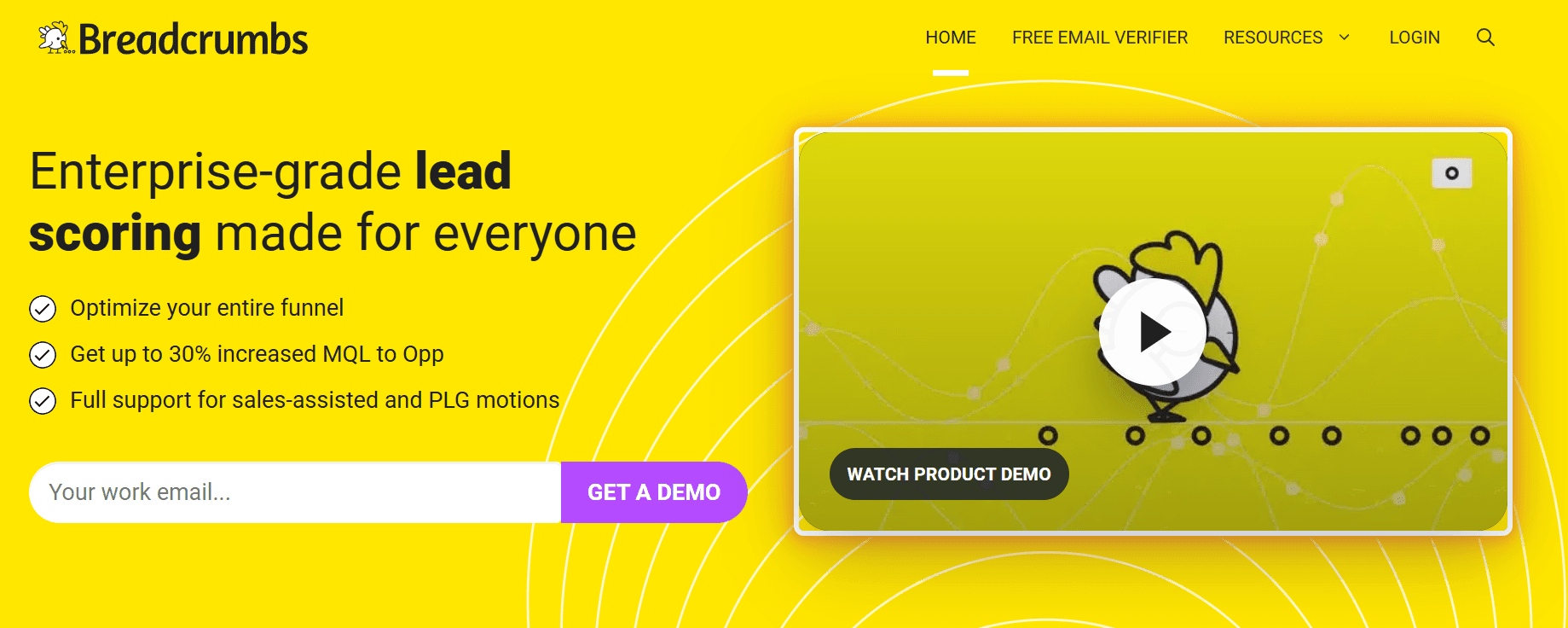
The constraint with this platform:
Breadcrumbs is entirely dependent on the quality of the rules you write. The common failure mode is over-weighting low-intent trackable actions such as email opens, PDF downloads, webinar registrations, and under-weighting the mid-funnel signals that actually predict close rate: pricing page visits, comparison searches, and feature-specific content.
Companies using advanced behavioural scoring achieve a 40% MQL-to-SQL conversion rate, compared with the industry average of 13%. The gap between those numbers lives in the rules someone wrote and what they chose to measure.
A model without negative scoring, i.e., subtracting points for job seekers, competitors, and students who repeatedly visit your careers page, will eventually surface a competitor's employee as a hot lead. Adobe's Marketo team flags this specifically. It's more common than anyone admits.
The problem that none of these tools solve
Let's put the numbers together.
Only 13% of MQLs convert to SQLs on average — 87 out of every 100 flagged as qualified produce zero revenue. Forrester puts the full-funnel number even lower: less than 1% of marketing inquiries become closed-won deals in a typical MQL-driven process. Sales isn't wrong to be sceptical of the queue. But the problem isn't the score.
Every tool above operates on the same assumption: a qualified lead gets routed to a rep, the rep acts, and the lead is still there when they do. The average response time is 47 hours. The probability of qualifying a lead drops 80% after the first five minutes. 58% of companies never respond to inbound leads at all.
The highest-intent signals — a lead scoring 90 because they've visited pricing three times this week, a visitor from a target account spending twelve minutes on the comparison page — are precisely where timing matters most.
These aren't passively curious leads. They're in an active evaluation window, right now, probably with three other tabs open. The scoring model correctly identified the urgency. The queue does not share its sense of urgency.
Lead scoring tools notify. They don't engage. The gap between that notification and the conversation is where qualified pipeline goes to die — and no amount of refining the scoring criteria fixes it, which is why the Tuesday meeting keeps happening.
This is where Breakout operates. It's an inbound AI SDR that engages high-intent visitors in real time — while they're on your site, while the intent is live, before the rep has seen the notification. It qualifies them against your ICP in an actual conversation, not a form, and books meetings directly into rep calendars.
Breakout is not a replacement for a scoring model. Scoring models identify who's worth watching. Breakout handles what scoring can’t: actually starting the conversation while the buyer is still there.
Drift, Qualified, and Intercom are present in the same moment — but they're chat widgets, not SDRs. They trigger on page visit without knowing what the visitor just did, who they are, or what they're evaluating. The conversation Breakout starts is different in kind, not just degree.
So, should you actually buy a dedicated scoring platform?
Honest answer, since you've read enough vendor content that isn't:
Buy one if:
You have 200+ inbound leads per month, 12+ months of clean closed-deal history, dedicated RevOps to build and maintain the model, and — this is the condition most teams skip — an execution layer that acts on routed leads in minutes, not hours. A scoring model feeding a slow execution stack is an expensive way to produce a better-organised queue that still doesn't convert.
Don't buy one if:
Your lead volume is low, your GTM is primarily outbound, your CRM data is a mess, or you're hoping better scores will improve conversion rates. They won't. Scoring improves prioritisation. Conversion is downstream of that and requires a different tool.
The question worth asking before you sign: Is prioritisation your actual bottleneck — or is it conversion? The teams that mistake a conversion problem for a prioritisation problem spend $20,000–$40,000 on a platform that produces excellent output, but nobody acts on it in time. The answer determines whether you need a better model, a faster execution layer, or both.
The Tuesday meeting will keep happening until someone fixes the lost 47 hours. Better scoring criteria alone won't do it.
Lead scoring identifies who's ready. Breakout starts the conversation before they leave. Try it yourself!
“We knew there was a high volume of high-intent visitors, but unless they were ready to talk to sales right then, we lost them. We needed a way to meet them where they were - without forcing a sales conversation.”
VP of Product, TechForward Inc.
Frequently Asked Questions
How much does lead scoring software cost?
Pricing ranges from free (Apollo's basic tier, Breadcrumbs free plan, HubSpot manual scoring on Professional) to $999/month for Breadcrumbs paid, ~$24,000/year for MadKudu Growth, and $50,000–$100,000+/year for 6sense. HubSpot predictive scoring requires Enterprise at $3,600/month — a significant jump from Professional, which catches many buyers off guard. Most enterprise platforms require a custom quote before you see an actual number.
Is lead scoring worth it for small teams?
Generally not at the price point of a dedicated platform. Lead scoring delivers real value when you have sufficient inbound volume (200+/month), clean closed-deal history to validate assumptions, and dedicated RevOps to maintain the model. Without those three conditions, you're not improving prioritisation — you're automating noise faster. For teams under $3M ARR, Apollo's bundled scoring or HubSpot Professional is usually the right starting point.
What's the difference between rule-based and predictive lead scoring?
Rule-based scoring means you define the logic, such as this action is worth 10 points, or this firmographic attribute adds 20. Predictive scoring means a machine learning model learns from your historical closed-won and closed-lost data to identify which signals actually predict conversion.
Predictive is more accurate at scale, but requires enough labeled data to train on — HubSpot and Dynamics both enforce minimum thresholds before generating a model. Under roughly 500 closed deals, a well-configured rule-based model will outperform a predictive one starved of training data. What neither model type addresses is timing — both produce a score, route it to a queue, and stop there. The lead still has to wait. Breakout is what acts on the score before the window closes.
Why are my lead scores not converting?
Usually one of three reasons.
First: the model is weighting the wrong signals — over-indexing on low-intent actions like email opens and webinar registrations, under-indexing on mid-funnel signals like pricing page visits and comparison searches.
Second: no negative scoring — without subtracting points for job seekers, competitors, and students, the model skews optimistic.
Third, and most commonly: the scores are fine, the response time isn't. A lead that scores 90 on Tuesday afternoon and gets called Thursday morning is not the same lead it was 47 hours earlier. Scoring tells you who. It doesn't keep them warm while they wait — and that's a problem no scoring tool was designed to solve. That's what Breakout is for.