
All Blogs
A simple breakdown of Apollo.io pricing without the confusing fine print.

Evan Marshall
Senior Growth AI Strategist
Published On
You should not need a calculator and a spreadsheet just to figure out how many credits it takes to contact one prospect.
Yet Apollo’s pricing model forces you to track usage constantly, which adds friction to a process that should feel simple.
Apollo looks affordable at first glance, but the real cost shows up when your team spends hours managing credits, cleaning data, and chasing unresponsive leads.
The platform gives you access to contacts, but it does not reduce the manual effort required to turn those contacts into meetings.
In this guide, you will understand Apollo.io pricing, how the credit system actually works, and why the highest cost is not the subscription but the execution effort behind it.
Key Takeaways
Here’s what Apollo pricing actually looks like once you factor in credits, effort, and real pipeline impact:
Apollo looks cheap upfront, but the real cost comes from credit overages, SDR time, and the manual execution required to build the pipeline.
The credit system adds complexity, forcing your team to constantly manage separate limits for email, mobile, and CRM export actions every month.
“Unlimited” data is a misnomer, especially when mobile and export credits run out quickly, forcing you into expensive annual contract upgrades.
Apollo provides the raw contacts, but your human team must still do all the heavy lifting to turn those names into meetings.
Breakout integrates directly with Apollo, pulling its data for enrichment while waterfalling through other providers to ensure the highest possible fill rates.
Breakout triggers your Apollo sequences automatically, allowing you to engage high-intent visitors without manual SDR intervention or the typical outbound grind.
AI SDRs skip the manual chase by converting your website visitors into qualified meetings instantly, without adding expensive human headcount to your team.
What Is Apollo.io Pricing In 2026?
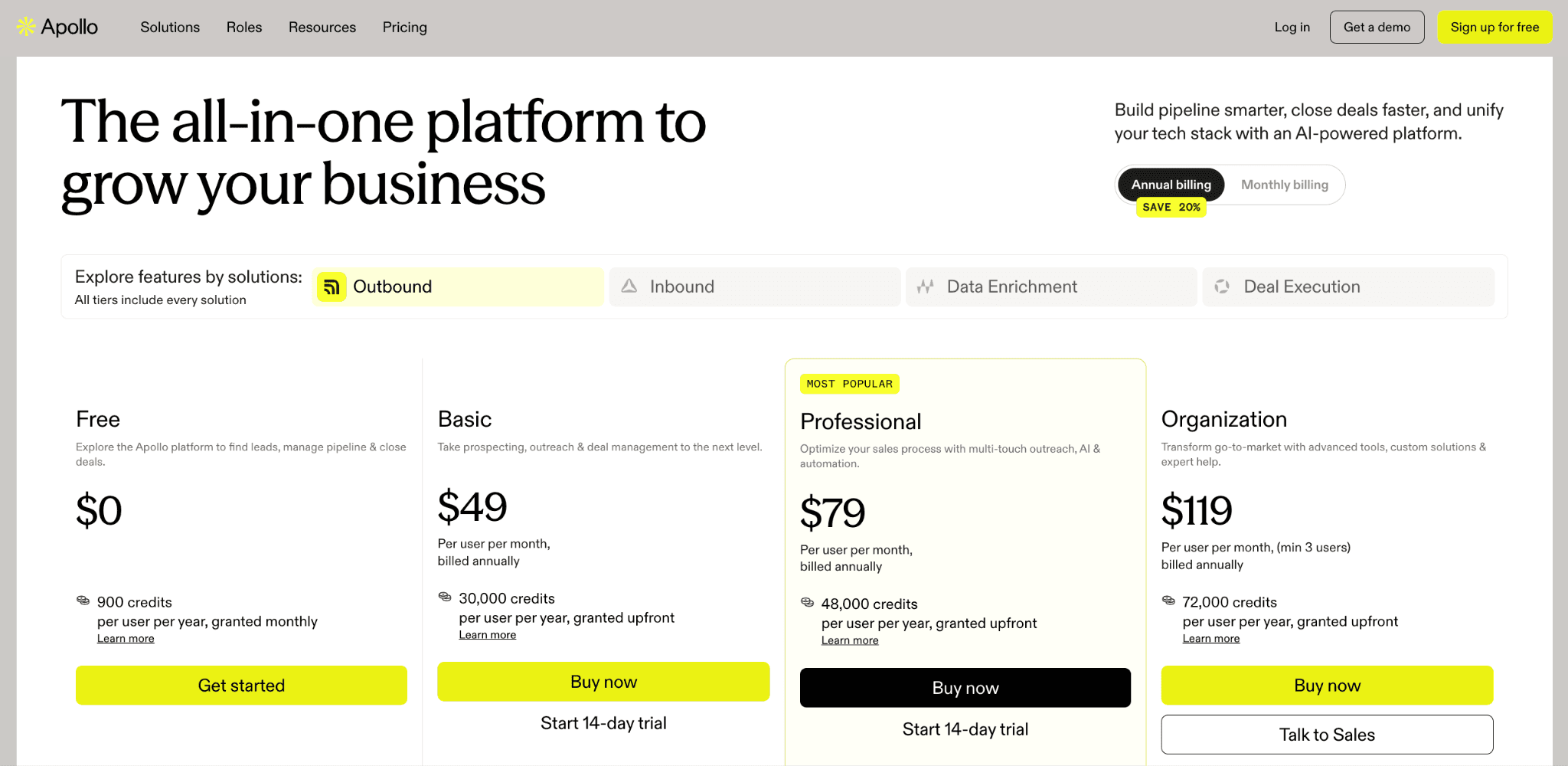
Apollo offers four main tiers ranging from $0 to over $100 per user per month, depending on your specific data needs. Their pricing model is built to get you in the door for cheap before charging you for the high-value credits.
You can choose between these four main subscription levels depending on the volume of prospecting your sales team performs:
1. Free: $0
The free plan gives you a starting point with limited functionality, including around 900 mobile credits and basic sequencing features. It works for testing the platform or individual research, but it quickly becomes restrictive for teams that need consistent outreach and reliable pipeline generation.
2. Basic: $49/user/month
The Basic plan provides around 30,000 credits per year and introduces more consistent outbound capabilities for small teams. You can run basic campaigns and access more contacts, but you still face limitations when scaling outreach or relying heavily on phone-based prospecting.
3. Professional: $79/user/month
The Professional plan includes uncapped sequencing and approximately 48,000 credits annually, making it suitable for growing teams. This tier supports more advanced workflows and testing, but your results still depend heavily on SDR execution and ongoing optimization efforts.
4. Organization: $119/user/month
The Organization plan requires at least three users and offers around 72,000 credits annually, along with advanced security features. It is designed for larger teams that need governance and reporting, but it increases total cost significantly as your headcount grows.
Hidden Costs: Mobile and premium credits drive most of the platform’s revenue, which means scaling outbound activity often requires purchasing additional credit bundles beyond your base plan.
How Does The Apollo Credit System Work?
Managing your data budget in Apollo requires a deep understanding of how different actions consume your limited monthly and annual credits. You must constantly monitor your usage to ensure your SDRs do not run out of fuel in the middle of a campaign.
Apollo separates data access into three distinct currencies that your revenue operations team must manage every single day:
Email Credits
Email credits are used to reveal work email addresses so you can add prospects to your automated cold outreach sequences today. These are unlimited on most paid plans but remain subject to fair use policies that prevent you from scraping the entire database.
Tip: You must be careful not to trigger these limits, or your account could be temporarily restricted from exporting any new leads.
Mobile Credits
Mobile credits are used to reveal direct dial phone numbers and are the most expensive and limited part of the platform. These credits are consumed quickly because high-quality mobile data is much harder for providers to source and verify for you.
You will often find yourself needing to buy extra bundles just to keep your cold calling team active during the month.
Export Credits
Export credits are required if you want to move your prospect data from Apollo into your CRM or a separate CSV file. This is often where the cheap plans become expensive because you are charged for taking the data out of their system.
Tip: Plan your exports carefully to avoid hitting your annual cap long before your subscription period is actually over.
What Is NOT Included In The Apollo Price Tag?
Buying an Apollo subscription gives you a massive list of names, but it does not provide the execution required to close deals. Most sales leaders realize too late that they have purchased a very large library, but still have nobody to read the books.
Apollo gives you the data, but it leaves the hardest part of the sales process entirely to your human team:
Real-Time Website Conversion
Apollo cannot talk to the buyers currently on your site because it only helps you find their emails for a cold message. You are paying to chase people who might not be interested while ignoring the warm prospects who are already researching you.
This lack of inbound engagement means you are missing the most valuable opportunities that are visiting your website right now.
Guaranteed Deliverability
You are responsible for your own email deliverability and domain health, which has become a full-time technical job in 2026. Apollo provides the email addresses, but they do not guarantee that your messages will actually land in the prospect's primary inbox.
If your domain gets flagged for spam, your expensive data subscription becomes useless because nobody will ever see your outreach.
Automated Meeting Booking
Apollo is a to-do list generator that tells your team who to contact, but it does not qualify or book meetings. Your SDRs must still manually handle every reply and objection before they can finally place a demo on your sales calendar.
This human bottleneck means your pipeline growth is always limited by the number of people you can hire and train.
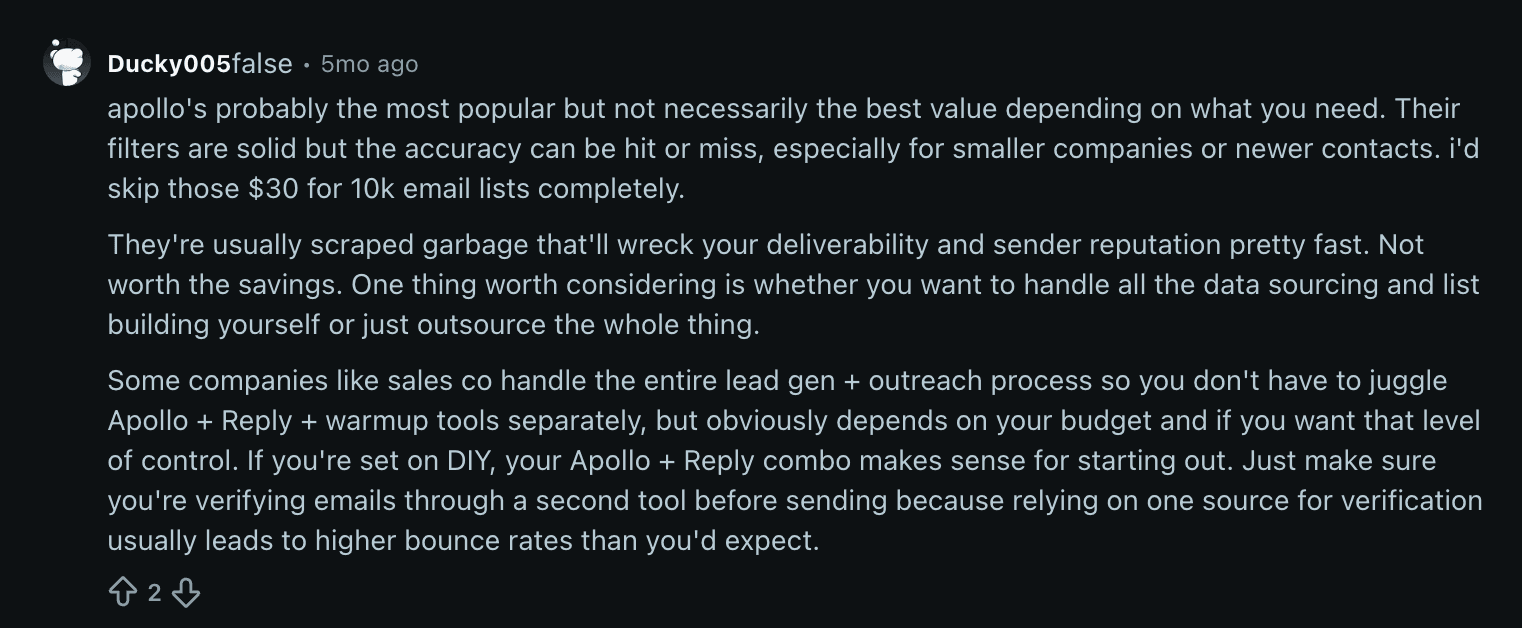
Most high-growth teams eventually realize that managing a complex DIY tech stack is a distraction from their core goal. You are essentially paying for a manual project that requires constant maintenance just to keep your emails landing in an inbox. Relying on a single source for verification often leads to higher bounce rates and a damaged sender reputation.
Sales leaders on the front lines are increasingly vocal about the hidden operational debt of budget data tools:
Apollo vs. Breakout: The ROI Comparison
Apollo is a database that provides the raw materials for outbound, but Breakout is an outcome machine that builds your pipeline. We believe that instead of paying to send more cold emails, you should invest in converting the buyers who are ready.
Breakout integrates directly with Apollo to trigger your existing sequences automatically the moment a high-intent visitor is identified on your site. Our AI SDRs pull data from Apollo for initial enrichment but also waterfall through multiple other providers to ensure superior fill rates.
Breakout uses AI SDRs to engage your website visitors in real time to qualify them and book meetings instantly.
Feature | Apollo.io | Breakout |
Focus | Cold Outreach Lists | Inbound Intent Conversion |
Price Point | Low ($49+) | Outcome-Oriented |
Effort | High (SDR manual work) | Low (AI handles conversion) |
Success Metric | Emails Sent | Meetings Booked |
The difference in effort is massive because Breakout handles the entire conversation from the first greeting to the final calendar invite. While your SDRs are busy cleaning Apollo lists, our AI is busy booking meetings with high-intent buyers on your site.
You get a predictable stream of revenue opportunities without the deliverability risks and manual grind of a traditional outbound sales motion.
Conclusion
Apollo is a great tool for building a database on a budget, but it is an expensive way to buy work. You are essentially paying for a list of strangers that your team must spend hundreds of hours trying to contact.
This model is difficult to scale because your results are always tied to the manual effort of your human sales team.
Don't spend your 2026 budget chasing cold leads while your most interested website visitors are leaving because nobody is helping them. Your website is where your buyers give you their full attention, and you should be ready to engage them instantly.
Converting your existing traffic is the fastest and most efficient way to grow your pipeline without adding more expensive headcount.
Replace wasted outreach hours with booked meetings. Start a free trial with Breakout to see how we turn your existing traffic into meetings for a fraction of the cost.
FAQs
Q. Is Apollo.io actually free?
Yes, the free plan is generous for individual researchers, but the strict limits on mobile credits make it difficult for teams. You will quickly find that 900 credits per year is not enough to support a consistent cold calling or outbound strategy. It is best used for occasional lookups rather than as a primary engine for a growing sales and marketing organization.
Q. What is the difference between Basic and Professional?
The Professional plan offers uncapped sequences and significantly more mobile credits, which are essential for teams doing heavy cold calling daily. The Basic plan is often too limited for teams that need to maintain a high volume of outbound activity.
Q. How many extra credits on Apollo?
You can purchase additional credit bundles if you run out, but the cost per credit is much higher than the subscription cost. These overage charges can quickly blow your budget if you do not strictly monitor how your sales team is exporting data. It is usually more cost-effective to upgrade your plan tier if you find yourself buying extra credits every month.
Q. Does Apollo pricing include email sending?
Yes, Apollo includes a built-in sequencer, but you must connect your own email provider, like Gmail or Outlook, to send messages. You are responsible for managing your own sender reputation and ensuring that your email volume does not trigger any spam filters.
Q. Why should I use Breakout instead of Apollo?
Use Apollo if you want a list of names to call, but use Breakout if you want a booked meeting. Breakout turns your website visitors into a qualified pipeline without the manual work and domain risks associated with cold outbound lists. We help you focus on the buyers who are already showing interest in your product instead of chasing strangers.


