
A buyer shows up on your site, your tools identify them, and then... a rep gets a Slack ping they'll see later. That gap, between signal and action, is where most AI SDR tech stacks quietly fall apart. What B2B revenue teams actually need is a stack designed around that handoff, beyond the tools on either side of it.
TLDR:
Most AI SDR stacks fail due to coordination gaps, not missing tools; the average visit-to-demo rate sits at 0.50%.
Configure CRM write logic before deploying your AI SDR agent or you will create duplicate leads and corrupted scoring data.
Target a lead response time under 60 seconds; a show rate below 60% signals you are booking meetings before intent is confirmed.
Qualified, Warmly, and Fin are now CRM-native products, leaving teams outside Salesforce or HubSpot without independent options.
Breakout covers visitor identification, AI engagement, multichannel sequencing, and CRM sync across Salesforce, HubSpot, and Marketo in one stack layer.
The Problem: Why Building an AI SDR Tech Stack Is Harder Than It Should Be
Most revenue teams don't have a stack problem. They have a gap problem. The tools exist, but the connections between them leak pipeline at every handoff.
A visitor lands on your site, gets identified by one tool, enriched by another, manually routed by a rep who saw the Slack alert three hours later, and eventually dropped into a sequence that sends its first email the next morning. By then, the buyer is already talking to a competitor. That window closes fast, and no amount of tooling fixes a workflow designed around human latency.
The numbers bear this out. The average website-visit-to-demo conversion rate sits at 0.50%, and the fully loaded cost of an underperforming SDR motion compounds far beyond base OTE. These aren't rounding errors. They're structural costs baked into how most teams have assembled their stacks.
The core issue is that most AI SDR tech stacks are built by addition, not design. Teams bolt on a visitor identification layer, then a sequencing tool, then a routing layer, and hope the CRM ties it together. It rarely does. What looks like a coverage problem is usually a coordination problem: too many tools with no single thread connecting signal to action.
Building something that actually works end-to-end requires rethinking the stack as a workflow, not a vendor list.
What Good Looks Like: Key Principles of an AI SDR Tech Stack
Before anything else, the most important question to ask when choosing AI SDR tools for your stack is whether it connects cleanly to everything else you're running. Four principles separate stacks that generate pipeline from ones that generate reports.
Signal Coverage Across the Full Buyer Journey
Pipeline generation can't be gated on website traffic alone. A capable stack captures intent across form submissions, content downloads, event attendance, and third-party intent data. When traffic slows, the pipeline engine stays active.
Identity Resolution at the Person Level
Company-level IP matching is losing reliability as more buyers browse from home networks instead of employer ranges. Person-level website visitor identification with LinkedIn enrichment is the minimum standard for visitor intelligence that's actually actionable.
Automation Depth From Signal to Booked Meeting
If your stack identifies a visitor but routes the follow-up back to a rep, you've built a faster alert system. Full-loop automation runs from signal detection through enrichment, engagement, qualification, objection handling, and meeting booking inside a single continuous workflow.
CRM Agnosticism and Stack Independence
After Qualified's acquisition by Salesforce in April 2026 and Warmly's acquisition by HubSpot on June 30, 2026, both tools now carry hard CRM dependencies that exclude large portions of the market, a key consideration in any enterprise AI SDR platform evaluation. A stack built around either creates lock-in risk the moment your CRM strategy changes.
Human-in-the-Loop Control Without Manual Bottlenecks
Fully autonomous tools remove visibility; fully manual workflows remove scale. The right design is configurable oversight: your team defines targeting, segmentation, and messaging, and the AI executes, with pre-send review on outbound sequences and an inspectable decision layer that shows why a prospect was selected and what triggered outreach.
Step-by-Step: How to Build an AI SDR Tech Stack
Each step below assumes you've already selected your core tools. The goal here is sequencing: what to configure first, what depends on what, and where skipping ahead creates problems you'll pay for later.
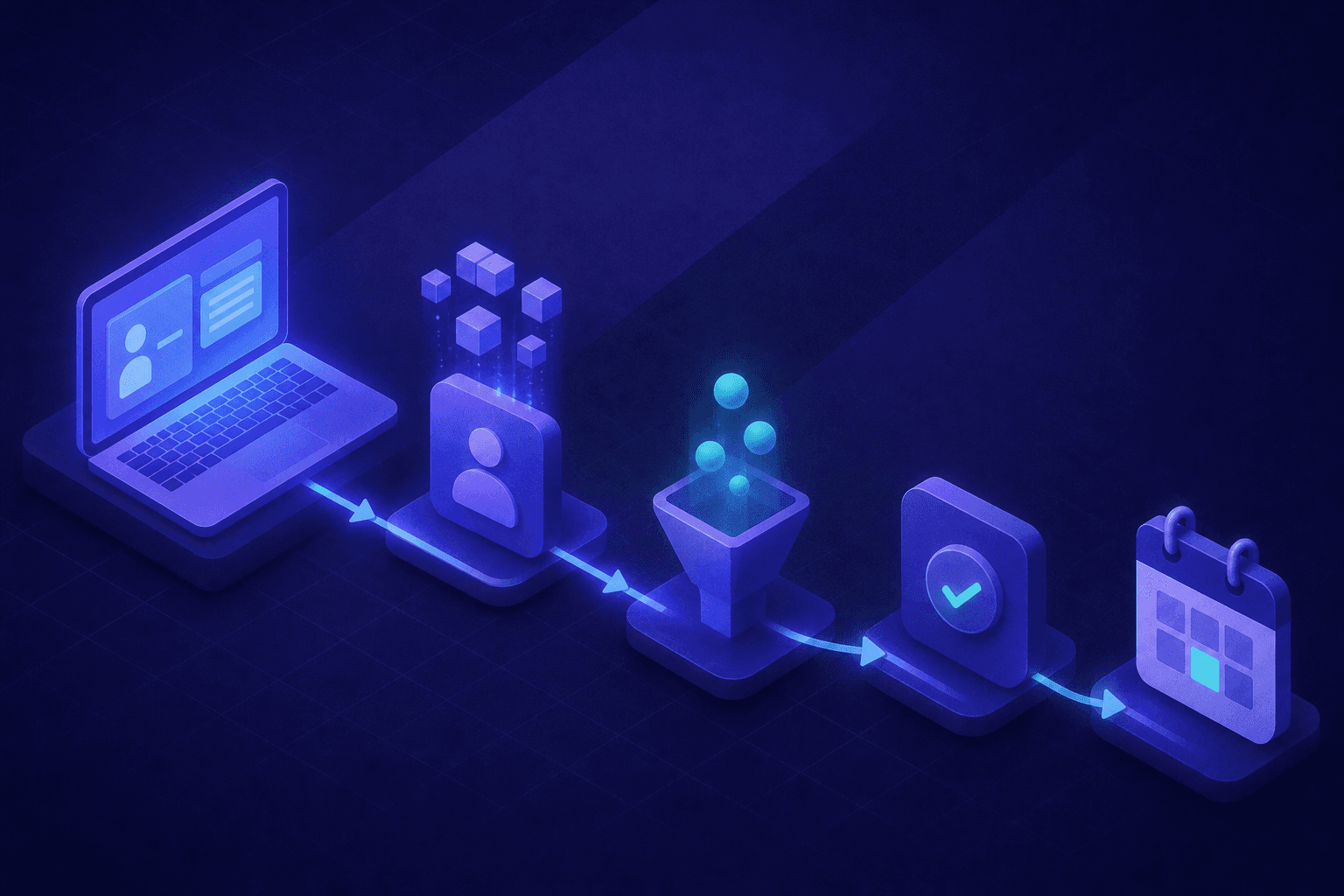
Step 1: Define Your Signal Sources and ICP Triggers
Map every buyer signal the stack needs to handle: website visits, form fills, event attendance, content downloads, and third-party intent data. Tie each signal type to ICP-fit criteria before touching any tooling. Stacks built around website traffic alone create pipeline dependency on ad spend volume.
Step 2: Audit Your Identity Resolution Layer
Check whether your deanonymization resolves to company or person level. As home-network browsing reduces IP-based match rates, waterfall enrichment with LinkedIn profile data and buying committee discovery becomes the minimum viable standard. Single-provider setups produce miss rates that compound quickly.
Step 3: Connect Your CRM and Define Write Logic
Configure native CRM sync with explicit write rules covering lead creation, contact conversion, duplicate logic, and activity tracking before deploying any engagement layer. Deploying an AI SDR agent before this is tested creates reconciliation debt that contaminates downstream scoring.
Step 4: Deploy Your Engagement and Qualification Layer
Train your AI SDR agent on your specific ICP, product, and sales motion. Generic scripts produce low-conversion interactions that frustrate high-intent buyers. Configure objection handling and in-conversation scheduling so the full qualification arc completes autonomously without a separate handoff step between qualification and calendar booking.
Step 5: Build Your Multichannel Follow-Up Sequences
Configure automated warm email and LinkedIn follow-up triggered within minutes of session end for visitors who leave without converting. Limiting follow-up to one channel, or waiting on rep availability to trigger outreach, loses pipeline that won't return.
Step 6: Configure Routing, Alerts, and Handoff Logic
Set up automated lead routing with ICP-aware scoring, location-based filtering, and internal traffic filtering by corporate email domain. Reps should receive only qualified, enriched, routed leads. Alerting on every session without ICP filtering trains reps to ignore notifications entirely, which defeats the stack.
Tools and Tech Stack Considerations
Most revenue teams run six or seven tools to do what a consolidated stack could handle in one. The table below maps each layer to what legacy and AI-native approaches look like in practice.
Stack Layer | Legacy Approach | AI-Native Approach (e.g., Breakout) |
|---|---|---|
Visitor Identification | IP lookup tool, single provider | Waterfall enrichment with person-level resolution and LinkedIn data |
Engagement and Qualification | Rule-based chatbot or live rep routing | Custom-trained AI SDR with objection handling and in-conversation scheduling |
Outreach Sequencing | Manual email tool plus separate LinkedIn outreach | Automated multichannel sequences triggered by visitor signals |
CRM Sync | Manual export or Zapier workaround | Native write logic across Salesforce, HubSpot, and Marketo |
GTM Campaign Execution | Manual orchestration across 5-10 tools | Autonomous agent with write access across connected tools |
Standalone tools still have a place, though they're worth weighing against a full AI SDR platform selection guide:
Smartlead: cold email deliverability at scale when sending infrastructure is the specific bottleneck
Apollo and Clay: purpose-built for cold contact list construction before any buyer signal exists
GongEngage: post-qualification sequencing once a meeting has been booked
None of these cover the full signal-to-pipeline motion, which is where point solutions start compounding into coordination problems.
The consolidation context matters here. Intercom's acquisition of Fin by Salesforce for approximately $3.6 billion is the most recent example of a formerly independent option becoming a CRM-native product.
Measuring Success: KPIs and Benchmarks
The table above tells you where your stack stands. The diagnostic logic tells you why.
If your visitor identification rate is strong but visit-to-demo conversion remains weak, the enrichment layer is working and the engagement layer is not. The AI agent may be using generic scripts, missing objection handling, or routing too slowly. If identification rate is the bottleneck, the enrichment stack needs expansion: single-provider IP lookup leaves too many sessions unresolved, particularly as home-network browsing reduces IP match reliability.
KPI | Weak Performance | Good Performance | Notes |
|---|---|---|---|
Visit-to-demo conversion rate | Below 0.5% | 1.5 to 2%+ | Industry baseline is 0.50%; AI-assisted engagement should meaningfully lift this |
Lead response time | More than 5 minutes | Under 60 seconds | Engagement window for high-intent visitors closes rapidly; this Harvard Business Review study found firms that contacted leads within an hour were 7x more likely to qualify them |
Visitor identification rate | Below 10% of sessions | 20 to 30%+ of sessions | Waterfall enrichment with person-level resolution improves this |
Qualified meeting show rate | Below 60% | 75 to 85% | Stronger pre-meeting qualification reduces no-shows; industry no-show baseline is 20% |
Pipeline influenced per SDR FTE | Baseline manual output | 3 to 5x multiplier with AI SDR | Measures AI output against human rep capacity, a key input for calculating AI SDR ROI |
Show rate is often the clearest signal of qualification quality. When show rates lag, the instinct is to add more reminder emails or pre-meeting nurture sequences, but those treat the symptom and not the cause. Stronger in-conversation qualification before calendar booking is the fix: the AI agent should confirm budget, timeline, and decision authority before surfacing the scheduling link, not after.
Common Mistakes That Kill AI SDR Tech Stack Results
Each of these mistakes is common enough that they rarely get flagged until pipeline numbers force the conversation.
Building Around Traffic Volume Instead of Signal Coverage
Visitor chat tools and inbound AI SDRs get the most attention because website traffic is visible and easy to measure. The problem is a pipeline engine that stalls the moment paid or organic traffic dips. Instrument signal sources across the full buyer journey: form fills, event attendance, content downloads, and intent data, so the stack runs regardless of how many visitors show up that week.
Deploying AI Engagement Before CRM Write Logic Is Configured
Teams ship the AI agent first and plan to "clean up" the CRM integration later. Later produces duplicate leads, missed routing rules, and enrichment data that never reaches the record, the kind of problem a tested Salesforce and Pardot integration is designed to prevent. Configure lead creation, contact conversion, and activity tracking before the agent goes live.
Treating Fully Autonomous Tools as a Zero-Oversight Solution
Tools like 11X and Artisan execute outbound sequences without human review. That speed comes with a trade-off: off-brand or poorly targeted messaging reaches prospects before anyone on your team sees it. Pre-send review and human-in-the-loop controls preserve scale without surrendering quality oversight.
Choosing CRM-Native Tools Without Auditing Lock-In Risk
Before committing to any tool in this category, audit the CRM dependency: if the tool requires a specific CRM to function, you are buying a CRM feature, not an independent stack layer, which is one reason native options like a Marketo and Salesforce integration matter.
Final Thoughts on Designing an AI SDR Tech Stack
The goal with any AI SDR tech stack is to close the gap between a buyer signal and a booked meeting without routing that gap through a rep queue. Coordination beats coverage every time. Your stack can have the right tools and still leak pipeline if the handoffs aren't designed to hold. Try Breakout if your current motion leaves too many high-intent sessions unresolved.
FAQ
What's the best way to build an AI SDR tech stack without creating more handoff gaps?
Start with CRM write logic before deploying any engagement layer: lead creation, contact conversion, duplicate rules, and activity tracking must be configured and tested first. Teams that ship the AI agent before this step create reconciliation debt that contaminates downstream scoring and routing, which is the most common reason stacks generate reports instead of pipeline.
Breakout vs. Qualified vs. Warmly: which should a B2B revenue team use in 2026?
Qualified and Warmly are no longer independent products. Qualified was acquired by Salesforce in April 2026 and Warmly by HubSpot on June 30, 2026, making both CRM-native tools with hard platform dependencies. Teams on HubSpot, Marketo, or any non-Salesforce CRM are structurally excluded from Qualified; teams on non-HubSpot stacks face the same with Warmly. Breakout operates across Salesforce, HubSpot, and Marketo natively and deploys in days without onboarding fees, making it the primary independent option for teams that need signal-to-pipeline automation without committing to a single CRM vendor's roadmap.
Can I use Breakout as both an inbound and outbound AI SDR, or is it only for website visitors?
Breakout runs both motions in a single workflow: inbound signals like website visits, form fills, event attendance, and content downloads trigger one set of automated plays, while outbound prospecting, personalized sequencing, and LinkedIn follow-up run in parallel. The pipeline engine stays active regardless of traffic volume, so the stack does not stall when paid or organic visit counts drop.
How do I know if my AI SDR tech stack's engagement layer or identity resolution layer is causing low visit-to-demo conversion?
Pull your visitor identification rate first: if it sits below 10% of sessions, the enrichment stack is the bottleneck and needs waterfall enrichment with person-level LinkedIn data to compensate for declining IP match rates from home-network browsing. If identification rate is healthy but visit-to-demo conversion stays below 1.5%, the engagement layer is the problem. The AI agent is likely running generic scripts, missing objection handling, or routing too slowly after the session ends.
Should I use 11X or Artisan for outbound sequencing, or does Breakout replace them?
Artisan and 11X execute outbound sequences end-to-end without human review, which maximizes sending speed but removes your team's visibility before messages reach prospects. Breakout's outbound motion includes pre-send review and an inspectable decision layer that shows why a prospect was selected and what triggered outreach, making it the right choice if your team needs AI-driven outbound scale without surrendering quality control over what goes out under your brand.