All Blogs
A quick look at better options than Drift.

Paige Rankwell
Senior Growth AI Strategist
Published On

Salesloft is sunsetting Drift, and customers are being pushed toward a new vendor.
That forces a reset for teams evaluating Drift alternatives and planning a Drift replacement.
Drift is one of the legacy conversational marketing tools that gave teams a way to engage visitors in real time. It helped teams move beyond static forms and introduced real-time conversations, lead routing, and meeting booking on the website.
A visitor could explain their use case in detail, signal urgency, and show clear intent, but that context rarely carried forward into the product or the sales process, which meant every new interaction started cold.
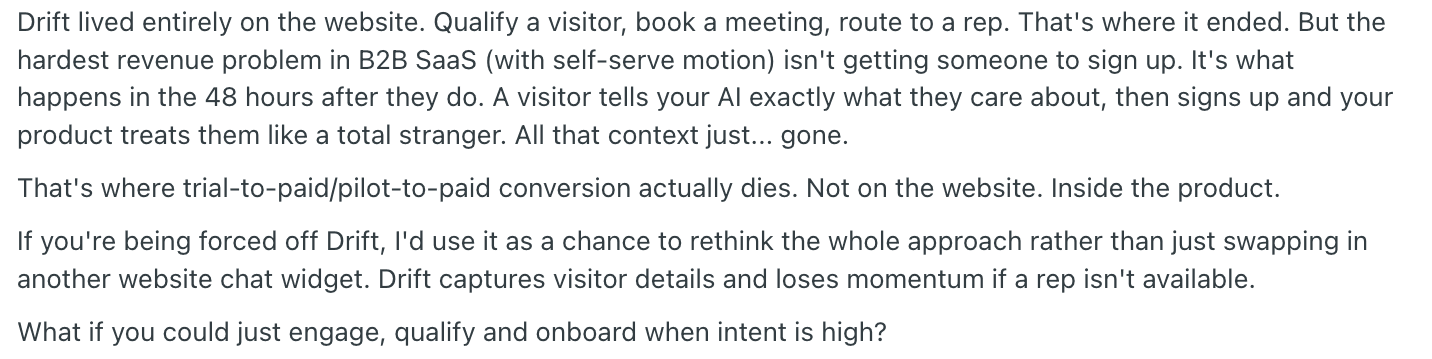
This Reddit discussion summarized this issue well. The thread pointed out that the real drop in conversion happens after the visit, when follow-up depends on manual effort.
That is where the pipeline gets lost. It’s also why replacing Drift with another chatbot does not fix the problem.
The shift is not from one tool to another. It is from chat-based workflows to systems that own the full interaction. Qualification, scheduling, and follow-up now happen in a single flow, without waiting on a rep.
In this shift, context becomes the advantage:
Which system remembers past interactions
Which system learns from deal outcomes
Which system improves over time
That is what separates older conversational tools from newer AI SDR tools. This is also why platforms like Breakout are gaining attention, especially among teams that want faster setup and continuous inbound coverage.
Breakout’s AI SDR works with real context, not scripted paths, and uses visual selling to guide visitors through decisions. It adapts each conversation based on behavior and continues follow-up across channels when someone leaves without converting.
Companies such as Ketch, CaptivateIQ, and MoEngage have already replaced Drift with Breakout, shifting away from systems that depend on routing logic and constant updates.
If you are looking into Drift alternatives in 2026 or planning your Drift replacement, this article walks you through the key decisions.
Here’s what we’ll cover:
What changed and why teams are switching
The top Drift alternatives to consider
How to migrate without losing the pipeline
Drift is shutting down: What broke and why it matters now
Drift is being phased out, but the shift started long before the official announcement.
A few of us saw this coming. Over the years, many teams had already begun questioning how much effort it took to keep the system running.
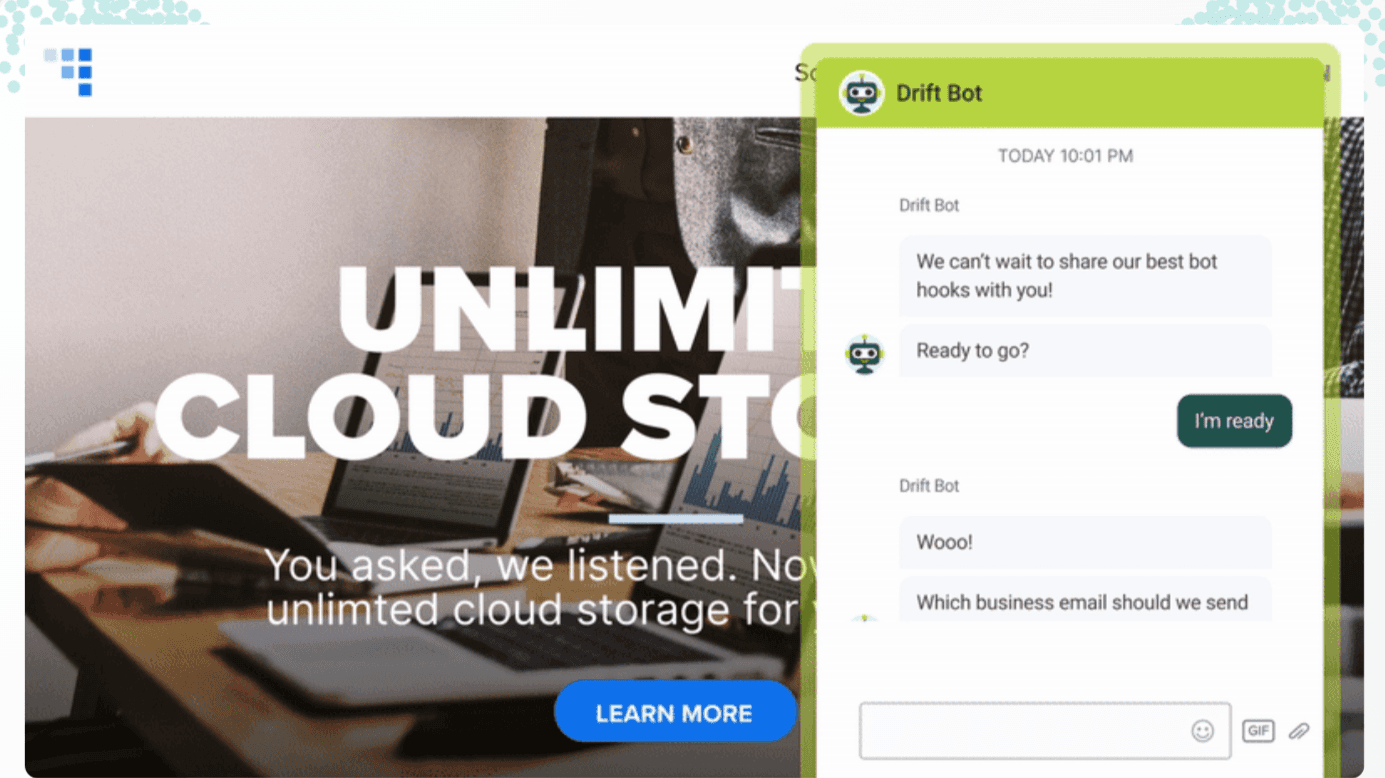
Workflows depended on routing rules, playbooks, and constant updates, which meant even small changes required time and attention.
The bigger issue was how the system handled real buyers.
If a rep was not available, conversations stalled. If routing logic failed, high-intent visitors ended up in dead paths with no clear next step. Meanwhile, maintaining Drift setups became harder over time.
Adding AI layers did not fix this.
The structure stayed the same, and teams were still responsible for maintaining flows, rules, and handoffs.
That is why many teams started moving away even before Drift was sunset.
The shutdown only accelerates a shift that was already in motion.
Here is what changed and why it matters:
Built for chat-based routing, not full conversion
Dependent on SDR availability to move deals forward
Performance tied to playbooks that require constant updates
Limited ability to adapt to changing buyer behavior
What it meant for teams using Drift
Missed opportunities when conversations stall
Slower lead response during peak intent windows
Higher effort to maintain and update workflows
Strong push toward AI SDR tools and modern Drift alternatives
The shift from chat to full-cycle inbound qualification
Inbound has moved past chat.
What matters now is whether a system can take a visitor from first interaction to a scheduled meeting without delay.
This is why comparisons have shifted from chatbot alternatives to AI SDR tools.
Recent data from HubSpot shows how fast this change is happening.
AI is rated the highest ROI tool by 31% of sales teams
84% say it saves time and improves internal processes
83% say it improves how teams personalize buyer interactions
82% say it helps surface stronger insights from sales data
AI SDRs operate with deeper context. Qualification, scheduling, and follow-up now happen without delays or rep dependency.
These tools use behavior, firmographic signals, and interaction history to guide conversations. They can present relevant content, adjust responses, move users toward action, and even capture insights from each interaction.
Teams gain visibility into buyer intent, objections, and decision triggers directly from conversations.
AI-led inbound qualification is addressing long-standing limitations:
Autonomy without human dependency
Traditional systems depend on reps to move conversations forward, which slows response and limits coverage. AI SDR tools manage conversations continuously and involve reps only when needed.
Breakout follows this model, where qualification and booking run without manual control.
Qualification that adapts in real time
Static flows collect limited inputs and miss intent signals during conversations.
AI SDR tools adjust questions based on behavior and guide visitors toward scheduling. Meetings are booked when readiness is clear, with full context passed to sales.
Context that shapes every interaction
Legacy tools treat each session as isolated, which slows down follow-up and weakens continuity. AI SDR tools like Breakout use behavioral and company signals to guide conversations from the start.
Breakout applies this by identifying visitors early and aligning responses with intent.
Top 5 best Drift alternatives to consider in 2026
As teams move off Drift, the list of Drift alternatives grows fast and often feels crowded. To make this easier, we narrowed the field to five Drift competitors worth evaluating in 2026.
Each tool fits a different motion.
Some are built for enterprise teams with Salesforce at the center, while some focus on identifying visitors and intent before engagement begins.
Others are moving toward AI SDR models that handle the full inbound flow.
Your choice depends on how you run inbound today and how much you want to automate.
Before we get into the details, here is a quick comparison of the top options.
Tool | What it is known for | Why consider it? | AI capability |
Breakout | Full-cycle inbound SDR with chat, voice, and demos | Replaces routing with end-to-end qualification and booking | High. Runs conversations, qualifications, and follow-up without playbooks |
Qualified | Salesforce-native conversational platform | Strong fit for teams with deep Salesforce workflows and SDR coverage | Moderate. Uses AI for routing, scoring, and meeting booking |
1mind | AI avatar and video-based engagement | New option linked to Drift transition, focused on interactive demos | Emerging. Strong on avatars, limited inbound execution depth |
Intercom (Fin) | Support-led chat and automation | Good for teams that combine support and light qualification | Moderate. AI handles responses and triage, with less focus on sales conversion |
Warmly | Visitor identification and intent signals | Helps teams identify accounts and trigger engagement based on behavior | Moderate. Strong on data signals, less on full-cycle execution |
Breakout: AI inbound SDR built for continuous, always-on inbound conversion
Breakout is built for teams that want inbound to convert without relying on SDR availability or routing logic. The tool runs conversations, qualifies visitors, and books meetings in one continuous flow using AI SDR logic.
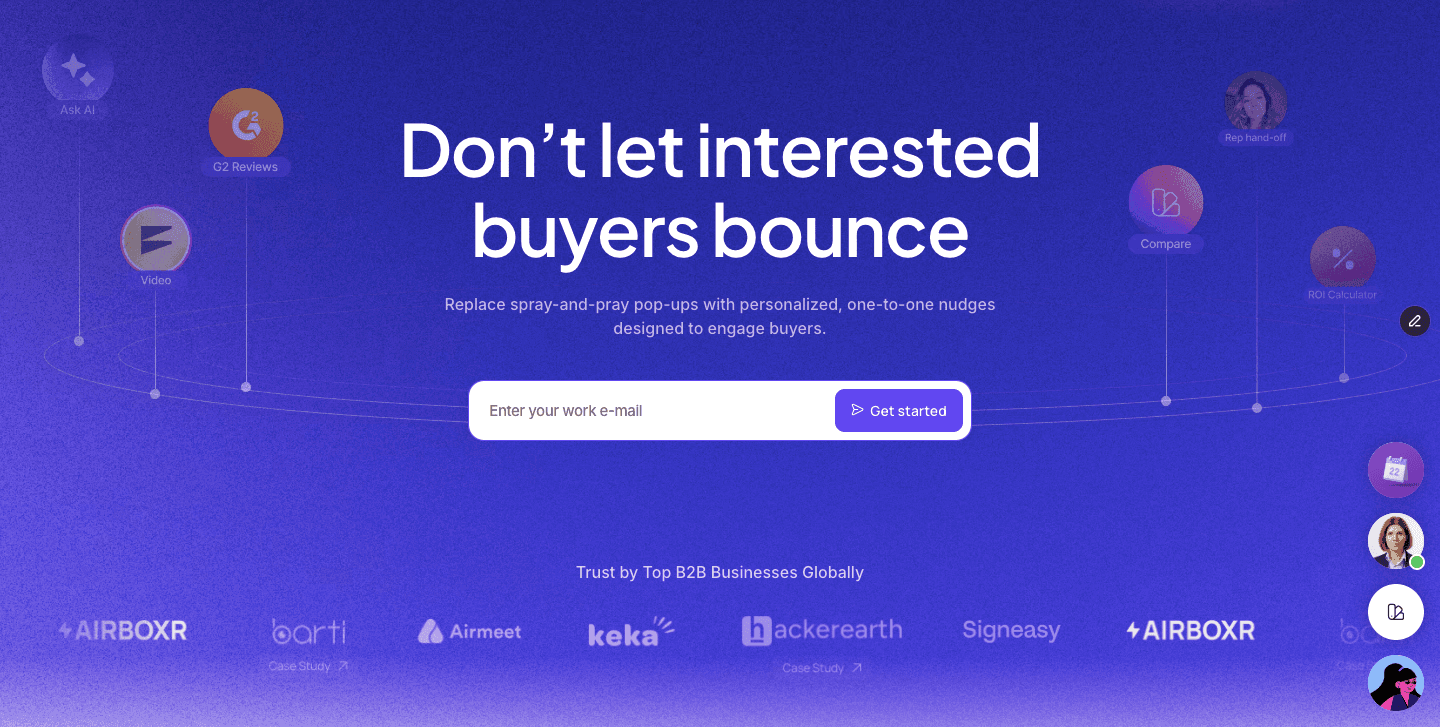
Instead of treating chat as a capture layer, Breakout treats inbound as a full process.
It is designed to react to visitor behavior, adjust messaging in real time, and move toward the next step without delay.
What makes Breakout a strong Drift alternative?
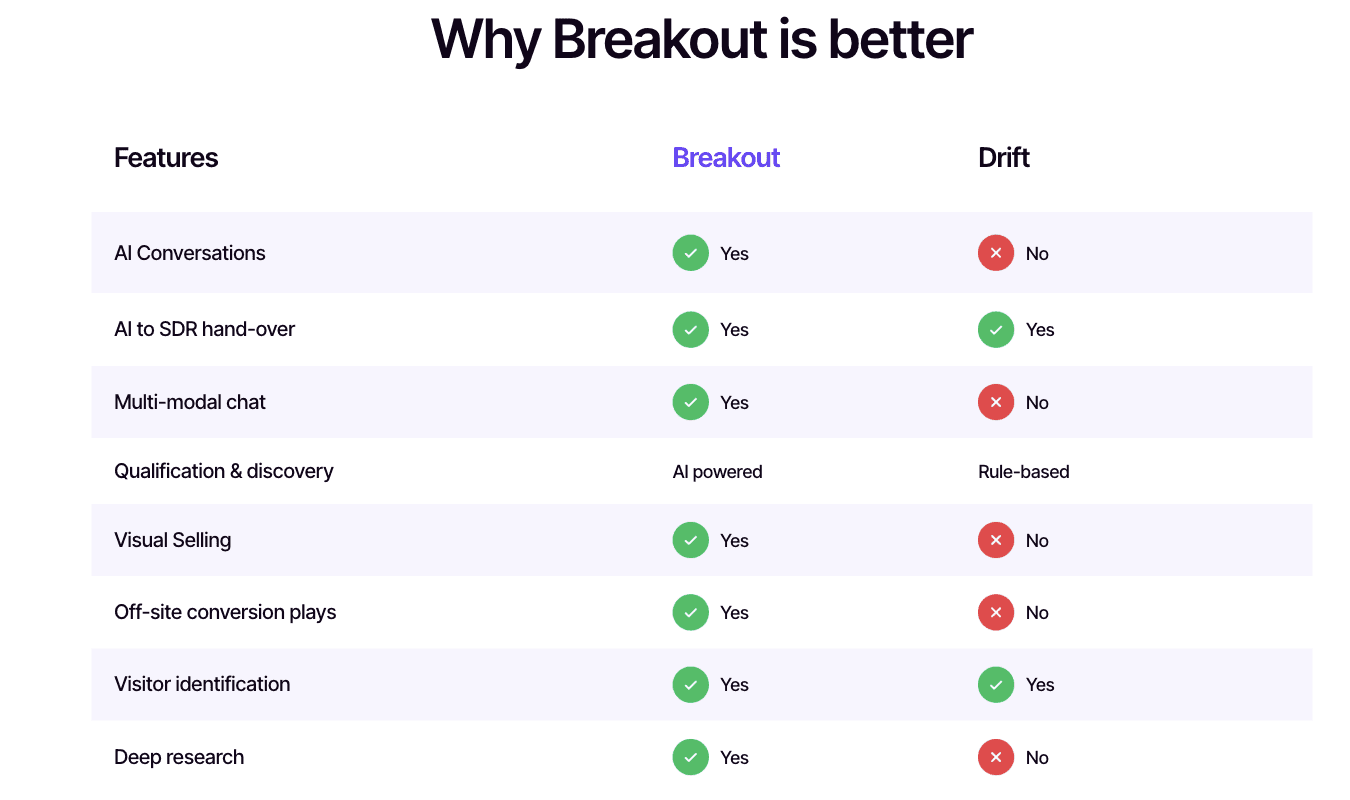
Drift depended on rules, routing logic, and rep availability to convert inbound traffic. That approach slows response time and increases manual work as traffic scales.
Breakout removes those constraints by handling the full inbound motion automatically. There are no static playbooks, and conversations do not pause when reps are unavailable.
This is why teams comparing Drift vs. Breakout often focus on speed, coverage, and conversion ownership.
Features that stand out
Visitor identity appears before any form fill or chat interaction
Conversations adjust based on persona, behavior, and funnel stage
Product value is shown through demos instead of being explained through text
Meetings get booked without waiting for rep availability
Follow-up continues across channels even after the visitor leaves
Where teams see the most value
Runs qualification, scheduling, and follow-up in one system without handoffs
Uses chat, voice, and interactive demos to keep visitors engaged longer
Identifies accounts and likely personas using real-time signals
Removes forms and collects data through natural conversation
Syncs directly with CRM and calendar tools without extra setup
Helps teams act on inbound signals even after sessions end
Limitations to consider
Reporting and analytics depth is still evolving for advanced use cases
Pricing
Entry plans support smaller teams and growing pipelines
Usage-based pricing aligns with inbound volume instead of headcount
Why teams are moving to Breakout
Breakout acts as the operating layer for modern inbound. For revenue teams, Breakout becomes instrumental in identifying, tracking, and engaging visitors from first touch to closed revenue.
Interactions on Breakout run through one system, and tools like Salesforce, HubSpot, Apollo, and Salesloft connect directly.
This removes fragmented workflows and keeps context consistent across the funnel. Breakout focuses on identifying real visitors. It surfaces account-level activity and connects it directly to your CRM.
Fast-growing companies such as MoEngage, Ketch, Browserstack, CaptivateIQ, and Pebl have already rebuilt their inbound motion this way.
Teams made the switch to keep pace with how buying behavior is changing.
MoEngage moved away from Qualified and rebuilt inbound with Breakout
Ketch replaced Drift and transitioned more than 10 SDRs within a week
CaptivateIQ left Drift after the September 2025 breach and selected Breakout instead of Qualified
Teams report
3–4x increase in qualified pipeline
Up to 88% visitor identification rates
No manual playbooks to maintain
Review
"Honestly, capturing almost 1 net-new lead a day in our first month was a massive win. That is real pipeline that would have otherwise just bounced off the site."
— Shilpi Puri
Director - Media & Demand GenerationRecruitCRM. Migrated out of Intercom. Chose Breakout over Drift, Qualified.
Qualified: Salesforce-first routing for teams built around one CRM
Built around Salesforce, Qualified connects inbound conversations directly to account data, ownership rules, and pipeline stages. Qualified treats every visitor interaction as part of an existing revenue system, not a separate chat layer.
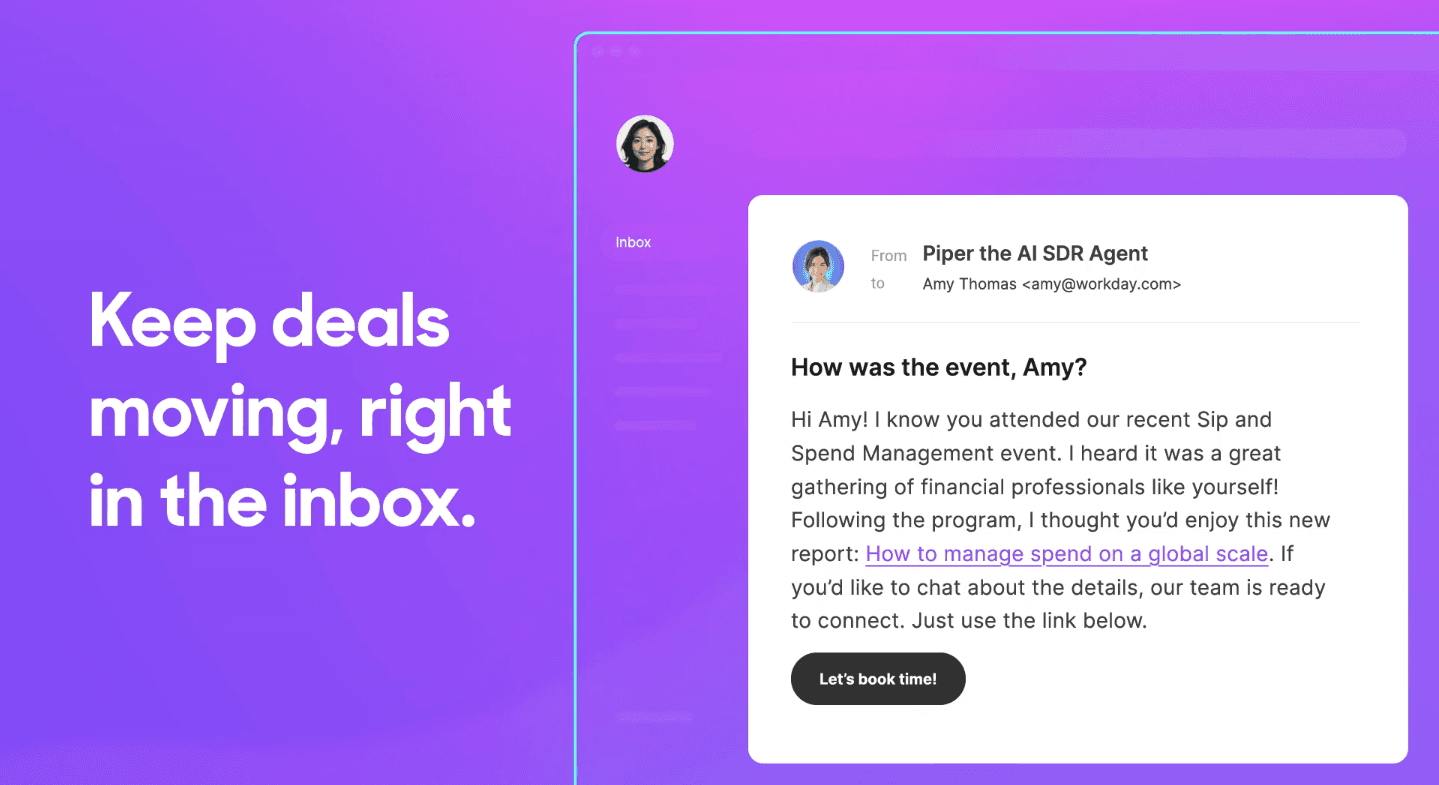
Instead of running fully autonomous conversations, Qualified focuses on structured qualification and routing. Qualified uses its AI agent, Piper, to assist with responses and booking, but most outcomes still depend on predefined workflows and routing logic.
Why is it a good Drift alternative?
Qualified is one of the more reliable Drift alternatives for enterprise teams that prioritize routing accuracy and CRM alignment. It handles lead qualification and meeting booking better than Drift, especially for structured inbound programs.
That said, it does not replace the full inbound motion and still depends on configured workflows.
Features that stand out
CRM-driven routing tied to accounts and territories
Behavioral scoring based on visitor activity
AI-assisted replies during live conversations
Calendar integration for scheduling
Chat customization using CRM data
Where teams see the most value
Enterprise teams deeply embedded in Salesforce
Organizations with complex buying groups
Teams that prioritize structured routing
Sales teams with dedicated SDR coverage
Limitations to consider
Limited value outside Salesforce-centric setups
Longer onboarding for complex configurations
Requires ongoing workflow maintenance
Pricing restricts access across teams
Not built for fully autonomous chatbot alternatives
Pricing
Pricing for Qualified spans Premier, Enterprise, and Ultimate plans.
Public estimates show entry-level pricing near $42,000 per year, with advanced tiers going beyond $72,000 yearly.
Review
“Qualified has made it that much easier for SDRs to do meaningful work. It makes it easier for prospects to book meetings with us, by streamlining our XDRs process, eliminating the need for emailing with a prospect back and forth to nail down a time, routing to the AE, etc. All of that is now a few simple steps the prospect can do when requesting a meeting, allowing SDRs to use time to gather more in-depth BANT and work their leads with precision.”
1mind: A conversational AI assistant positioned as Drift’s successor
Considered as Drift’s successor, 1mind centers its product on AI-driven conversations using avatars and natural language. 1mind allows teams to deploy assistants across sales and support, with a strong focus on interaction quality.
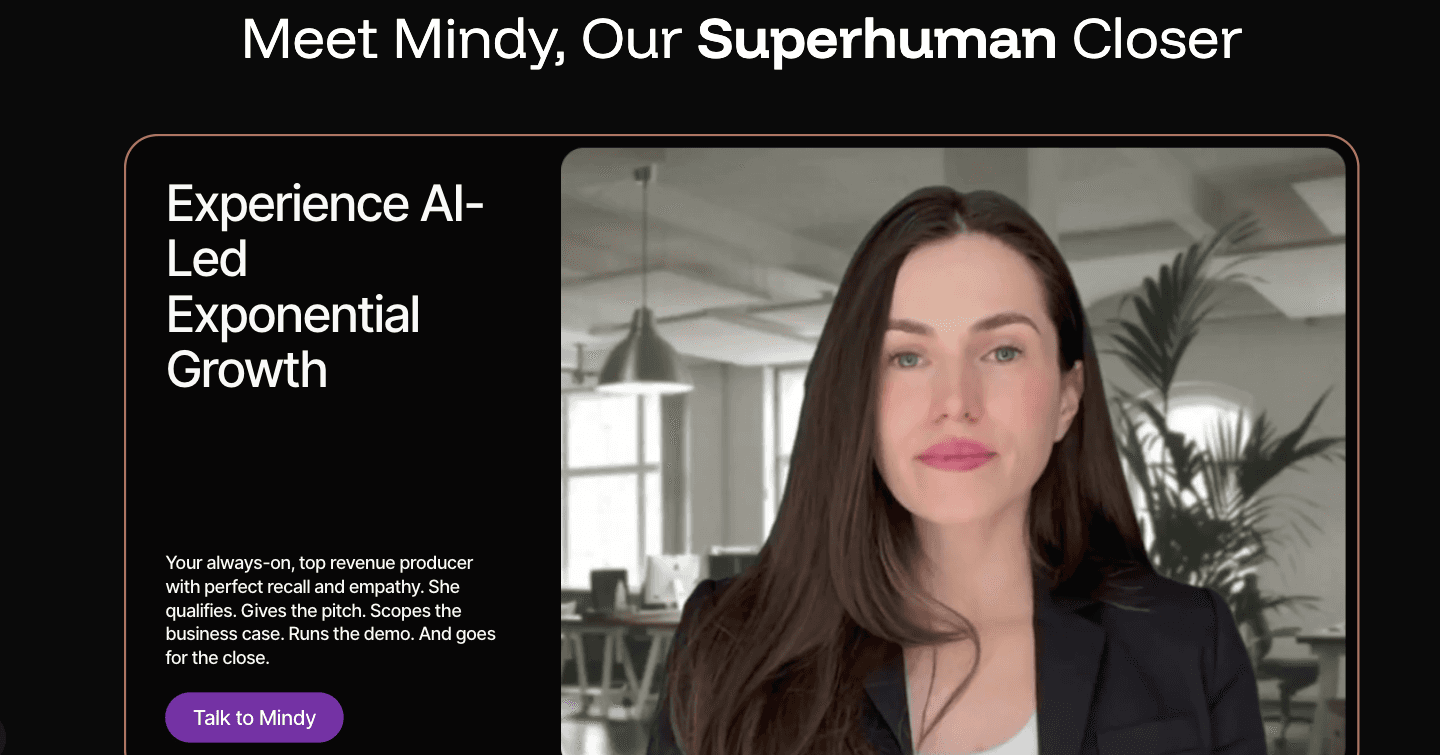
Unlike AI SDR tools built for inbound conversion, 1mind focuses on conversation once a visitor starts engaging. 1mind does not deeply connect pre-visit signals or automate full-funnel actions like scheduling and follow-up.
Why is it a good Drift alternative?
1mind replaces rule-based chat flows with more adaptive conversations that feel less scripted. It allows teams to respond dynamically without maintaining complex workflows that Drift requires.
It also extends beyond chat into onboarding and support, which gives teams more flexibility. That said, it does not fully replace inbound systems built around pipeline generation and conversion.
Features that stand out
Custom AI assistants tailored to different business roles
Natural language conversations with contextual responses
Video avatar interface for interactive engagement
Multi-use deployment across sales, support, and onboarding
Conversation handling without rigid chat trees
Where teams see the most value
Teams experimenting with conversational AI across functions
Companies focused on engagement rather than strict qualification
Use cases where onboarding and support overlap with sales
Smaller teams looking for flexible chatbot alternatives
Limitations to consider
Does not identify visitors before interaction begins
No native multi-channel follow-up after sessions end
Limited support for SDR workflows like routing or pouncing
Qualification depth depends on conversation design
Less suited for teams focused on pipeline generation
Pricing
Reach out to their sales team for details on their pricing plans.
Review
“1mind matches prospect with the right solutions, examples, and resources that fit their situation (whether it’s a question from a prospect or a general chat). It can share all kinds of helpful content within the conversation: testimonial videos, documents, and even the correct sales rep's calendar.”
Intercom: Support-first platform with light inbound sales capability
Built around customer support, Fin by Intercom focuses on resolving queries through chat, tickets, and automation. Intercom uses its assistant, Fin, to answer questions, route issues, and reduce support load through knowledge base integration.

While it can capture leads, the system is designed for support workflows first. Sales-related actions like qualification or meeting booking remain secondary to resolving incoming queries.
Why is it a good Drift alternative?
Intercom improves on Drift by combining chat with a full support system. It removes the need for separate tools to manage conversations and tickets.
It fits teams where most inbound traffic comes from existing users. It does not focus on qualification, scheduling, or driving the pipeline from new visitors.
Features that stand out
AI assistant for handling support queries and ticket routing
Unified inbox across chat, email, and other channels
Automated escalation for complex conversations
Search across help docs and internal content
Where teams see the most value
Organizations consolidating chat and ticketing systems
Teams with high support volume and ongoing customer queries
Businesses that need fast resolution rather than deep qualification
Support teams looking to reduce manual workload
Limitations to consider
AI responses depend on predefined content and rules
Not suited for teams focused on inbound pipeline generation
Limited depth in lead qualification and sales workflows
Pricing
Starts at $0.99 per resolution, with additional costs for seats and advanced features.
Review
“I really like how Fin by Intercom is convenient and easy to use for interacting with customers via email, chat, and phone. The ability to create or use automated help and desk articles is super helpful.”
Warmly: Visitor intelligence and signal-based engagement platform
Warmly focuses on turning anonymous website traffic into identifiable accounts and actionable signals. Warmly monitors behavior in real time and allows teams to engage visitors across multiple channels while interest is still high.
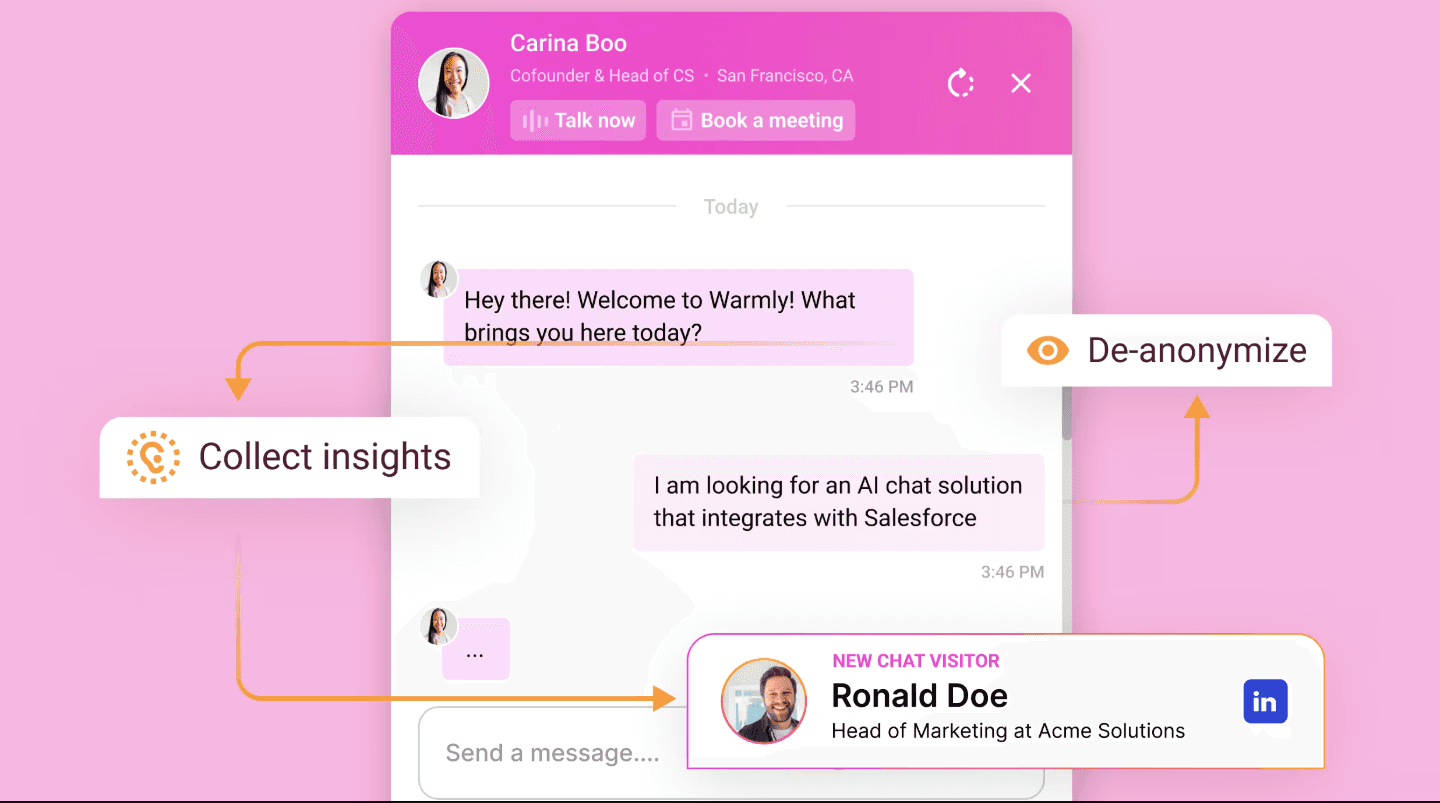
The platform is built for visibility and speed. It helps teams understand who is visiting and when to act but does not handle the full path from qualification to closed revenue.
Why is it a good Drift alternative?
The tool replaces static chatbot interactions with a signal-led approach. It helps teams act on visitor activity instead of relying on predefined chat flows or manual routing logic.
It works well for teams that want faster engagement across channels. It does not fully handle qualification, scheduling, and follow-up in one continuous flow.
Features that stand out
Real-time visitor identification at the company and contact level
Behavioral tracking based on on-site activity and intent signals
Multi-channel engagement across chat, email, and LinkedIn
Built-in meeting booking and rep handoff
Funnel reporting tied to visitor and account activity
Where teams see the most value
Teams that prioritize speed in responding to inbound interest
Lean sales teams that need visibility into anonymous traffic
Businesses looking for flexible engagement across channels
Limitations to consider
Does not offer deep conversational qualification
Limited support for full inbound workflows
Integration depth may not meet enterprise requirements
Some features require higher pricing tiers
Relies on external data sources for enrichment accuracy
Pricing
Free plan available
Paid plans typically range from $15,000 to $30,000+ annually
Review
“I appreciate that Warmly provides valuable data on who is visiting our website. This insight significantly aids in following up and engaging with leads effectively. The visitor tracking feature stands out as particularly useful in understanding website traffic.”
How to migrate from Drift without breaking the pipeline
A Drift migration affects more than chat; it changes how inbound demand is captured, qualified, and routed, so any transition must protect conversion rates while reducing system complexity.
Teams reviewing Drift alternatives in 2026 are moving away from rule-heavy setups toward systems that require fewer manual inputs and respond faster to buyer intent.
Simplify routing into AI workflows
Drift relies on predefined routing paths that expand over time and require constant updates to stay relevant.
Rather than recreating those flows, teams are shifting to models where qualification and routing happen within a single interaction, based on intent and account signals instead of static rules.
Maintain CRM sync
Your CRM should continue to reflect every interaction, meeting, and update without disruption during the transition.
This requires validating field mappings early and confirming that conversations, bookings, and activity logs continue to sync cleanly as you move across Drift competitors.
Phase out playbooks
Drift playbooks include outdated routing logic and scripts that no longer reflect how buyers engage.
Instead of migrating everything, teams keep only what still matters and replace the rest with systems that adapt during the conversation.
How teams are making the switch
Companies moving to Drift alternatives in 2026 are following a clear pattern:
Break down existing Drift workflows and rebuild them into simpler systems
Go live within days by deploying tracking and routing early
Keep inbound conversations active during the transition
Maintain clean CRM data so no leads are lost
Teams report that this approach reduces delays and removes dependency on manual routing.
If you want a deeper technical walkthrough, click here for a step-by-step migration guide that shows how to replace Drift without interrupting inbound flow.
Final take: The best tool to replace Drift
With Drift sunsetting, teams are moving toward tools that do more than chat. This guide covered the strongest Drift alternatives across different approaches.
Some focus on routing and CRM control. Others focus on signals and engagement. While a few others handle the inbound end-to-end.
Selecting a Drift alternative comes down to how your team operates. If your process is built around CRM routing, structured tools will fit. Or if your focus is signal tracking, intent platforms work.
Let's say your goal is to convert inbound traffic without friction; you need a system that handles the full interaction.
Breakout is built for that model.
It connects visitor identification, conversation, qualification, and scheduling into one flow. There is no reliance on forms or manual routing. This places it ahead of many AI SDR tools when inbound conversion is the priority.
For teams evaluating Drift alternatives in 2026, the difference is clear. Some tools assist the process. Others complete it.
Explore how Breakout fits your inbound motion. Book a demo.
FAQs
What are the best Drift alternatives?
Teams looking for Drift competitors often evaluate Breakout, Qualified, Intercom, Warmly, and 1mind. These tools vary in how they handle routing, support, and inbound conversion.
Newer AI SDR tools like Breakout go further by handling the full inbound process, from identifying visitors to booking meetings, which reduces the need for manual workflows.
Can Drift workflows be migrated?
Yes, Drift workflows can be migrated, but most teams do not carry them over as they are. They simplify routing logic, remove outdated playbooks, and rebuild only what is needed.
When moving to tools like Breakout, much of that logic gets replaced by automated workflows.
What is the best AI SDR tool in 2026?
There are many AI SDR tools in the market, but the stronger ones focus on outcomes, not just conversations.
They reduce delays between interest and action. Platforms like Breakout stand out because they combine visitor identification, conversation handling, and scheduling in one system.