All Blogs
A simple breakdown of Top 4 Qualified Competitors: The Ultimate Buyer’s Guide [Use Cases + pricing without the confusing fine print.

Paige Rankwell
GTM Analyst
Published On

2025 marked the sharpest reset in B2B sales headcount in over a decade.
A recent survey found that 36% of B2B software companies downsized SDR or BDR roles, while only 19% expanded them. What seems like a slowdown is really a reset in how teams work.
Most sales teams are smaller now because automation handles much of the routine work.
AI has freed sales reps from data entry and routing, letting them focus on active opportunities. As a result, 64% of reps agree AI lets them reach out with more context, leading to higher conversions and quicker wins.
That’s why businesses today are re-evaluating the tools at the center of their pipeline stack. Explore Breakout as a Qualified alternative for modern inbound conversion.
But this shift also exposes a growing divide in the sales tech stack. Tools like Qualified, built for enterprise sales teams inside Salesforce, still deliver strong attribution and routing. It combines visitor intelligence, live chat, and AI routing through its assistant, Piper.
But its high price point and Salesforce dependency make it less viable for growing mid-market teams seeking agility and speed.
For SMBs or mixed-stack users, those trade-offs don’t add up anymore. The smarter move is a platform-agnostic, AI-first system that can qualify and book meetings without a 10-person SDR bench.
The market has a range of Qualified alternatives that run lighter, go live faster, and adapt to any CRM stack.
In this buyer’s guide, we will examine the use cases and pricing behind the most capable Qualified alternatives, each built to make pipeline conversion simpler, faster, and smarter.
We’re exploring capabilities like:
Full-cycle AI SDRs that qualify and schedule without manual routing
Cross-CRM compatibility for HubSpot, Salesforce, and mixed environments
Transparent pricing that scales with usage, not headcount
Let’s start with where Qualified fits in today’s sales stack and where it doesn’t.
The Qualified profile: What it is and why buyers seek alternatives
Qualified works best when every visitor interaction, routing rule, and follow-up is tightly mapped to Salesforce data and SDR workflows. In those scenarios, the platform delivers clarity over the pipeline and attribution.
However, many sales teams are undergoing change: fewer specialists, more independence, multiple CRMs, and faster GTM pivots.
In these cases, the rigidity and cost of Qualified’s platform drive interest in newer platforms built for flexibility and lower total cost of ownership.
We’ll unpack three critical areas:
Qualified’s inbound website traffic engine: How it works and where it limits growth
Deep Salesforce and intent data integration: What it gives and what it demands
When should you look elsewhere? The hidden costs, dependency, and flexibility issues
How Qualified handles inbound web leads
Piper, Qualified’s AI SDR, analyzes visitor actions and firmographic data to turn website traffic into live, qualified opportunities. Once a target account arrives, the platform opens a chat, asks tailored questions, and pushes the qualified lead into Salesforce.
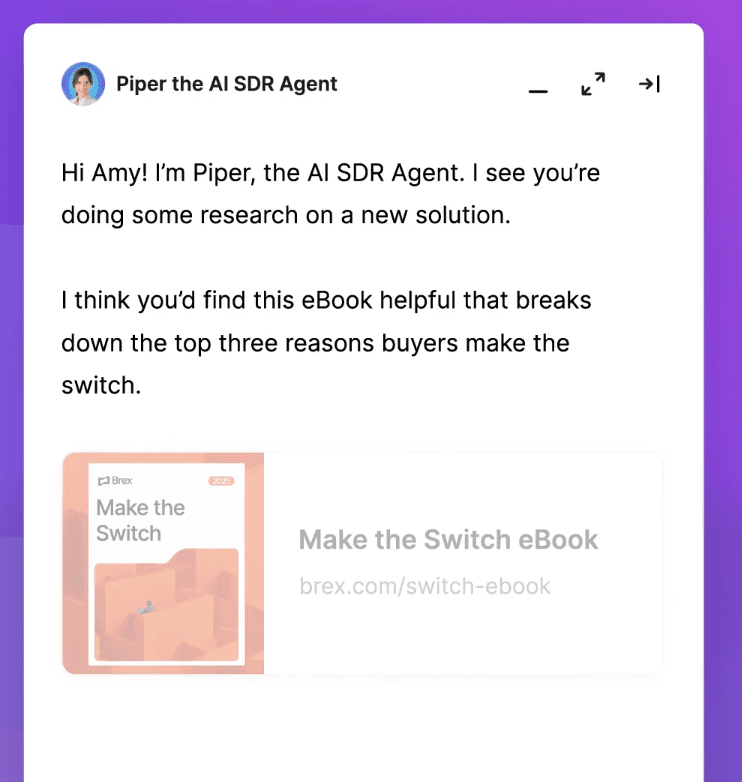
However, because most workflows are rule-based and tightly configured, the setup and tuning demand specialist staff. That makes it harder for faster-moving teams to maintain momentum or explore beyond the inbound conversion model.
Deep Salesforce integration and account-intent strengths
Built natively on Salesforce, the platform maintains a continuous data flow that connects marketing and sales performance in real time. Account-level intent signals (via its “Signals” product) are routed into the CRM, enabling sales teams to act on site behavior in real time.
For enterprises whose stack is entirely Salesforce-centric, this offers clear visibility into funnel stages and pipeline attribution. But for organizations using HubSpot or mixed CRMs, the integration advantage becomes a lock-in point.
So when should you look elsewhere?
Qualified is powerful, but its annual minimum (~$70,000 plus staffing) and implementation time often push mid-market teams to look at other conversational marketing platforms.
The tool is built for large, structured revenue teams and often requires months of setup and ongoing maintenance.
For teams outside that profile (SMBs, mid-market firms, or those using non-Salesforce stacks), Qualified alternatives may offer similar pipeline conversion benefits with platform-agnostic architecture, lower total cost of ownership, and fewer trade-offs.
Comparing the top 5 Qualified competitors and alternatives
For teams who are reviewing their conversational marketing platforms in 2025, the choice matters.
While Qualified remains the high-cost, high-value option for enterprises locked into Salesforce, its entry price (often $70K+ per year) and tight Salesforce coupling limit its flexibility.
The following lineup looks at the best qualified alternatives, each rated on three axes:
How its architecture fits your stack
How its use case mirrors your GTM motion
And how their pricing compares to Qualified’s premium tier
Breakout: The best AI-first challenger
Breakout represents a new direction for conversational marketing, one built entirely around AI SDRs that qualify, engage, and book meetings around the clock.
The platform reads intent signals, handles qualification automatically, and books meetings, all without human routing. This makes it ideal for teams seeking a Qualified alternative that delivers immediate results without Salesforce dependency.
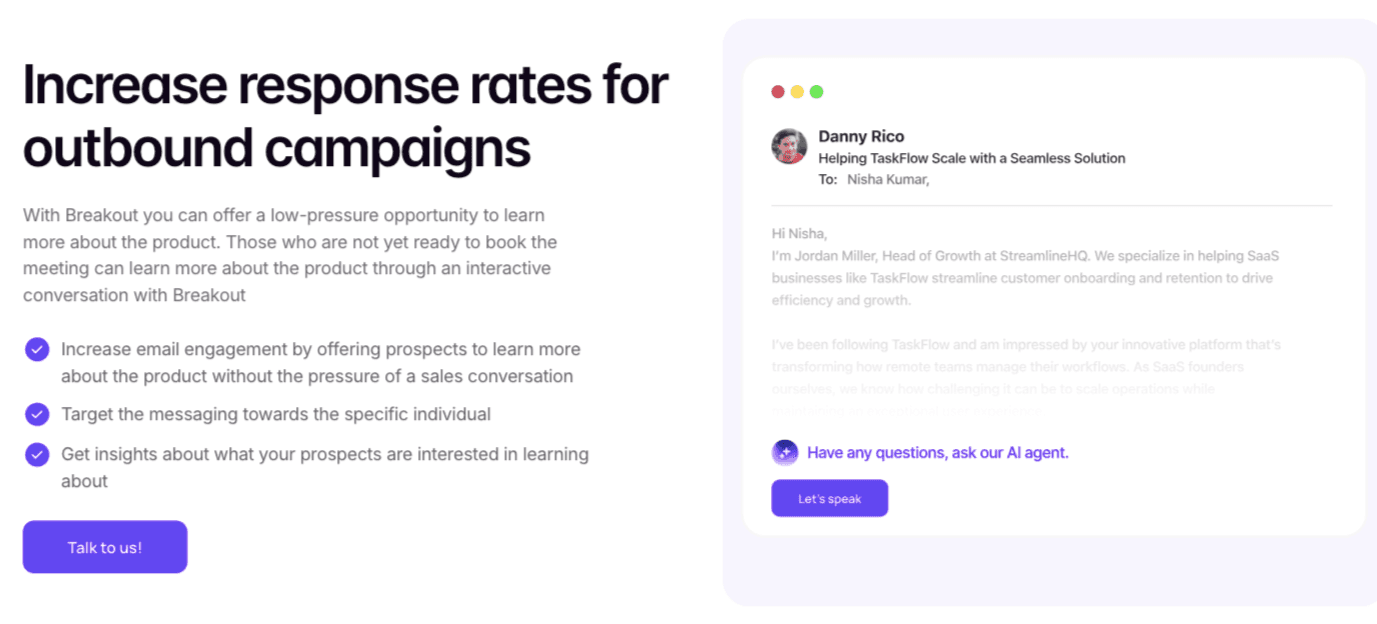
Where Qualified depends on Salesforce for data routing and setup, Breakout works across any CRM or GTM system, learning from your own content, traffic, and buyer behavior.
Breakout replaces static flows and manual rules with adaptive AI reasoning. It reads visitor intent in real time, asks qualifying questions, captures BANT data, and schedules meetings automatically.
Unlike legacy chatbots, it personalizes every conversation based on funnel stage, role, or company signals. Some clients report up to a 40% lift in conversion rates after deployment.
Take the case of Barti, a B2B brand that turned its static website into a live, self-serve conversion engine with Breakout. Its AI agent guided visitors through contextual conversations and qualified leads instantly.
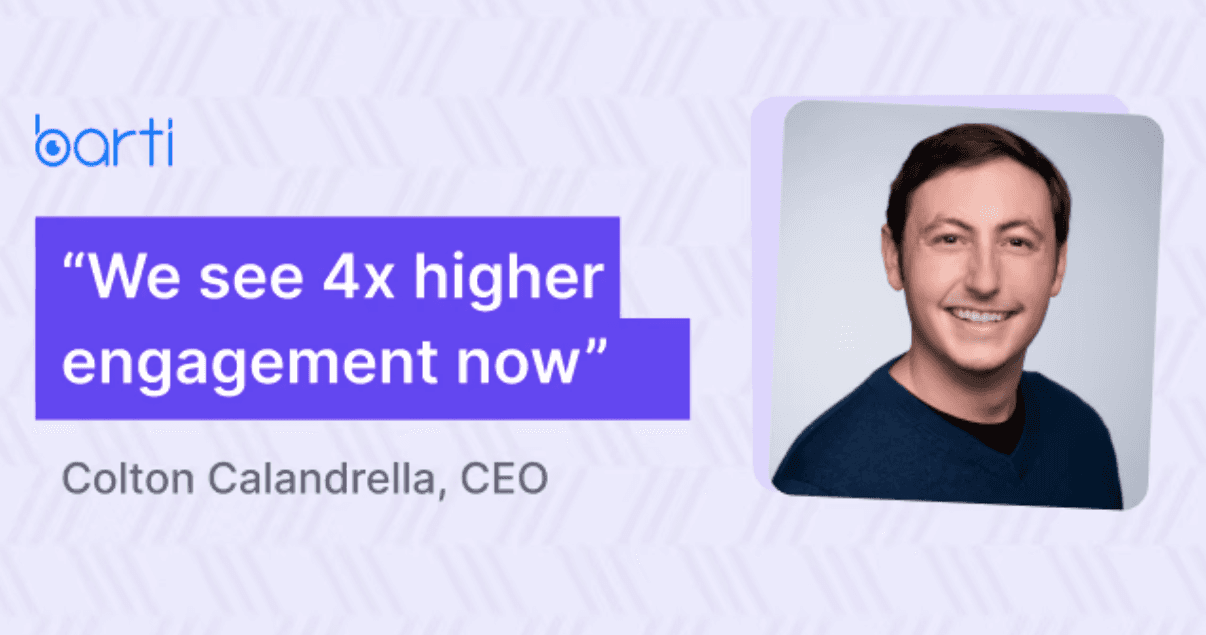
The result: 19% incremental pipeline influenced
10% directly converted by Breakout
9% indirectly, all without adding headcount
Use case
Breakout is built for companies that want their websites to sell. It automates SDR functions (qualification, routing, and scheduling) while personalizing each interaction through chat, voice, or interactive demos.
It fits teams that value fast deployment, minimal human dependency, and measurable ROI.
Pricing
Breakout’s pricing structure is value-driven, designed to scale with usage rather than licenses. Entry-level tiers suit startups, while larger plans follow usage-based billing.
Knock AI: The multi-channel inbound AI SDR
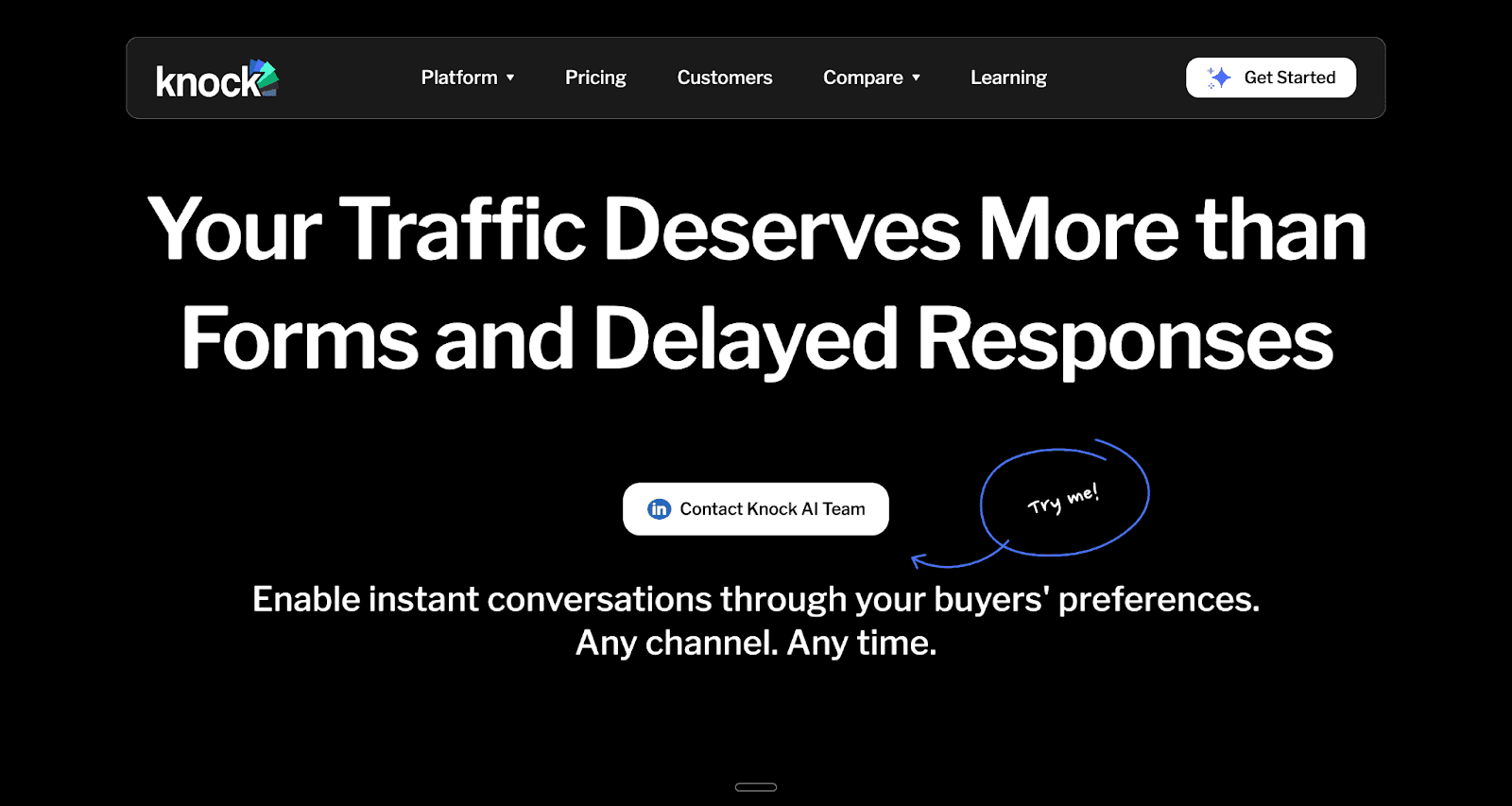
Knock AI represents a new category of AI SDR, one that extends beyond website chat into real-time, multi-channel buyer engagement.
Knock AI captures and converts buyer intent across channels such as Slack, LinkedIn, WhatsApp, and email, ensuring no high-intent lead is lost after leaving the website.
Instead of relying on static routing or single-channel conversations, Knock AI uses intent detection, enrichment, and agent-based workflows to qualify leads, personalize responses, and book meetings instantly.
This makes it especially powerful for modern GTM teams where buyers don’t stay confined to a single channel and expect fast, contextual responses wherever they engage.
Use case
Knock AI is built for teams that want to capture and convert inbound demand wherever it appears, not just on their website.
It fits companies with multi-channel buyer journeys, where leads interact across Slack communities, LinkedIn, or messaging platforms before booking.
Pricing
Knock AI starts at $1,000/month, with pricing scaling based on volume, channels, and qualification workflows.
Intercom: The support-first solution
Unlike Qualified or Knock, which focus on pipeline acceleration, Intercom remains centered on customer experience and support resolution.
Its AI agent, Fin, automates repetitive service interactions, answering FAQs, managing tickets, and routing complex queries to agents.

As one of the Qualified alternatives, Intercom fits companies where service drives retention. Its workflows are polished for ticket triage, but its outbound engagement remains limited.
Compared to AI-first tools, it’s more of a support automation system than a pipeline generator.
Use case
Intercom’s Fin automates ticket resolution and routing for customer service teams. It uses AI to interpret questions, retrieve information, and escalate unresolved cases.
The tool supports chat, email, and social channels, allowing teams to unify support under one system.
Pricing
Pricing starts at $0.99 per resolution, scaling with use. This makes it a flexible option for teams that scale support volume seasonally.
HubSpot Sales Hub: The all-in-one CRM alternative
Teams already using HubSpot find its native chat system a natural next step for sales engagement. Conversations flow directly into the CRM, allowing reps to track every visitor interaction without leaving their workspace.

The built-in chat tool focuses on lead capture and follow-up automation rather than deep qualification. Messages route through shared inboxes, while the drag-and-drop chatbot builder helps set up quick responses or meeting scheduling.
As one of the lighter Qualified competitors, HubSpot’s chat functions best as an extension of the CRM, not as a standalone AI SDR layer. For startups or small-scale teams, it provides affordable automation and clear visibility.
Use case
A fit for HubSpot-native sales teams that need basic chat engagement tied directly to CRM data. It suits small- to mid-market firms focused on managing inbound form fills or nurturing early-stage leads without heavy engineering work.
Pricing
HubSpot offers a free basic plan, with paid tiers unlocking advanced flows, deeper routing, and analytics. Costs rise with feature use but remain accessible for smaller businesses.
Head-to-head comparison: How the top Qualified competitors stack up
Before making a switch, it helps to see how the Qualified alternatives compare on price, Salesforce dependency, and AI automation depth.
This table looks at Qualified, Knock, Intercom, and HubSpot and compares them with Breakout to show where each fits and where Breakout stands apart as the AI-first, platform-agnostic choice for pipeline generation.
Platform | Primary use case | Pricing/lock-in | AI vs. Human focus | The Breakout advantage |
Qualified | Salesforce-native pipeline generation through Piper, its AI SDR | Custom enterprise plans (~$70K+ annually); Salesforce required | Heavy reliance on Salesforce and SDR support | Works without Salesforce; delivers faster setup and lower cost for mid-market teams |
Knock AI | Multi-channel inbound AI SDR across Slack, LinkedIn, WhatsApp, and web | Starts at ~$12K annually; no CRM lock-in | Fully AI-driven, agent-based workflows | Captures and converts intent across channels, not just website |
Intercom | Support automation and lead triage via Fin | Starter from $888/year; sales tools are add-ons | Support-focused AI with limited lead automation | Built for sales-first use; qualifies and books meetings autonomously |
HubSpot Chat | CRM-integrated chat for inbound queries | Free basic tier; upgrades for automation, cheaper option for SMBs | Simple logic flows; human-managed follow-up | More advanced AI SDR features; adapts beyond CRM users |
Choosing the right Qualified alternative for your sales motion
We’ve seen how each Qualified competitor fits a different motion. The right pick depends on your sales setup and pace of execution.
If you’re a Salesforce enterprise with structured SDR coverage, Qualified will do the job. They offer deep CRM logic but come with long setup cycles and higher seat costs.
If you need AI-led pipeline generation that runs without human routing or Salesforce lock-in, Breakout is built for it. It works across stacks, qualifies in real time, and books meetings automatically.
For support-focused teams, Intercom’s Fin fits better. It handles service and lead handoffs but isn’t built to drive inbound conversions.
The difference with Breakout lies in how it blends AI reasoning, conversation, and orchestration, helping sales teams work leaner and smarter, not harder.
Let your inbound run itself. See Breakout qualify and book live. Click here to schedule your demo.
FAQs
What is Qualified used for, and who is it best suited for?
Qualified is designed for Salesforce-based sales teams that want to convert website visitors into sales conversations. It helps identify target accounts, route chats to reps, and track pipeline activity within Salesforce.
Why are teams exploring Qualified alternatives?
Most teams start exploring AI-first alternatives like Breakout due to Qualified’s high annual cost (often $70K+) and its deep Salesforce requirement.
How does Breakout compare to Qualified for pipeline generation?
Qualified’s AI (Piper) still relies on preset routing and logic trees. Breakout’s AI runs autonomously, capturing context from content, CRM, and intent data to hold human-like conversations and book meetings automatically.
Which Qualified alternative delivers the best ROI in 2025?
Most teams shifting from legacy conversational marketing tools report Breakout paying back in months, not years. With AI-native orchestration, it reduces lead handling costs and accelerates inbound conversion rates substantially.