


Apollo and ZoomInfo have earned their positions at the top of their category the hard way.
ZoomInfo, founded in 2007, is publicly traded (Nasdaq: GTM), pulled in $1.25 billion in revenue in 2025, and has been named a Gartner Magic Quadrant Leader for ABM platforms two years running, with customers including Adobe, Snowflake, and JPMorgan. Apollo, founded in 2015, has raised $251 million, reached a $1.6 billion valuation, and now serves 500,000+ companies and 3 million users on the strength of undercutting ZoomInfo's price by 3 to 10 times.
Recently, they both added visitor identification, and the two timelines make for an interesting story. Apollo's contact-level website visitor tracking, is genuinely new. It entered closed beta in early 2026 and is documented in Apollo's 2026 release notes, still US-only as it rolls out.
ZoomInfo's WebSights isn't new at all — it's been part of the platform since April 2024. What shipped in 2026 was an enhancement, Automatic Traffic Filtering, which separates real human visitors from bot traffic in the existing tool. ZoomInfo is refining something it already had, while Apollo does the catching up.
Both platforms now promise the same thing: first-party proof that an account is actively researching, sent straight into your workflow. But by the time a rep sees the alert, opens the CRM, and starts writing an email, the visitor has already left. So, the signal capture works. Yay! The actual sales conversations, however, don't.
As we compare these two industry heavyweights for an honest 2026 update, we're looking beyond pricing or database size, and asking if there's a better way to fix the gap they both leave. Let's begin!
The Numbers
Apollo | ZoomInfo | |
List price | Free (900 credits/year), Basic $49/user/month, Professional $79/user/month, Organization $119/user/month (3-seat minimum) | Not published. SalesOS Professional ~$14,995/year, Advanced ~$24,995/year, Elite $39,995+/year, most teams land at $25,000–$60,000/year once seats and add-ons are included |
Database size | 210–275M contacts (self-reported, varies by source), 35–73M companies | 420M+ contacts, the largest in the category |
Data accuracy | ~88% in North America by practitioner estimates, dropping to roughly 60% outside it, real-world bounce rates in the 15–35% range depending on region | 95%+ verified accuracy claimed, under 5% bounce rate, independently the stronger dataset for enterprise US accounts |
G2 rating | 4.7 out of 5 across 9,400+ reviews | 4.5 out of 5 across 12,600+ reviews |
Website visitor ID | Contact-level de-anonymization via the Inbound Add-On, US-only, rolled out through 2026 | WebSights, company-level, bundled into the Advanced tier and above |
Apollo wins on price and breadth, replacing a data provider, sequencer, and dialer in one $49–119/month seat. ZoomInfo wins on accuracy and depth, particularly for enterprise US accounts, at three to ten times the cost. Both are still worth understanding in real depth before you sign on the dotted line, starting with what each one actually costs once the credit systems kick in.
Pricing: What You Actually Pay, Not What the Page Says
Apollo's list price is real, but it's also the smallest number you'll see on an invoice. The Basic, Professional, and Organization tiers are priced per seat, and each one comes with monthly caps on mobile credits and export credits that are separate from the "unlimited" email credits Apollo advertises.
A Professional-tier rep gets roughly 100 mobile credits a month, at about 8–10 credits per mobile number revealed, which covers maybe a dozen verified mobiles before the team needs to buy more at around $0.20 per extra credit, sold in blocks rather than one at a time. Credits don't roll over. A team of 5 SDRs on Professional, billed annually, runs close to $400/month before anyone touches an overage; once phone-heavy outbound motions start burning through mobile credits, multiple 2026 buyer breakdowns put the real cost at $150–400 per user per month, well above the $49–119 sticker.
ZoomInfo's pricing tiers are different but land in a similar place. The published-adjacent numbers, $14,995 for Professional, $24,995 for Advanced, $39,995+ for Elite, all carry a 3-seat minimum and require an annual contract, no monthly option exists. But the tier price is described by ZoomInfo's own account reps and independent buyers as less than half of first-year total cost. Per-seat add-ons of $1,500–2,500/user, mandatory credit packages, and features like real-time intent signals or Copilot push the real number to $30,000–60,000/year for a mid-market team, and $60,000–100,000+/year for a 10+ seat enterprise deployment.
The median ZoomInfo contract lands at $31,875/year across more than 1,300 verified purchases tracked by Vendr in 2026, and several buyers report 10–20% automatic price increases baked into renewal terms.
The honest comparison isn't $49 against $14,995, it's $150–400/user/month against $30,000–60,000/year for a similarly sized team, a gap that's real but meaningfully smaller than the sticker prices suggest.
Data Accuracy: What Independent Testing Actually Shows
Vendor-claimed accuracy numbers are close to useless on their own. Apollo cites 91% email accuracy through what it calls a 7-step verification process, ZoomInfo cites up to 95% using 300+ human researchers plus machine-learning verification, and neither number is independently auditable from the vendor's own page.
What's more useful is a March 2026 independent benchmark that ran 1,000 identical leads through both platforms on the same day and hand-verified a fifth of the results, plus a separate live-send test across 450 leads, corroborated independently by UpLead and ColdIQ.
The two platforms don't actually win the same category. On phone data, ZoomInfo has a real edge. In the independent test, it returned a working mobile number for 67% of contacts, against 41% for Apollo, and a direct-dial office number for 71%, against 52% for Apollo. That's a 26-point gap on mobiles and a 19-point gap on direct dials. For a team of five reps working a call list, it's the difference between roughly two-thirds of numbers actually connecting versus fewer than half. On email, the story flips, or at least evens out. In the live-send test, Apollo's list actually produced a higher reply rate than ZoomInfo's, and campaign bounce rates for both landed close together, 1.8% for Apollo against 0.8% for ZoomInfo, a real difference at high volume but a solvable one, a standalone verification pass on Apollo's list for a few dollars per thousand emails closes most of that gap.
So the accuracy question isn't really "which platform is more accurate," it's "accurate at what." ZoomInfo's edge is concentrated in phone and mobile data, especially for US enterprise contacts. Apollo's email data holds up competitively at a fraction of the price, and its weaker spots are direct dials and coverage outside North America, which lines up with the ~88% in-region, ~60% out-of-region estimate practitioners report.
What Each Platform's Visitor Identification Actually Does
For most of Apollo's and ZoomInfo's history, "speed to lead" meant speed to outbound, finding a contact fast, verifying the email, and getting a sequence out the door. Visitor identification is the newer piece, and as covered above, Apollo is still rolling it out while ZoomInfo has been refining it for two years.
Apollo's version sits inside the Inbound Add-On. It resolves a visitor down to the individual, not just the company, then lets you build a workflow: flag the visitor, add them to a list, trigger an alert or a sequence. It's currently US-only and still in closed beta.
ZoomInfo's version, WebSights, works at the company level. A visitor from a known account lands on your site, WebSights matches the IP to the company, and that intent signal feeds into ZoomInfo's broader account intelligence, available starting on the Advanced tier.
Both are genuinely useful. Both are also identification, not engagement. Here's what actually happens after either one fires:
Visitor lands on your site
Apollo or ZoomInfo matches the IP or session to a known contact or account
A workflow rule fires, flag, alert, add to sequence
A rep sees the alert, minutes or hours later
The rep drafts and sends a follow-up, by email or a queued sequence step
The visitor, who left the site sometime between steps 1 and 5, receives a cold-feeling message about a page they looked at earlier that day
A CRM does this same handoff for a lead who filled out a form: create the record, route it to a rep, wait. Apollo and ZoomInfo just extended that pattern one step earlier, to someone who hasn't filled out anything yet. The record gets created and routed, and a human eventually acts on it. What neither tool does is act on the visitor themselves, in the moment they're actually there.
How Breakout Fills The Gap
Breakout does step 2 differently from the above workflow, and then keeps going!
It identifies the visitor the same way, company and person level, no form required, but instead of handing that identity to a workflow and waiting for a rep, it starts a real AI-led conversation immediately, while the visitor is still on the page. In practice, that means:
Identifying the visitor at the company and person level the instant they land, before they've scrolled past the fold, let alone filled out a form
Engaging them in a real conversation that holds context and answers actual product questions, not a decision-tree chatbot that breaks the moment someone asks something off-script
Adapting what it shows based on behavior, a returning visitor re-reading the pricing page gets a different response than someone on their first visit to the docs
Following up automatically over email and LinkedIn, using the context already captured, if the visitor bounces before converting
Booking the meeting or handing off a fully qualified, contextualized conversation to a rep, all before the visitor has a reason to close the tab
Barti's Head of Marketing & Partnerships described what that produces on the other end: "Our first lead through Breakout came fully qualified, with a clear summary of their questions, concerns, and context. The rep needed no prep. That's when we knew this was a real unlock." (Sarah Lee, Head of Marketing & Partnerships, Barti)
Run the same six-step sequence from above with Breakout in place of the identify-then-workflow motion:
Visitor lands on your site
Breakout identifies them, company and person level, in real time
Breakout starts a conversation immediately, no rep, no delay
The visitor gets real answers while they're still deciding whether to stay
Breakout books a meeting or hands the rep a qualified, contextualized lead
The rep's first touch is a scheduled call, not a cold follow-up to someone who already left
Breakout's Pricing Model
The pricing model is a real departure too, worth reading alongside the credit-system breakdown above. Apollo and ZoomInfo both charge per seat with usage credits stacked on top, so the bill grows with headcount and phone-heavy usage regardless of how many visitors actually convert.
Breakout's $2,000/month Growth tier is flat, doesn't multiply by rep count, and there's no mobile-credit meter running in the background. The lighter $500/month tier covers visitor identification alone if the full conversational layer isn't needed yet.
Both processes start at step 1, a visitor landing on the site. What happens between there and an actual conversation is where they split. Apollo and ZoomInfo automated step 3, the alert that tells a rep someone's there. Breakout collapses steps 3 through 6 into one thing: it starts the conversation itself, right then, instead of alerting a human to start one later.
Finding The Right Fit
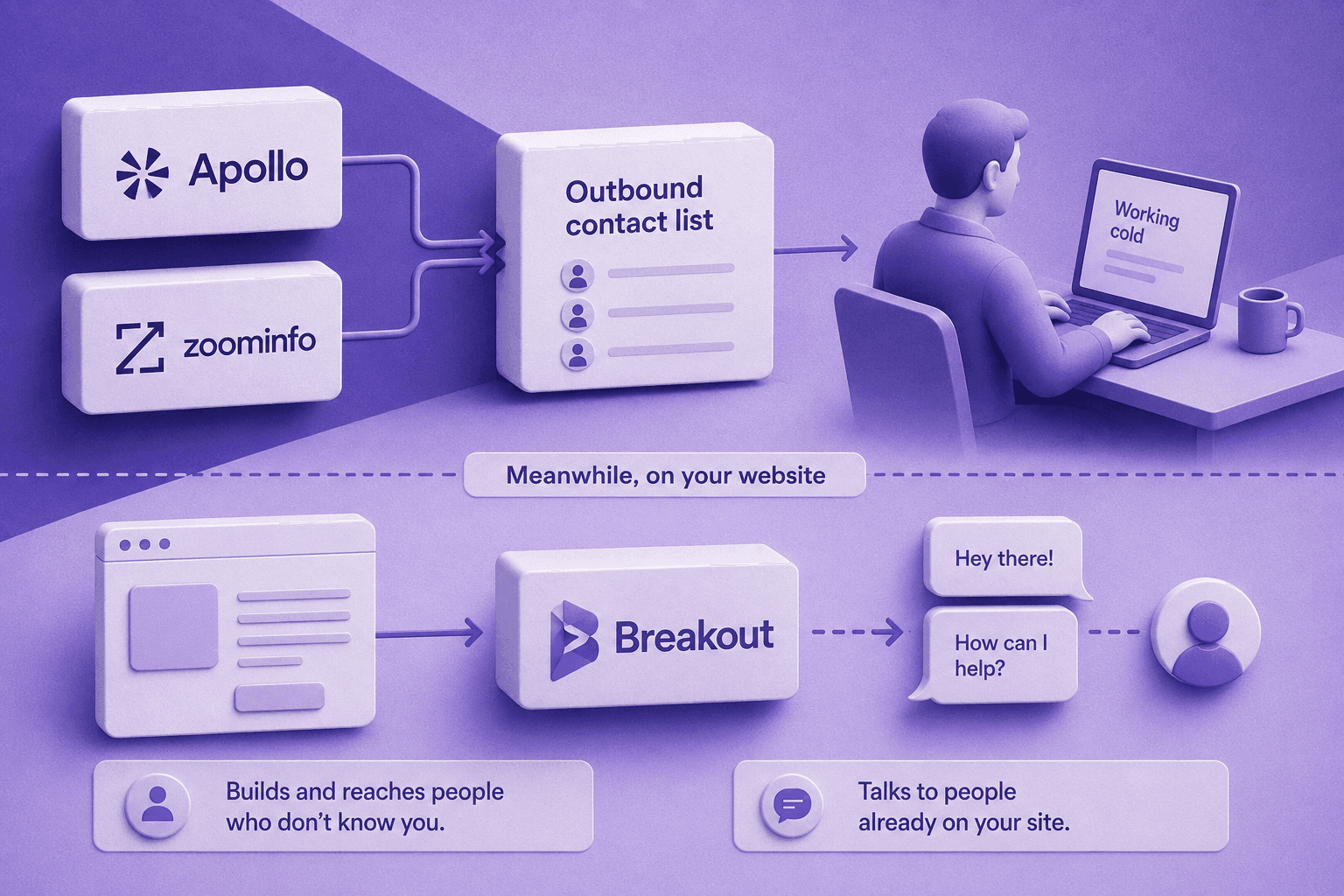
Apollo makes sense as the default for startups and SMBs running US-focused outbound. ZoomInfo makes sense for enterprise teams where data accuracy at scale matters more than price, and where a dedicated RevOps team can absorb the cost and the learning curve. Both are legitimate picks for finding people who don't know you yet and getting a message in front of them.
Neither one replaces having a real conversation with someone who already found you. That's a separate job, and it's still open even after you've picked one of these two and paid for whichever tier includes visitor identification. Breakout runs alongside either platform rather than competing with it, Apollo or ZoomInfo builds and reaches your outbound list, Breakout catches and talks to the people already showing up on your site in the meantime.
Book a demo and see what happens when someone on your site gets a real answer instead of an alert in someone else's inbox. Try Breakout today!
FAQ
Does Apollo's website visitor tracking replace a tool like Breakout?
No. Apollo's contact-level tracking identifies who's on your site and can trigger a workflow, an alert, a sequence enrollment, but it doesn't hold a conversation with the visitor. Breakout engages the visitor directly, in real time, while they're still on the page.
Is ZoomInfo's WebSights the same thing as visitor identification in Breakout?
They solve related but different problems. WebSights identifies which company an anonymous visitor belongs to and feeds that into ZoomInfo's broader intent data. Breakout identifies the visitor and then starts a live, AI-led conversation with them, something WebSights doesn't attempt to do.
Should I pick Apollo or ZoomInfo if I'm a small team?
Apollo, in most cases. Its self-serve pricing starts free and tops out around $119/user/month, and it bundles data, sequencing, and a dialer in one platform. ZoomInfo's entry point starts around $14,995/year and is built for teams with the budget and RevOps capacity to use its deeper accuracy and enterprise features.
Can I run Breakout alongside Apollo or ZoomInfo?
Yes, and most teams do exactly that. Apollo or ZoomInfo handles building and reaching your outbound contact list. Breakout handles the people already on your website who haven't filled out a form, a separate job neither platform was built to do.