All Blogs
A 2026 guide to Chili Piper's real pricing and hidden costs, for revenue teams deciding if routing tools or AI-first platforms like Breakout deliver better pipeline ROI.

Evan Marshall
Published On

Getting more meetings from your inbound traffic without just hiring more reps is where Chili Piper starts to show its limits. It routes leads well, but conversion still depends on manual follow-up, and that follow-up has a real dollar cost attached to it. Here's a straightforward look at what Chili Piper actually costs in 2026 and where the model breaks down.
TL;DR
Chili Piper looks affordable at $30/user, but real costs stack fast. Platform fees, multiple products, and SDR dependency push monthly spend to $1,000 to $3,000+ in software and $10K to $20K in headcount.
It works best for teams that already have strong inbound and SDR capacity, and need structured routing, not conversion.
If your goal is more meetings without hiring more reps, routing alone falls short. AI-first platforms like Breakout convert traffic in real time, reduce cost per meeting, and remove reliance on manual follow-ups.
Chili Piper pricing (2026): plans & what's included
Chili Piper follows a modular pricing model.
Each product is priced separately, with a per-user fee and an additional platform fee. To cover the full inbound funnel, most teams end up using multiple products together.
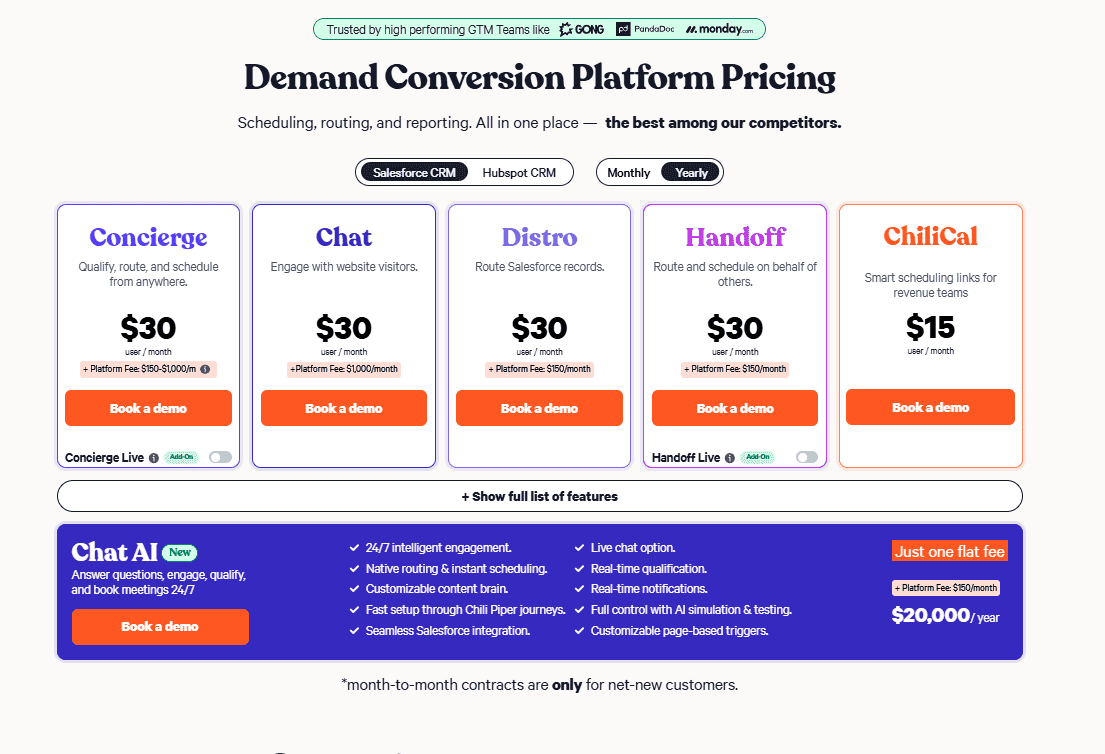
At a base level:
Most products start at $30 per user per month
Platform fees range from $150 to $1,000+ per month depending on usage
ChiliCal is priced lower but acts as a foundational layer
This structure means you are not buying a single platform. You are assembling a system.
1. Concierge
Concierge is Chili Piper’s core product. It handles inbound lead capture, qualification, and routing.
Pricing:
Starts at $30 per user per month
Platform fee ranges from $150 to $1,000+ per month based on inbound lead volume
What’s included:
Qualification from web forms
Routing based on form inputs and CRM data
Instant meeting scheduling after form submission
Lead-to-account matching, including fuzzy matching
Multi-round robin routing across teams and territories
AI-powered spam detection and enrichment
Concierge is designed to convert form submissions into scheduled meetings. It is typically the entry point for most Chili Piper customers.
2. Chat
Chat extends Chili Piper’s functionality to website conversations. It allows visitors to engage and book meetings directly through chat.
Pricing:
Starts at $30 per user per month
The platform fee is typically around $1,000 per month
What’s included:
Automated chat journeys triggered by behavior such as UTMs, URLs, and time on page
Targeted chat display rules based on visitor attributes
Routing based on conversation data and CRM logic
Shared routing logic with other Chili Piper products
Chat is often used alongside Concierge to capture and convert visitors who do not fill out forms.
3. Distro
Distro focuses on backend routing within the CRM. It is primarily used for managing lead distribution and ownership.
Pricing:
Starts at $30 per user per month
The platform fee is around $150 per month
What’s included:
Routing of leads, contacts, accounts, and opportunities
Assignment based on territory, ownership, or custom rules
SLA management for lead follow-ups
Deduplication and record matching
Automatic account and opportunity assignment
Distro is less about conversion and more about smooth workflows inside the CRM.
4. Handoff
Handoff is built for routing meetings between teams, especially from SDRs to account executives.
Pricing:
Starts at $30 per user per month
The platform fee is typically around $150 per month
What’s included:
Real-time routing between SDRs and AEs
Calendar coordination across multiple reps
Round-robin scheduling and ownership-based routing
Controls to guarantee fair distribution of meetings
Optimization for no-shows and rescheduling
Handoff is typically used in mid-funnel workflows where multiple teams are involved in closing deals.
5. ChiliCal
ChiliCal is Chili Piper’s scheduling product. It provides basic meeting booking functionality and supports other products in the suite.
Pricing:
Starts at $15 per user per month
The platform fee is typically around $150 per month
What’s included:
Scheduling links for individual reps
One-click meeting booking
Calendar sync with Google and Outlook
Round-robin scheduling across teams
Automatic time zone detection
CRM logging for meetings
ChiliCal can be used as a standalone scheduling tool, but it is most commonly bundled with other Chili Piper products.
Chili Piper's pricing reflects a product suite instead of a single tool. Each module solves a specific part of the inbound process.
To build a complete inbound conversion system, most teams need more than one of these products. This is where total costs increase quickly.
The hidden cost of Chili Piper: what you actually pay
Chili Piper’s pricing looks simple at first glance.
A per-user fee
A platform fee
A few add-ons
In reality, the cost builds across layers. And it compounds as you grow.
To understand what you actually pay, you have to look beyond the base price.
1. Platform fees that scale with inbound
Chili Piper charges a platform fee based on the number of inbound leads you receive.
Typical tiers look like:
Up to 100 leads: ~$150/month
100-1000 leads: ~$400/month
1000+ leads: ~$1000/month
Your cost increases as your inbound grows.
You are effectively paying a tax on demand. Before conversion even happens.
2. Seat-based pricing that scales with team size
Most Chili Piper products start at $30 per user per month.
That seems reasonable until you model it.
Example:
10 SDRs + 5 AEs + 2 ops users = 17 users
17 × $30 = $510/month (per product)
Now factor in reality:
Most teams use at least 2-3 products
Effective cost becomes $1,000 to $1,500/month just in seat licenses
And this is before platform fees.
As your team grows, this number increases linearly. More reps means more cost.
3. Multiple products to run a complete flow
Chili Piper is not one tool. It is a stack.
To cover the inbound journey, teams typically combine:
Concierge for form routing
Chat for website engagement
Distro for backend routing
Handoff for SDR to AE transitions
Even with bundled pricing, costs add up quickly.
Example scenario:
20 users across 3 products at discounted ~$20/user/product
20 × 3 × $20 = $1,200/month
Platform fee: ~$400 to $1000/month
Total: ~$1,600 to $2,200/month
And this excludes add-ons.
4. Add-ons and feature unlocks
Key capabilities are not always included by default.
Features like:
Live qualification
Advanced routing logic
AI chat or enrichment
May require additional configuration or cost. This increases both spend and implementation complexity.
5. You still need SDRs to convert
Chili Piper handles routing. It does not handle conversion.
After a lead is routed, SDRs follow up manually, qualification happens through human effort, and meeting bookings depend entirely on how fast a rep responds.
To put a number on it: two SDRs at a fully loaded cost of $8,000 per month each comes to $16,000 per month in human cost. Chili Piper does nothing to reduce that dependency.
Even if Chili Piper improves routing, it does not reduce this dependency.
6. Important hidden cost: lost conversion
This is where the biggest impact lies.
With Chili Piper, a visitor fills a form, routing happens, and follow-up comes minutes or hours later.
Even small delays reduce conversion rates. Research shows 78% of B2B buyers go with the vendor that responds first.
With 500 inbound leads per month, fast follow-up might convert 40% into meetings, producing 200 meetings. Add a delay, and that conversion rate drops to 25%, leaving you with just 125 meetings.
That is 75 lost meetings. At a $5,000 ACV, that is $375,000 in missed pipeline. This cost never appears on your invoice. But it is real.
What you actually end up paying
When you combine everything, you are looking at $1,000 to $3,000 per month in software costs (seats, platform, and products), $10,000 to $20,000 per month in SDR costs, and significant revenue loss from delayed conversion.
Chili Piper is not expensive because of its base pricing.
It becomes expensive because costs scale with growth, conversion depends on manual effort, and revenue leaks through delay.
Breakout simplifies the entire model.
There are no platform fees, no per-seat pricing, and no need to stitch together multiple products. Pricing is straightforward and scales with usage, not complexity.
As you grow, costs increase predictably without added layers or hidden charges. One system handles the entire inbound flow, without the overhead that typically comes with it.
Chili Piper vs AI-first alternatives (cost & ROI)
Chili Piper is built for routing. Most modern alternatives are built for conversion.
That difference defines both cost and ROI.
With Chili Piper, the flow starts after a form is submitted. Routing happens. Then SDRs take over. Conversion depends on speed, availability, and follow-up quality.
AI-first platforms remove that dependency. They engage instantly, qualify in real time, and book meetings without delay.
The result is clear. Higher conversion rates. Lower cost per meeting. Less reliance on headcount.
1. Breakout (Inbound AI SDR)
Breakout is not a scheduling tool.
It is an AI-led inbound conversion platform built for modern revenue teams.
Unlike Chili Piper, Breakout does not wait for a form fill.
It engages visitors before they even submit their details. Using auto-waterfall enrichment and AI-driven nudges, it identifies and interacts with high-intent buyers in real time.
The entire inbound flow happens inside one system. There are no handoffs between tools. There are no delays between steps.
Breakout:
Identifies anonymous visitors as they land
Qualifies intent using AI agents
Engages in real-time based on context
Books meetings instantly when fit is confirmed
This removes the biggest inefficiency in inbound conversion. Time.
Pricing reflects this difference in approach.
Breakout does not charge per seat. It does not add platform fees based on lead volume. There are no separate modules to unlock functionality.
Plans typically start around $1,500 per month and scale depending on usage.
Here is what follows:
Costs stay predictable as your team grows
You are not penalized for higher inbound volume
You do not need to stack multiple tools
More importantly, Breakout replaces:
Scheduling tools
Chat tools
Routing tools
Parts of SDR workflow
From an ROI perspective, the impact is direct.
Instead of paying for infrastructure and headcount, you are investing in outcomes. More meetings. Faster conversion. Higher pipeline velocity.
Chili Piper manages inbound flow. Breakout converts inbound demand.
2. RevenueHero

RevenueHero focuses on simplifying form-based routing and scheduling.
It improves speed and usability compared to Chili Piper but operates within the same post-form model.
Key features:
Instant meeting booking after form submission
Rule-based routing using CRM and form data
Calendar sync with round-robin scheduling
Basic qualification tied to form inputs
Pricing:
Lower than Chili Piper in most cases
No heavy platform fee structure
Still follows a per-user or usage-based model
Verdict:
RevenueHero makes routing faster and easier.
But it still relies on form submissions and does not fundamentally improve conversion. It is best suited for teams optimizing their workflow instead of pipeline growth.
3. Calendly
Calendly is a scheduling tool built to remove friction from meeting booking. It gives reps shareable links and handles calendar coordination, but stops there. It has no routing logic, no lead qualification, and no CRM-native intelligence.
Shareable scheduling links with one-click booking and calendar integrations
Basic team scheduling with round-robin distribution
Free plan available; low-cost paid tiers with no platform fees
Good for: Small teams or individual reps that need a fast, affordable way to share availability and book meetings without complex routing requirements.
Limitation: Does not qualify leads, route intelligently, or engage visitors. It only books meetings for people who already want one.
Bottom line: Calendly is the right tool for simple scheduling. It is the wrong tool if your goal is converting more inbound traffic into pipeline.
4. HubSpot
HubSpot includes built-in scheduling, routing, and automation as part of its CRM suite. For teams already on HubSpot, it is the path of least resistance, with no additional vendor and no extra integration layer. The trade-off is depth: routing logic and qualification are rule-based and tied to the form-first model.
Meeting scheduling links and basic routing workflows built into the CRM
Form and pipeline integration with CRM-native automation
No separate platform fee for scheduling, since costs roll into HubSpot subscription tiers
Good for: Teams already running on HubSpot that want to consolidate tools and avoid adding a separate scheduling or routing vendor.
Limitation: Routing and qualification are rule-based and form-dependent, with no real-time visitor engagement, and advanced routing scenarios often require workarounds.
Bottom line: HubSpot works for basic inbound processes. If you need more than form-to-meeting routing, you will quickly hit its ceiling.
Most alternatives to Chili Piper either reduce cost or simplify routing.
Breakout changes the model entirely.
It replaces routing with real-time conversion, eliminates tool sprawl, and introduces predictable pricing without hidden fees. For teams focused on pipeline growth, it delivers a stronger ROI than traditional routing tools.
Scenario comparison: cost per meeting
The real question is not what a tool costs. It is what you pay to generate one meeting. Let’s break this down with a simple scenario.
Inputs
The scenario assumes 10,000 monthly visitors, a 2% form conversion rate producing 200 leads, and an average deal size (ACV) of $5,000.
Now, the difference comes from how those leads turn into meetings.
1. Chili Piper: form → routing → SDR follow-up
Flow:
Visitor fills a form
Chili Piper routes the lead
SDR follows up
Meeting is booked later
Because of delays and manual follow-ups, not all leads convert. At a 30% meeting rate, 60 meetings get booked. Costs break down to roughly $2,000 per month for Chili Piper and $16,000 per month for the SDR team, for a total of $18,000 per month.
2. Breakout: real-time engagement → qualification → booking
Flow:
Visitor lands on the site
Engaged instantly
Qualified in real time
Meeting booked immediately
No delays. No manual follow-ups required.
Assume:
Meeting rate: 50%
Meetings booked: 100
Costs:
Total cost for Breakout: $2,000/month
Cost per meeting comparison
Metric | Chili Piper | Breakout |
Visitors | 10,000 | 10,000 |
Leads | 200 | 200 |
Meetings | 60 | 100 |
Total cost | $18,000 | $2,000 |
Cost per meeting | $300 | $20 |
Is Chili Piper worth it in 2026?
Chili Piper remains a solid option for teams that need structured routing and scheduling. If you already have strong inbound and a dedicated SDR team, it can help your workflow run more smoothly.
But the bar for inbound conversion has changed. Buyers expect immediate engagement. Delays reduce intent. And routing alone does not drive pipeline.
You still depend on form fills, SDR follow-ups, and multiple tools working together. Costs increase with team size and inbound volume, while conversion remains tied to response speed.
For teams focused on generating more meetings without increasing headcount, this model becomes limiting.
Platforms like Breakout offer a different approach. They engage visitors instantly, qualify in real time, and convert interest into meetings without delay.
If your goal is to turn more traffic into pipeline, it is worth switching to a system built for conversion. See how an AI SDR converts visitors instantly into meetings. Book a demo now!
FAQ
What does Chili Piper actually cost per month when you add up seats, platform fees, and multiple products?
Most teams running Concierge, Chat, and Distro together pay $1,600 to $2,200 per month in software alone, before factoring in SDR headcount. With two SDRs at fully loaded cost, total monthly spend lands between $18,000 and $20,000, making the $30/user starting price a poor basis for budgeting decisions.
Chili Piper vs Breakout for inbound lead conversion: which produces a lower cost per meeting?
Chili Piper routes leads after form submission and hands them to SDRs, producing roughly 60 meetings from 200 leads at a cost of $300 per meeting in the scenario modeled above. Breakout engages visitors before form submission, qualifies in real time, and books meetings immediately, producing 100 meetings from the same traffic at $20 per meeting. The gap comes from removing time delays and manual follow-up, not from lead volume.
How does Chili Piper's modular pricing model create unpredictable costs as your team scales?
Chili Piper charges a per-user fee for each product separately, plus a platform fee that increases with inbound lead volume. As your team grows and inbound traffic rises, both cost levers move at the same time. Seat licenses multiply across every product you use, and platform fees escalate through usage tiers, making budget forecasting unreliable in a way that a flat-rate or usage-based model avoids.
Can I replace Chili Piper's routing, chat, and scheduling stack with a single tool?
Yes. Breakout handles visitor identification, real-time qualification, chat engagement, and meeting booking inside one system, removing the need to stitch together Concierge, Chat, and Distro. The trade-off is that Chili Piper offers deeper CRM-side routing controls and SLA management for teams with complex territory and ownership rules, so if structured backend routing is your primary need, consolidating into a single conversion tool requires validating that its routing logic matches your existing CRM workflows.
What is the hidden revenue cost of Chili Piper's form-first routing model?
The cost appears in conversion loss from response delays, not on any invoice. Research shows 78% of B2B buyers choose the vendor that responds first. With 500 monthly inbound leads, dropping from a 40% to a 25% meeting conversion rate due to follow-up delays costs roughly 75 meetings per month, which at a $5,000 ACV amounts to $375,000 in missed pipeline each month.