
All Blogs
A quick look at better options than and.

Evan Marshall
Senior Growth AI Strategist
Published On

When you're comparing Drift reviews and pricing, you're really asking whether it's the right conversational marketing tool for your team or if there's a better alternative. Drift has name recognition, but user feedback in 2026 points to real friction around cost, setup complexity, and feature limitations that matter when you're trying to convert website traffic into pipeline. We'll cover how Drift works, what actual users say about it, what you'll pay at each tier, and which alternatives give you similar capabilities without the same trade-offs.
TLDR:
Drift starts at $2,500/month with no free trial and requires 2-4 weeks to set up.
Reviews average 4.4 stars, but users report unexpected pricing increases and generic bot conversations.
Drift intercepts demand on your site but doesn't generate net new pipeline on its own.
Breakout starts at $500/month and identifies high-intent visitors across the web, beyond your site.
What is Drift and How Does It Work?
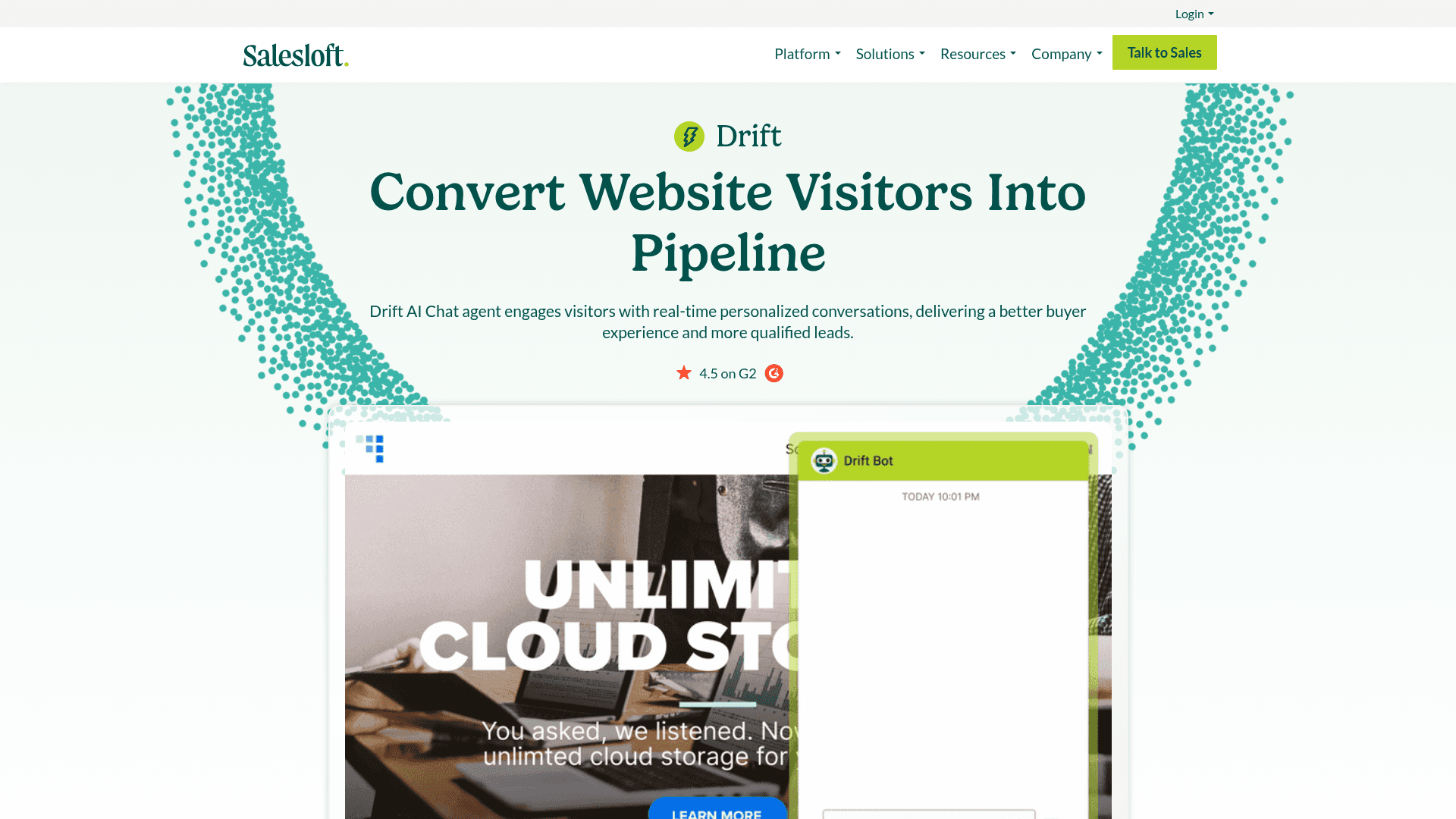
The core idea is straightforward: instead of making prospects fill out a form and wait for a rep to follow up, Drift engages website visitors the moment they arrive, qualifies them through automated conversation, and routes hot leads directly to sales.
The product is organized around a few key capabilities. Its chatbot builder lets revenue teams create branching conversation flows without engineering support. Drift Intel layers in account-level intent data to personalize those conversations based on who is visiting. Drift Video allows reps to send short async video messages to prospects. And Drift Prospector helps reps focus their outreach by surfacing accounts showing buying signals.
Setup typically involves dropping a JavaScript snippet on your site, connecting your CRM (Salesforce and HubSpot are the most common integrations), and configuring routing rules so conversations land with the right rep or sequence. If you're looking at alternatives to Drift, understanding this setup burden is key.
Where Drift sits in the stack matters. It lives at the top of the funnel, on your website, intercepting demand you have already generated through paid, organic, or brand channels. It does not generate net new pipeline on its own. That distinction is worth keeping in mind as you assess whether the product solves the actual problem your team is facing.
Why Consider Drift Alternatives?
Drift has long been a recognized name in conversational marketing, but several real-world friction points push marketing and revenue teams to look elsewhere.
The cost is a frequent sticking point. Drift's pricing can run well into five figures annually, and many of the features teams actually want sit behind higher-tier plans. For a Series B company balancing headcount growth with CAC targets, that math gets uncomfortable fast.
Setup complexity is another common complaint. Getting Drift fully configured across your site, CRM, and routing rules typically requires dedicated admin time and ongoing maintenance. Teams that expected a quick deployment often find themselves weeks into an implementation that still feels unfinished.
There are also capability gaps that matter at the revenue layer. Drift's AI features have improved over the years, but buyers evaluating the tool in 2026 consistently flag limitations around intent detection, meeting booking accuracy, and the depth of CRM sync. As marketing strategy evolves in 2026, teams need tools that deliver both conversational engagement and accurate intent signals.
What the Review Data Says
Across G2 and Capterra, Drift G2 review scores, which sounds strong until you read the qualitative feedback. Recurring themes in lower-rated reviews include:
Pricing increases that weren't anticipated at renewal, leaving teams scrambling to justify the spend
Bot conversations that feel generic or miss buyer context, reducing conversion rather than helping it
Support responsiveness that declines after the initial onboarding period
These patterns explain why search interest in "Drift alternatives" has grown steadily, and why teams actively shopping in this category are weighing multiple tools before committing. The conversational marketing software market is projected to grow from $12.4 billion in 2023 to $49.8 billion by 2030, making tool selection increasingly critical as the category matures.
Best Drift Alternatives in June 2026
If you've outgrown Drift or are assessing it against other options, here are the strongest alternatives worth considering right now.
Breakout
Breakout is an AI-powered sales assistant built for revenue teams that need more than a chat widget. It goes beyond reactive conversation by proactively identifying high-intent visitors, routing them to the right rep in real time, and giving sales teams the context they need before a conversation even starts. Where Drift often requires heavy manual configuration and ongoing tuning, Breakout is designed to surface qualified opportunities with less overhead. It's built for Series B and beyond, where pipeline quality matters as much as pipeline volume.
HubSpot Live Chat
HubSpot's live chat is tightly integrated with its CRM, making it a natural fit for teams already in the HubSpot ecosystem. It handles basic qualification and routing well, though it lacks the depth of AI-driven intent signals that more specialized tools offer.
Intercom
Intercom is a strong option for product-led growth companies that need both support and sales conversations in one place. Its AI features have improved, but it skews toward customer success workflows over pure pipeline generation.
Qualified
Qualified focuses on pipeline acceleration for Salesforce shops. It offers solid intent data and rep-facing features, though pricing can be steep and it's tightly coupled to the Salesforce ecosystem.
Feature Comparison: Drift vs Top Alternatives
Here's how Drift stacks up against the top alternatives across the capabilities that matter most to revenue teams in 2026.
Capability | Drift | Breakout | Qualified | Chili Piper | Warmly |
|---|---|---|---|---|---|
Starting Price | $2,500/month | $500/month | Custom pricing | $15,000/year | $700/month |
Free Trial | No | Yes (30 days) | No | No | Yes (limited) |
AI Autonomy | Rule-based playbooks | Fully autonomous AI SDR | Rep-dependent Pounce model | Routes to live reps | Deterministic routing bot |
Visitor Identification | Basic company ID | Waterfall enrichment (company + person) | IP-based or Salesforce cookies | Post-form only | IP resolution (65% company, 10-25% person) |
Multi-Modal Chat | Text only | Text + demos + video + slides | Text only | Text + booking widget | Text only |
Visual Selling | No | Yes | No | No | No |
Off-Site Conversion | No | Warm email + LinkedIn follow-ups | Hand-raisers only | Post-form follow-up only | Signal-based outreach |
CRM Integration | Salesforce, HubSpot, Marketo | Salesforce, HubSpot, Marketo + 40+ tools | Salesforce-native only | Salesforce-first, limited HubSpot | Salesforce, HubSpot |
Setup Time | 2-4 weeks (6-12 weeks enterprise) | 1 week | Months | Weeks | Hours |
Meeting Scheduling | Yes | Native AI-driven | Yes with rep routing | Industry-leading | Third-party integration |
Native Scheduler | Yes | Yes | Yes | Yes | No |
Deep Research | No | AI-powered custom research | No | No | Signal aggregation |
What the table tells you
A few patterns stand out when you look across the full picture. Drift sits at the high end of the pricing spectrum with no free trial, yet offers comparatively limited AI autonomy and visitor identification depth. Qualified and Chili Piper each excel in narrow areas, specifically Salesforce-native workflows and meeting routing respectively, but neither extends engagement off-site. Warmly gets buyers in the door quickly but tops out at deterministic routing with no native scheduler. Breakout is the only option in this group that pairs visual selling, off-site follow-up, and waterfall enrichment at a sub-$1,000 starting price.
Why Breakout is the Best Drift Alternative
Breakout is built specifically for B2B revenue teams that need more than a chatbot sitting on a homepage. Where Drift focuses on chat-based engagement and routing, Breakout goes deeper into the buying journey by combining AI-powered research, real-time buyer signals, and automated outreach into a single workflow.
Here is what sets Breakout apart for a marketing or revenue leader evaluating alternatives:
Breakout surfaces intent signals across the web, beyond your own site, so your team knows which accounts are actively in-market before a prospect ever fills out a form.
The AI layer in Breakout does account research automatically, pulling firmographic context, recent news, and buying triggers so reps go into every conversation already informed.
Breakout connects signal to action by automating personalized outreach at the account level, cutting the gap between a buyer showing interest and your team responding.
Setup is built for speed. Revenue teams at Series B and beyond can get Breakout running without a lengthy implementation cycle or heavy reliance on engineering resources.
Drift was designed for a world where inbound chat was the primary conversion lever. Yet the B2B buyer intent data market is worth an estimated $4.5 billion in 2026, growing at a 15.9% CAGR, signaling that revenue teams are rapidly investing in tools that catch intent signals before buyers ever fill out a form.
Breakout is designed for how B2B buying actually works today, where deals start long before someone visits your site and winning teams act on signal before competitors even know a deal is in motion.
Final Thoughts on Choosing Beyond Drift
You don't need another tool that just sits on your website waiting for visitors to show up. What actually moves pipeline is catching intent early, acting fast, and giving your reps context before conversations start. If Drift's pricing or setup complexity is getting in the way, Breakout gives you deeper intelligence and faster time to value at a fraction of the cost to compare how autonomous selling stacks up against traditional chat routing.
FAQ
Why are teams looking for alternatives to Drift in 2026?
The most common reasons are pricing concerns (often reaching five figures annually), setup complexity that extends implementations to weeks or months, and capability gaps in AI-driven intent detection and meeting booking accuracy. Many teams also report pricing increases at renewal that weren't anticipated during the initial contract.
When should you consider moving away from Drift?
If you're spending more on Drift than you're generating in attributed pipeline, if setup and maintenance require ongoing admin resources you can't spare, or if your chatbot conversations feel generic and fail to convert high-intent visitors. It's also worth reconsidering if you need off-site engagement capabilities that extend beyond your website.
What features should you prioritize when comparing conversational marketing tools?
Focus on visitor identification depth (company and person-level), AI autonomy that reduces manual configuration, native scheduling capabilities, CRM integration breadth, and whether the tool can engage buyers off-site through email or LinkedIn. Setup time and starting price matter significantly for budget planning and time-to-value.
How does Breakout differ from other Drift alternatives?
Breakout combines waterfall enrichment for visitor identification, AI-powered research that informs every conversation, visual selling through demos, and video, and automated off-site follow-ups across email and LinkedIn. It starts at $500/month with a 30-day free trial, and most teams complete setup in one week without heavy engineering resources.


