All Blogs
A plain-English look at Breakout and Qualified so you can see which one fits better.

Evan Marshall
Senior Growth AI Strategist
Published On
Most website visitors never wait for a sales rep to reach out. If you are evaluating a Breakout vs. Qualified comparison, start with our detailed alternative page.
That creates a problem for most conversational marketing platforms because many of them still depend heavily on live rep engagement to move buyers forward.
The category was originally built around speed-to-lead.
Engage the visitor quickly → Route them to sales fast → Try to book a meeting before the session ends.
That model worked when buyers expected early sales conversations.
They do not anymore.
Modern B2B buyers research independently, compare vendors quietly, and often form strong preferences long before speaking to a rep. By the time many visitors land on a pricing page or product tour, they are not discovering the category for the first time.
They are already evaluating finalists.
This changes what inbound conversion platforms actually need to do.
Revenue teams no longer just need faster chat routing. They need systems that can:
Identify anonymous buyers early
Adapt conversations dynamically
Qualify visitors automatically
Continue engagement after sessions end
Convert intent outside SDR working hours
Generate pipeline without increasing operational complexity
That shift is exposing the limitations of traditional conversational marketing workflows.
Qualified helped define the category through its live “pounce” model, allowing sales teams to engage high-intent visitors quickly through chat and Salesforce-based routing.
But much of the platform still centers around rep-assisted engagement and operational workflow management.
Breakout approaches the problem differently.
Instead of functioning primarily as a conversational routing layer, Breakout operates more like an inbound conversion engine that works across the full buyer journey.
The platform identifies visitors, qualifies intent, adapts engagement dynamically, and continues follow-up after visitors leave the website.
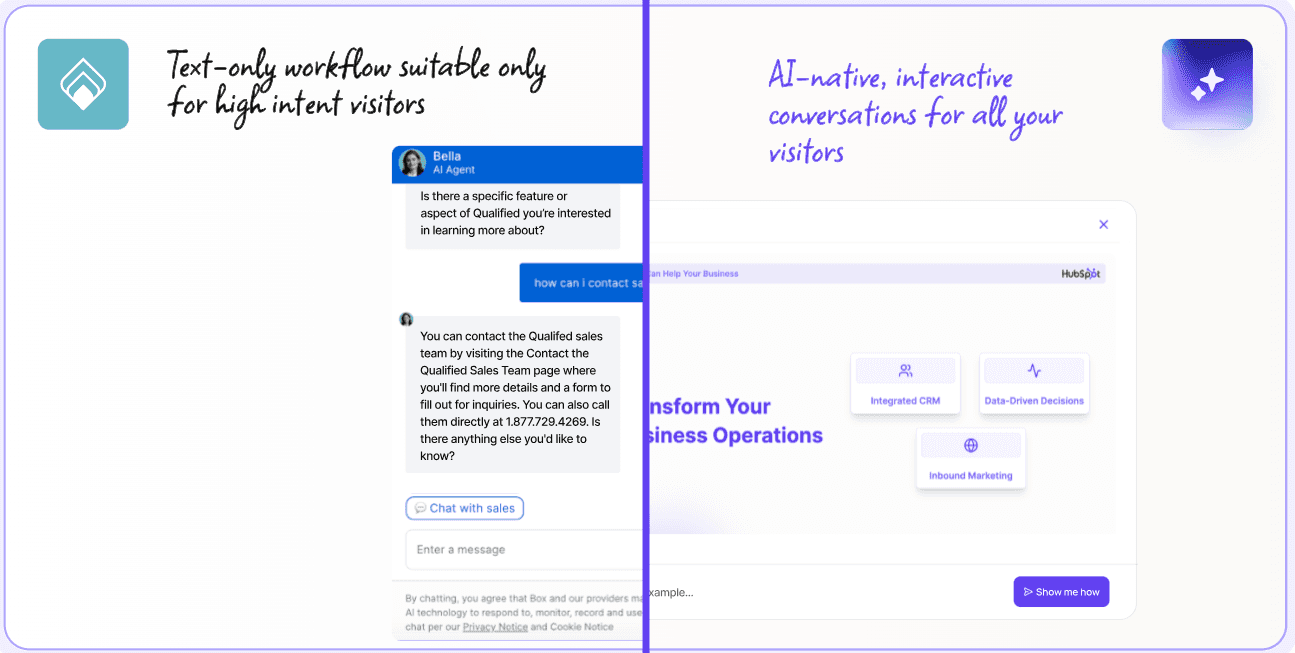
The difference sounds subtle.
Operationally, it changes almost everything:
Rep dependency
Workflow maintenance
Time-to-value
Visibility into anonymous traffic
After-hours conversion
Pipeline scalability
In this guide, we will compare Breakout vs. Qualified across the areas that matter most to modern B2B revenue teams, including:
AI autonomy
Visitor identification
Conversational engagement
CRM flexibility
Setup complexity
Inbound-led outbound workflows
Overall pipeline generation
By the end, you will have a clearer understanding of which platform fits modern GTM teams better in 2026.
TLDR: Breakout vs. Qualified at a Glance
Category | Breakout | Qualified |
Core Focus | Autonomous inbound conversion | Conversational marketing and live engagement |
Engagement Model | Handles qualification and engagement automatically | Routes visitors to live reps |
Visitor Identification | Identifies companies and individual visitors in real time | Mostly company-level identification |
AI Capabilities | Handles qualification, routing, follow-up, and buyer engagement | AI mainly supports rep workflows |
Rep Dependency | Lower | Higher |
Workflow Management | Minimal manual setup | Heavy workflow and routing management |
CRM Flexibility | Supports multiple CRMs | Deep Salesforce dependency |
Setup Time | Faster implementation | Longer onboarding and configuration |
Inbound-Led Outbound | Included | Limited |
Follow-up Workflows | Personalized automated outreach | Basic nurture flows |
Best For | Teams prioritizing scalable pipeline generation | Teams prioritizing live chat engagement |
Operational Overhead | Lower | Higher |
Time-to-Value | Typically weeks | Often months |
Before getting into the detailed comparison, let’s understand how each tool works.
Breakout: Built for Autonomous Inbound Conversion
Breakout is not trying to become another chatbot platform.
The platform is designed around a larger operational goal – converting inbound traffic into qualified pipeline without increasing SDR dependency.
That distinction matters because most inbound workflows break after the website session ends.
A visitor lands on the site. They explore pricing, integrations, product pages, and maybe a case study. They show intent.
Then one of two things happens:
They book a meeting
They disappear
Most platforms are optimized only for the first outcome.
Breakout is built to operate across both.
The workflow starts with identification.
Breakout identifies companies visiting the website and, in many cases, the individual buyer as well. Visitor profiles are enriched in real time using behavioral signals, CRM activity, and engagement context.
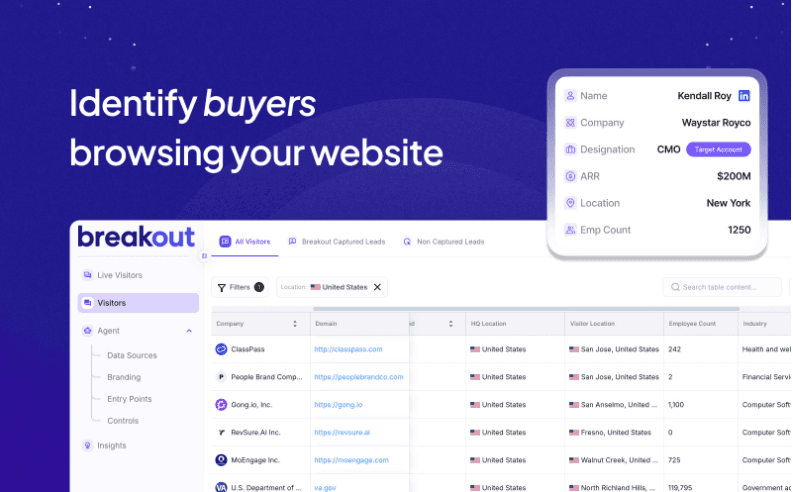
That context shapes the conversation dynamically.
A first-time visitor browsing product pages receives a different experience from a returning enterprise buyer evaluating integrations or implementation details. The system adapts qualification, prompts, and engagement paths based on intent rather than static chatbot flows.
This reduces one of the biggest operational burdens inside conversational marketing systems: workflow maintenance.
Most traditional platforms require teams to continuously manage:
Routing logic
Qualification paths
Decision trees
Territory mapping
Conversational branches
Breakout abstracts much of that complexity away.
Teams define workflows in plain language while the platform handles execution dynamically.
The more important difference appears after visitors leave the site.
It continues engagement using website behavior and buying signals to trigger personalized follow-up workflows automatically. High-intent visitors who never filled out a form can still enter outbound sequences based on real browsing activity.
This is where many conversational platforms stop short operationally.
They generate intent signals. But they rely on separate outbound systems, SDR intervention, or manual follow-up processes to capitalize on them.
Breakout keeps the workflow connected.
For lean GTM teams, that matters more than feature depth alone.
Qualified: Built for Rep-Assisted Conversational Marketing
Qualified is also an AI SDR that helps B2B revenue teams identify high-intent website visitors and engage them.
Its core strength is “pouncing” on visitors while buyer intent is still high.
The platform routes visitors to available reps quickly to accelerate sales conversations.
Qualified also includes AI features like automated chat, lead qualification, and meeting booking.
For Salesforce-centric companies, Qualified works as a conversational engagement platform tied closely to SDR workflows.
The platform offers:
Live website chat
AI-assisted conversations
Lead routing and handoffs
Meeting scheduling
Salesforce-based personalization
Workflow automation inside SFDC
However, the platform still depends heavily on rep availability and operational setup.
Most workflows require ongoing management inside Salesforce.
As teams scale, maintaining routing logic and qualification workflows becomes increasingly complex.
This becomes especially challenging across multiple territories, segments, and buyer journeys.
Qualified’s AI mainly supports reps instead of operating as an autonomous inbound SDR.
Qualified works best when:
Reps are online and actively responding
Salesforce architecture is already mature
Teams manage workflow complexity internally
The GTM motion depends heavily on live conversations
For companies focused on improving speed-to-lead, Qualified can still be effective.
But teams prioritizing AI-led conversion often need more autonomous execution and lower operational overhead.
Breakout vs. Qualified: Where the Differences Actually Matter
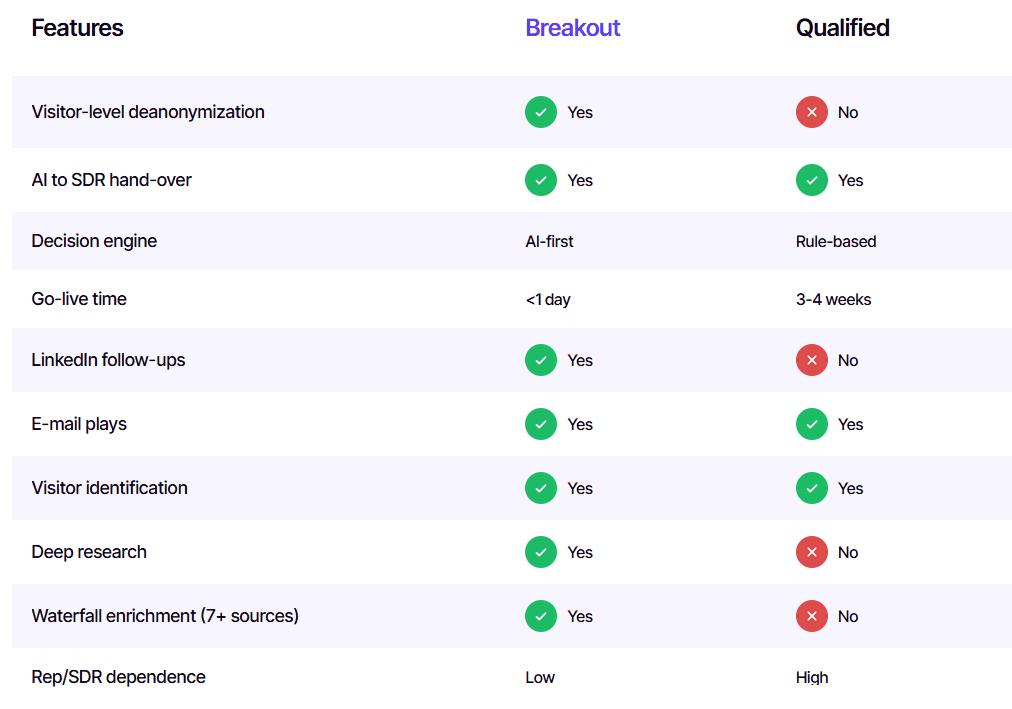
At a feature level, Breakout and Qualified look similar.
Both help teams engage website visitors, qualify buyers, route conversations, and book meetings.
That is not where the real buying decision happens.
The actual difference is operational.
Qualified is built around accelerating live sales engagement. Breakout is built around reducing how much manual involvement is required before pipeline creation.
Those are very different workflow philosophies.
The distinction becomes clearer as teams scale conversational programs across:
Multiple segments
Larger territories
Higher inbound volume
Leaner SDR teams
More complex buying journeys
The platforms start solving different problems entirely.
1. AI Autonomy
Qualified still treats reps as the center of the conversion workflow.
Its AI capabilities mainly support routing, chat engagement, and qualification before handing conversations to SDRs. That works well when sales coverage is strong, and reps are consistently available.
Breakout pushes much more of the workflow into the platform itself.
Qualification, buyer engagement, follow-ups, routing, and conversation management happen automatically throughout the session.
Conversations adapt dynamically based on visitor behavior, CRM context, and intent signals instead of relying heavily on predefined workflows.
The practical difference is operational dependency.
One platform accelerates rep workflows. The other reduces how much rep involvement is required in the first place.
Capability | Breakout | Qualified |
AI Architecture | AI-native | Rep-first with AI layers |
Qualification | Autonomous | Rep-assisted |
Conversation | Dynamic and adaptive | More workflow-dependent |
Rep Dependency | Lower | Higher |
After-hours Coverage | Strong | More limited |
2. Visitor Identification
Most conversational marketing platforms identify accounts.
The more useful question is whether they identify actual buyers early enough for the workflow to matter.
Breakout uses multiple enrichment providers to identify not only the company visiting the site, but often the individual buyer as well. Visitor profiles enrich in real time while the session is still active.
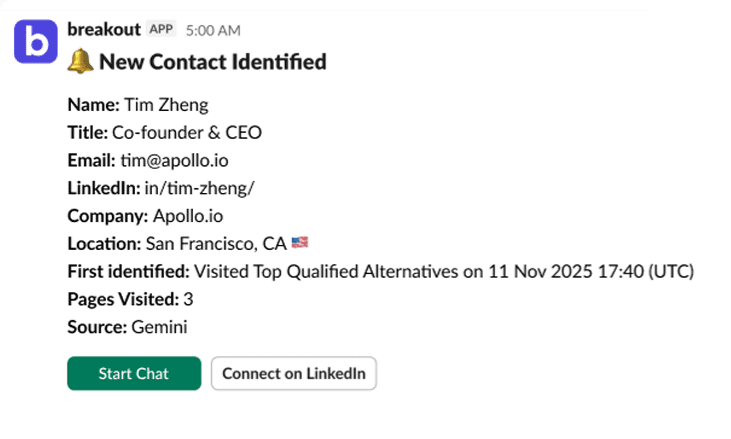
That changes personalization quality significantly.
A company-level signal tells you traffic exists. Person-level visibility tells you who is evaluating the product and how aggressively the system should engage.
Qualified relies more heavily on:
IP matching
Existing Salesforce records
Cookie recognition
That creates less visibility into anonymous inbound traffic, especially earlier in the buying journey.
Capability | Breakout | Qualified |
Visitor Identification | Company and person-level | Mostly company-level |
Identification Method | Multi-provider enrichment waterfall | IP matching and Salesforce cookies |
Real-time Enrichment | While visitors are browsing | More limited |
Anonymous Visitor Coverage | Extensive | Partial |
Personalization Context | High | Moderate |
3. Conversational Engagement
This is where the architectural gap becomes more visible.
Breakout treats conversations as dynamic qualification workflows.
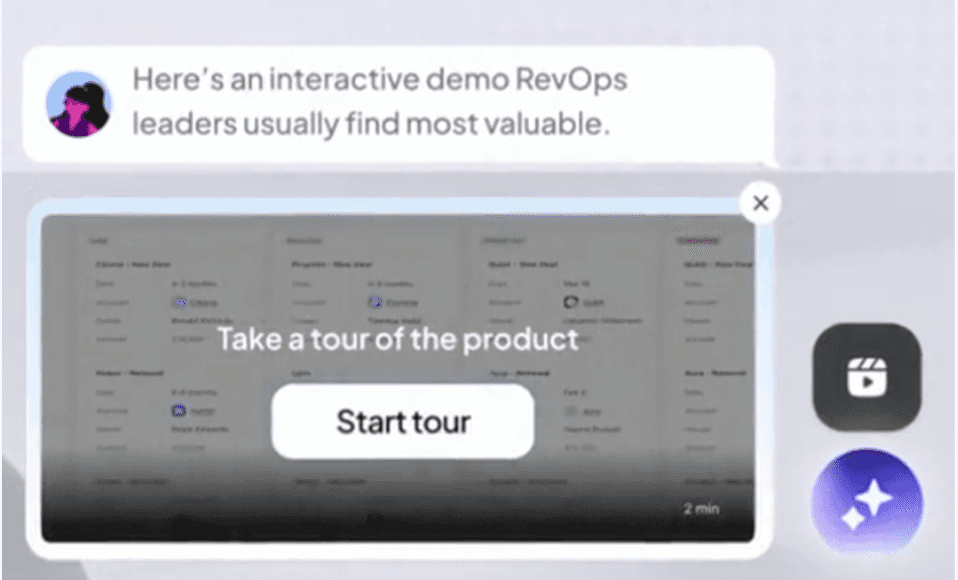
The platform adjusts engagement based on:
Browsing behavior
CRM activity
Intent signals
Journey stage
The hidden advantage is operational simplicity.
Most teams underestimate how quickly conversational workflow management becomes difficult at scale. Routing paths multiply. Decision trees expand. Qualification logic duplicates across segments.
Breakout reduces much of that operational overhead by allowing teams to define workflows in plain language while the platform manages execution dynamically.
Qualified relies more heavily on structured workflows and Salesforce-based orchestration.
That works well in mature RevOps environments. But maintenance requirements increase alongside complexity.
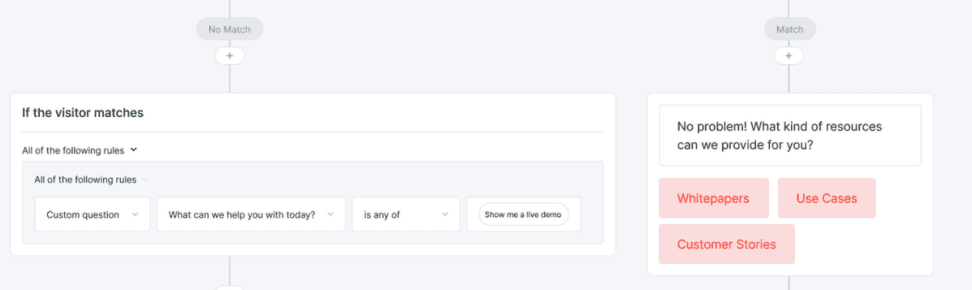
The workflow works well until scale introduces operational drag.
Capability | Breakout | Qualified |
Engagement Model | Autonomous AI-led engagement | Rep-assisted engagement |
Workflow Management | AI-managed workflows | Manual rule-based workflows |
Personalization | Session-aware and CRM-aware | Salesforce-based |
Conversation Style | Dynamic and adaptive | Structured workflows |
AI Conversion | Handles engagement independently | More rep-dependent |
Rep Availability Dependency | Low | High |
Follow-up Workflows | Automated AI follow-up | Basic nurture flows |
4. CRM Flexibility
Qualified operates most effectively inside Salesforce-centric environments.
For organizations already deeply invested in Salesforce workflows, that can feel operationally natural.
The tradeoff is dependency.
As conversational workflows expand, so does the amount of:
Routing configuration
Workflow management
Operational coordination
Salesforce administration
required to maintain the system cleanly.
Breakout operates more independently across modern GTM stacks.
Teams can integrate multiple CRMs without building extensive operational logic directly inside Salesforce first. That reduces implementation friction and shortens deployment timelines.
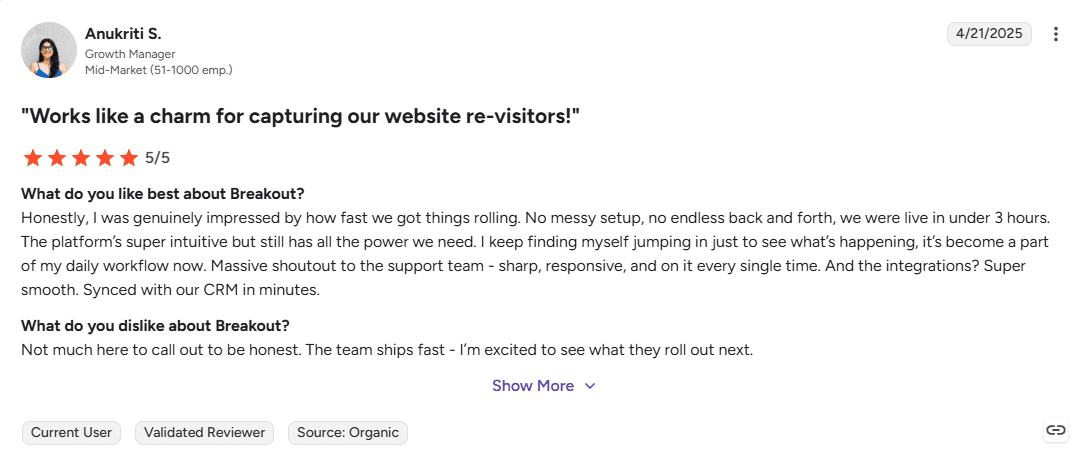
The hidden cost in conversational platforms is rarely the software itself.
It is workflow maintenance.
Capability | Breakout | Qualified |
CRM Compatibility | Supports multiple CRMs | Primarily Salesforce-focused |
Salesforce Dependency | Lower | High |
Implementation Complexity | Faster and simpler deployment | More operational setup required |
Workflow Management | Less CRM-heavy configuration | Deep SFDC workflow dependency |
Reporting Visibility | Available outside CRM workflows | SFDC-native reporting |
5. Onboarding and Setup time
This is often where platform differences become obvious internally.
Breakout is designed to reduce onboarding friction. Much of the qualification logic, engagement flow, and routing execution happens automatically, which means teams spend less time configuring operational workflows manually.
Most companies can launch without:
Long implementation cycles
Heavy Salesforce customization
Extensive RevOps coordination
Qualified usually requires more operational setup upfront.
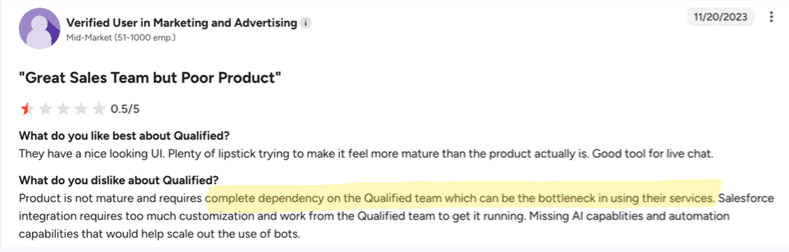
As workflows scale across territories and segments, teams often spend significantly more time maintaining routing rules, qualification logic, and conversational paths inside Salesforce.
That is not necessarily a flaw.
It simply reflects the type of workflow architecture the platform was originally designed around.
Capability | Breakout | Qualified |
Deployment Speed | Faster | Slower |
Technical Setup | Minimal | More complex |
Operational Overhead | Lower | Higher |
Time-to-Value | Weeks | Often months |
6. Inbound-Led Outbound Workflows
This is probably the clearest separation between the two platforms.
Most conversational marketing systems stop once the website session ends.
Breakout continues engagement after visitors leave the site.
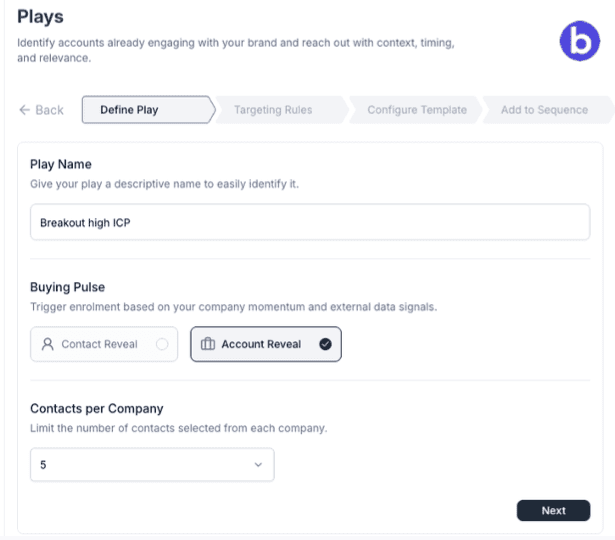
The platform uses:
Browsing behavior
Intent signals
Visitor enrichment
Engagement history
to automatically trigger personalized outbound follow-up workflows.
This allows teams to prospect high-intent visitors who never filled out forms or started conversations directly.
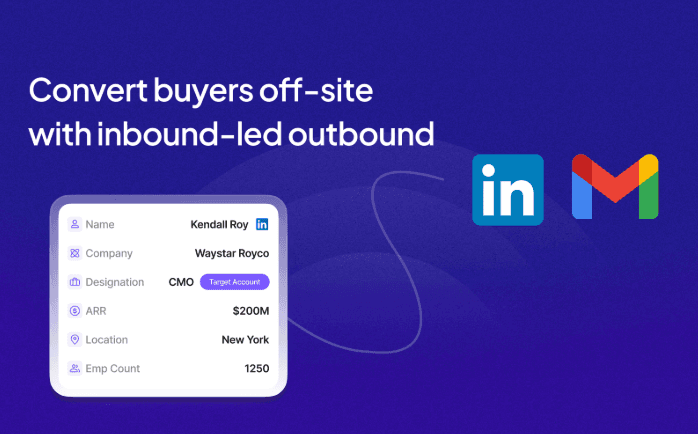
Qualified focuses more heavily on live website engagement and follow-up workflows tied to existing hand-raisers.
The result is a narrower inbound capture model.
And increasingly, that matters.
Modern buying journeys stay anonymous much longer than most conversational marketing systems were originally designed for.
Capability | Breakout | Qualified |
Follow-up Workflows | Personalized AI-driven outreach | Basic nurture and follow-up emails |
Visitor Prospecting | Website signal-based prospecting | Limited |
Outbound Activation | Inbound-led outbound workflows | Primarily inbound-focused |
Anonymous Visitor Re-engagement | Supported | More limited |
Post-session Engagement Extensive | Moderate | Often slower |
Breakout vs. Qualified Pricing
Breakout Pricing:
Breakout offers more transparent pricing compared to Qualified.
The platform separates its plans based on how teams want to use visitor identification and inbound automation.
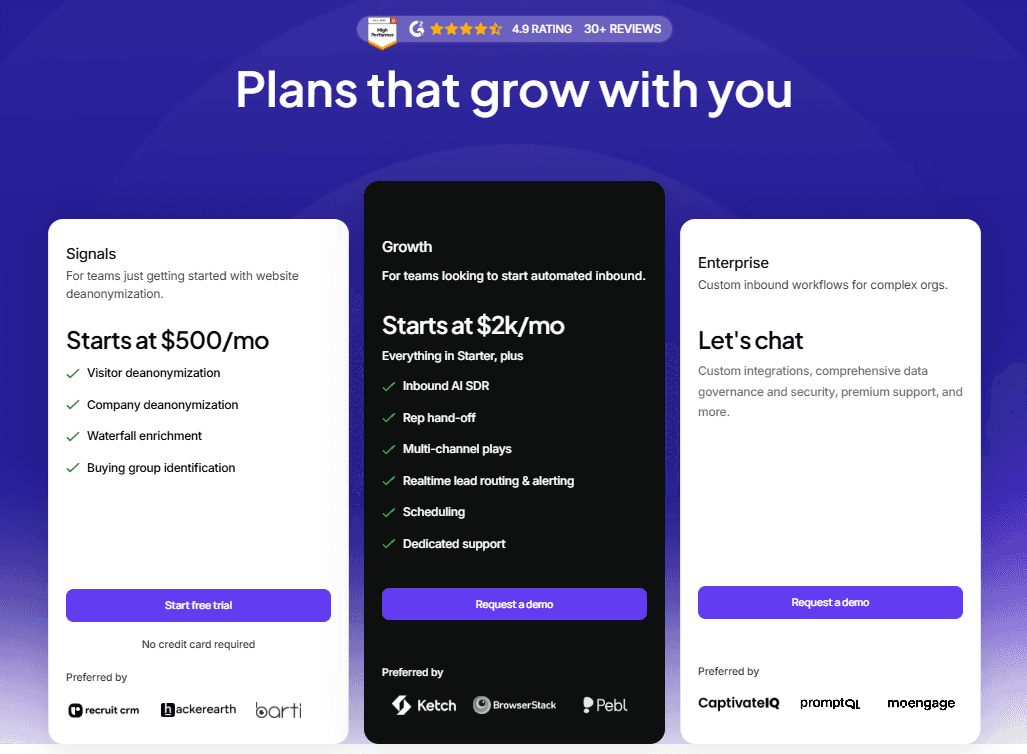
Breakout currently offers three pricing tiers:
Signals Plan
Starts at $500/month
Designed for teams getting started with website deanonymization and visitor intelligence.
Includes:
Visitor deanonymization
Company identification
Waterfall enrichment
Buying group identification
Growth Plan
Starts at $2,000/month
Built for teams looking to automate inbound conversion workflows.
Includes everything in Signals, plus:
Inbound AI SDR
Rep hand-off
Multi-channel engagement
Real-time lead routing and alerts
Scheduling
Dedicated support
Enterprise Plan
Custom pricing
Designed for larger organizations with advanced workflow, integration, security, and governance requirements.
Qualified Pricing:
Qualified does not publicly share detailed pricing on its website.
Pricing is typically customized based on:
Salesforce environment complexity
Workflow requirements
Website traffic
Team size
Conversational volume
In practice, the cost difference goes beyond subscription pricing alone.
Qualified often requires additional operational investment because many workflows depend heavily on Salesforce configuration, routing logic, and manual workflow management.
As teams scale, this can increase:
RevOps involvement
Workflow maintenance
Setup complexity
Time-to-value
Breakout takes a more streamlined approach.
Many qualification, engagement, routing, and follow-up workflows are handled automatically within the platform itself.
This reduces operational overhead and allows teams to launch faster without extensive Salesforce configuration.
For teams prioritizing:
Faster implementation
Lower maintenance overhead
Better visitor identification
Automated qualification
Inbound-led outbound workflows
Breakout often delivers a more efficient long-term operating model compared to Qualified.
Why Breakout Fits Modern GTM Teams Better Than Qualified
The difference between Breakout and Qualified is not just feature depth.
It is operational design.
Qualified still centers much of the workflow around live rep engagement and Salesforce-managed orchestration. That works well for organizations already built around large SDR teams and mature RevOps infrastructure.
But many modern GTM teams are optimizing for something else now:
Lower operational overhead
Faster deployment
Better visibility into anonymous traffic
More scalable inbound conversion
Less dependence on manual workflow management
That shift changes how platforms get evaluated.
1. Less Workflow Maintenance Over Time
Most conversational platforms become harder to manage as workflows scale.
Routing logic expands.
Qualification paths multiply.
Different territories and segments require separate maintenance. Over time, conversational systems start behaving more like operational infrastructure projects than inbound conversion tools.
Qualified still depends heavily on structured workflows inside Salesforce.
Breakout reduces much of that maintenance burden.
Teams define qualification logic, routing behavior, and engagement criteria in plain language while the platform manages execution dynamically. The result is less operational drag as inbound programs grow.
The hidden cost in conversational marketing is usually not licensing.
It is workflow maintenance.
2. Better Coverage Beyond Business Hours
Qualified performs best when reps are available to respond quickly.
That model breaks down more often than companies expect.
Modern buying behavior does not happen neatly during SDR coverage windows. High-intent visitors research products late at night, across time zones, and between meetings. Many of the strongest buying signals happen when sales teams are offline.
Breakout continues progressing conversations without depending heavily on rep availability.
The platform handles:
Qualification
Buyer guidance
Follow-ups
Meeting progression
Contextual engagement
automatically throughout the session.
And when visitors leave without converting, the workflow does not stop there.
Follow-up continues based on browsing behavior and intent signals.
3. More Visibility Into Anonymous Buyers
Most conversational platforms identify accounts.
Breakout focuses more heavily on identifying the actual buyer behind the session.
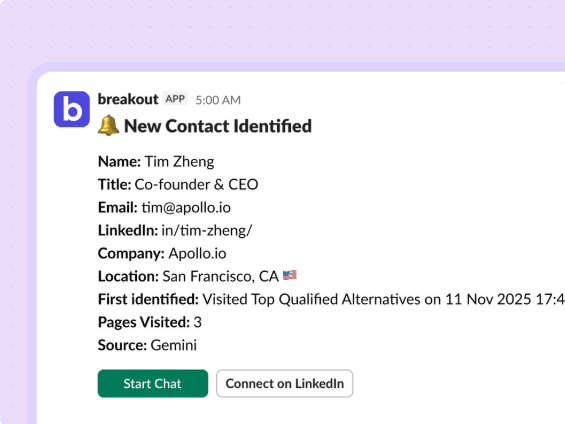
The platform enriches visitor profiles in real time while they are still active on the website, often identifying both the company and the individual visitor before any form submission happens.
That changes engagement quality significantly.
The earlier the intent becomes visible, the earlier qualification and personalization can adapt around it.
Qualified relies more heavily on:
IP matching
Existing Salesforce records
Cookie-based recognition
That creates less visibility into anonymous inbound traffic earlier in the journey.
4. The Workflow Continues After the Website Session
This is where the architectural difference becomes most visible.
Most conversational marketing platforms stop once the website conversation ends.
Breakout continues the buying journey through inbound-led outbound workflows that re-engage high-intent visitors automatically after they leave the site.
The platform combines:
Visitor identification
Intent enrichment
Qualification
Follow-up outreach
Re-engagement workflows
inside the same system.
That allows teams to continue progressing high-intent visitors who never booked meetings or started conversations directly.
Qualified supports nurture workflows, but the platform remains more centered around live website engagement and hand-raiser conversion.
As buying journeys become increasingly self-directed, that limitation becomes more noticeable.
5. Better Aligned With Modern Buying Behavior
Most buyers do not want to start with sales conversations anymore.
They want:
Immediate answers
Contextual engagement
Independent evaluation
Faster research workflows
Flexible progression
before speaking with a rep.
Breakout aligns more naturally with that buying behavior because the platform is designed to keep the buying journey moving continuously without requiring constant human intervention.
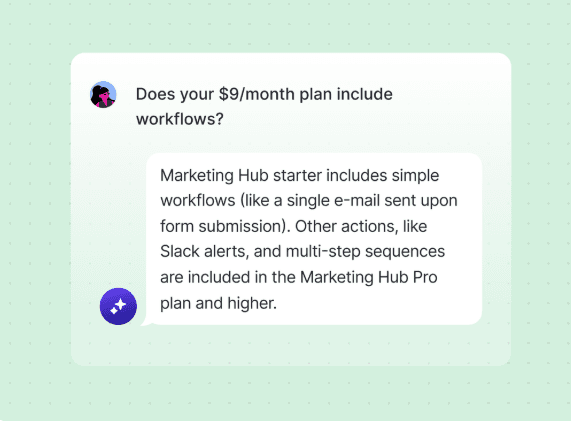
For teams prioritizing:
Faster time-to-value
Leaner SDR operations
More scalable inbound conversion
Better activation of anonymous traffic
Lower workflow complexity
Breakout often becomes the stronger long-term operational fit.
Experience Better Conversion With an Inbound AI SDR
Qualified remains one of the strongest conversational marketing platforms for Salesforce-centric organizations with mature SDR workflows.
It still performs well in environments where live rep engagement drives conversion.
But many modern revenue teams are now solving for different operational constraints:
Lower SDR dependency
Better visibility into anonymous traffic
Faster deployment
Reduced workflow maintenance
Inbound-led outbound execution
More scalable pipeline generation
That is where Breakout fits better.
The platform is less focused on helping reps engage visitors faster and more focused on converting buying intent continuously across the full inbound journey.
For teams evaluating conversational marketing software in 2026, that architectural difference matters more than feature parity alone.
Ready to see how an inbound AI SDR can improve your pipeline generation?
FAQs
1. Is Breakout a Qualified alternative?
Yes. Breakout is a strong Qualified alternative for teams looking to improve inbound conversion through automated qualification, visitor identification, and AI-led engagement.
While both platforms engage website visitors, Breakout focuses more heavily on autonomous execution and pipeline generation.
2. What is the difference between Breakout and Qualified?
Qualified focuses primarily on conversational marketing and live rep engagement.
Breakout focuses more on autonomous inbound conversion through visitor identification, AI-led qualification, automated follow-up, and inbound-led outbound workflows.
3. Does Qualified require Salesforce?
Qualified works most closely within the Salesforce ecosystem.
Many workflows, routing rules, and conversational experiences depend heavily on Salesforce configuration.
4. Can Breakout identify anonymous website visitors?
Yes.
Breakout uses multiple enrichment providers to identify both companies and individual visitors in real time, even before form submissions happen.
5. Which platform is better for AI SDR workflows?
Breakout is better suited for AI SDR workflows because the platform handles qualification, engagement, routing, and follow-up more autonomously.
Qualified remains more dependent on rep-assisted engagement workflows.
6. Does Breakout support inbound-led outbound?
Yes. Breakout can automatically follow up with high-intent website visitors using personalized outbound workflows based on browsing behavior and intent signals.
7. Is Qualified more chat-focused than AI-focused?
Qualified remains more centered around live website engagement and conversational routing.
Its AI capabilities support those workflows rather than replacing them entirely.
8. Which platform is easier to implement?
Breakout generally requires less workflow configuration and operational setup.
Qualified implementations often involve more Salesforce configuration and workflow management.
9. Can Breakout work without live reps online?
Yes. Breakout continues engaging, qualifying, and following up with visitors even when sales teams are offline.
10. What are the best Qualified alternatives in 2026?
Some of the top Qualified alternatives in 2026 include:
Intercom
6sense Conversational Email
Conversica
For teams prioritizing autonomous inbound conversion and lower operational overhead, Breakout stands out as one of the strongest options available today.