All Blogs
A quick look at better options than Drive Revenue.

Evan Marshall
Senior Growth AI Strategist
Published On

TL;DR
Visitor identification is table stakes for modern B2B teams
Factors.ai helps you see who visited, but not act on it
Attribution tools explain behavior after the visit, not during it
Conversion now depends on engaging buyers while the intent is live
Breakout uses that same data to engage, qualify, and book meetings in real time
The shift is from analyzing traffic to converting it into a pipeline
Knowing your visitors is non-negotiable in the current market.
Several B2B companies already use visitor identification tools to analyze website data and create targeted campaigns.
Fast-growing SaaS companies like Notion and Airtable rely on these tools to understand buying intent and personalize outreach.
Most serious B2B teams have already made this shift. If a company is not using a visitor identification tool in 2026, it is already way behind.
Tools like Factors.ai became popular for a reason. They’re strong at attribution. They tell you who visited, where they came from, and what they looked at.
So why even look for alternatives to Factors.ai?
Because in 2026, identification and attribution alone aren’t enough.
New platforms like Breakout do not just identify visitors. They engage and convert them directly on your website. In many cases, your website can now convert more buyers than any single campaign ever could.
On top of this, Factors.ai has its own limitations in action and execution.
So if you are looking for better Factors.ai alternatives, this article is for you.
We have reviewed each tool and its use cases to help you make a clearer decision. You will see what Factors.ai does well, where it falls short, how the alternatives differ, and which platform fits your goals best.
First, Let's Understand Factors.ai Better!
Factors.ai is built for B2B teams that want clearer visibility into website traffic and attribution.
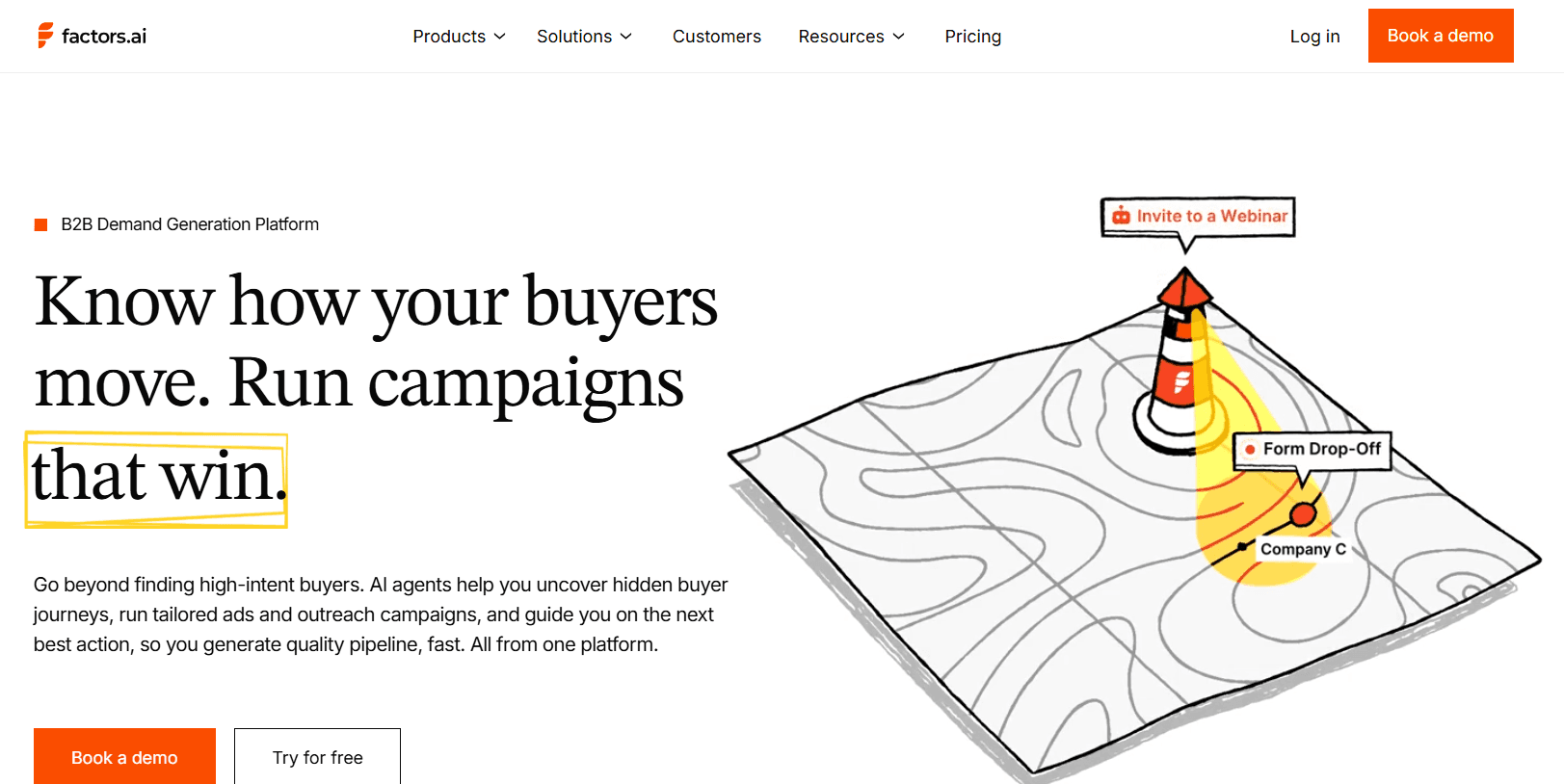
At a basic level, it helps you see which companies are visiting your site, where they came from, and how different touchpoints connect over time.
For teams dealing with long sales cycles and multiple stakeholders, this kind of clarity is useful. It brings structure to data that is otherwise scattered across tools.
Marketing and sales teams often use Factors.ai to answer practical questions.
Which channels are driving the right accounts
Which pages attract serious buyers
How paid, organic, and outbound efforts contribute before a lead ever converts
For reporting and budget decisions, this insight matters
This is where Factors.ai fits. It brings structure to fragmented attribution data and helps teams move beyond basic analytics.
So, Why Do Businesses look for Factors.ai Alternatives?
Factors.ai is built mainly for insight.
It tells you who visited your site and what they did. It stops there. There is no real-time engagement. No way to influence the visit while the buyer is still on your website.
For teams that only need attribution, this works fine.
For teams focused on speed, conversion, and pipeline creation, it starts to feel limiting.
As inbound becomes a core growth channel, insight alone is not enough. Teams want tools that do something with intent, not just report on it later.
Here are the main reasons businesses start looking elsewhere.
1. Learning curve and complexity
Some users report that bringing Factors.ai up to full value takes time.
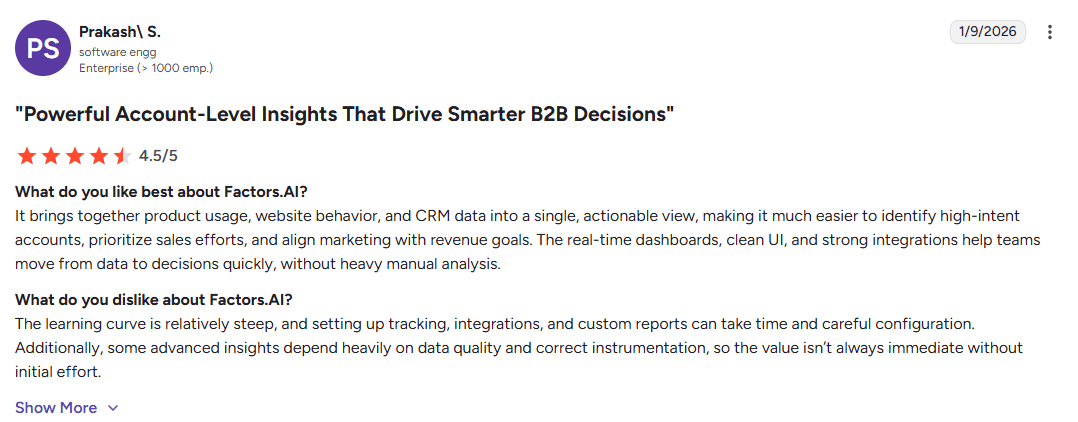
Setting up tracking, integrations, and reports can be complex. Teams without dedicated analytics support often find that this slows them down.
2. Limited actionability
Factors.ai shows which accounts engage and how they move across pages and channels. That visibility is useful for understanding behavior after the visit.
However, it does not act on that data while visitors are still on the site. The insight remains passive.
Breakout takes a different approach. It uses the same visitor data to engage buyers in real time, qualify intent, and guide high-intent visitors toward a meeting.
Instead of reviewing intent later, teams can influence the outcome while the buyer is still present.
This difference becomes important when the goal shifts from reporting to conversion.
3. Cost versus impact
Teams are shifting spend toward tools that help generate pipeline directly.
Platforms that identify visitors and then engage, qualify, and book meetings are becoming more appealing because they deliver measurable action, not just reporting.
This is where many teams begin exploring alternatives. Not to replace insight, but to turn it into pipeline.
These are the main reasons businesses start looking for Factors.ai alternatives. Let’s take a closer look at the top options next.
The Top Eight Factors.ai Alternatives that Drive Revenue
Not all Factors.ai alternatives solve the same problem. Some tools focus on attribution and reporting. Others focus on visibility.
A smaller set focuses on conversion. That difference matters in 2026, when websites are expected to do more than collect data.
B2B teams use the tools below to understand who is visiting their site and how to act on that intent.
Each takes a different approach, depending on whether the goal is insight, engagement, or pipeline.
1. Breakout
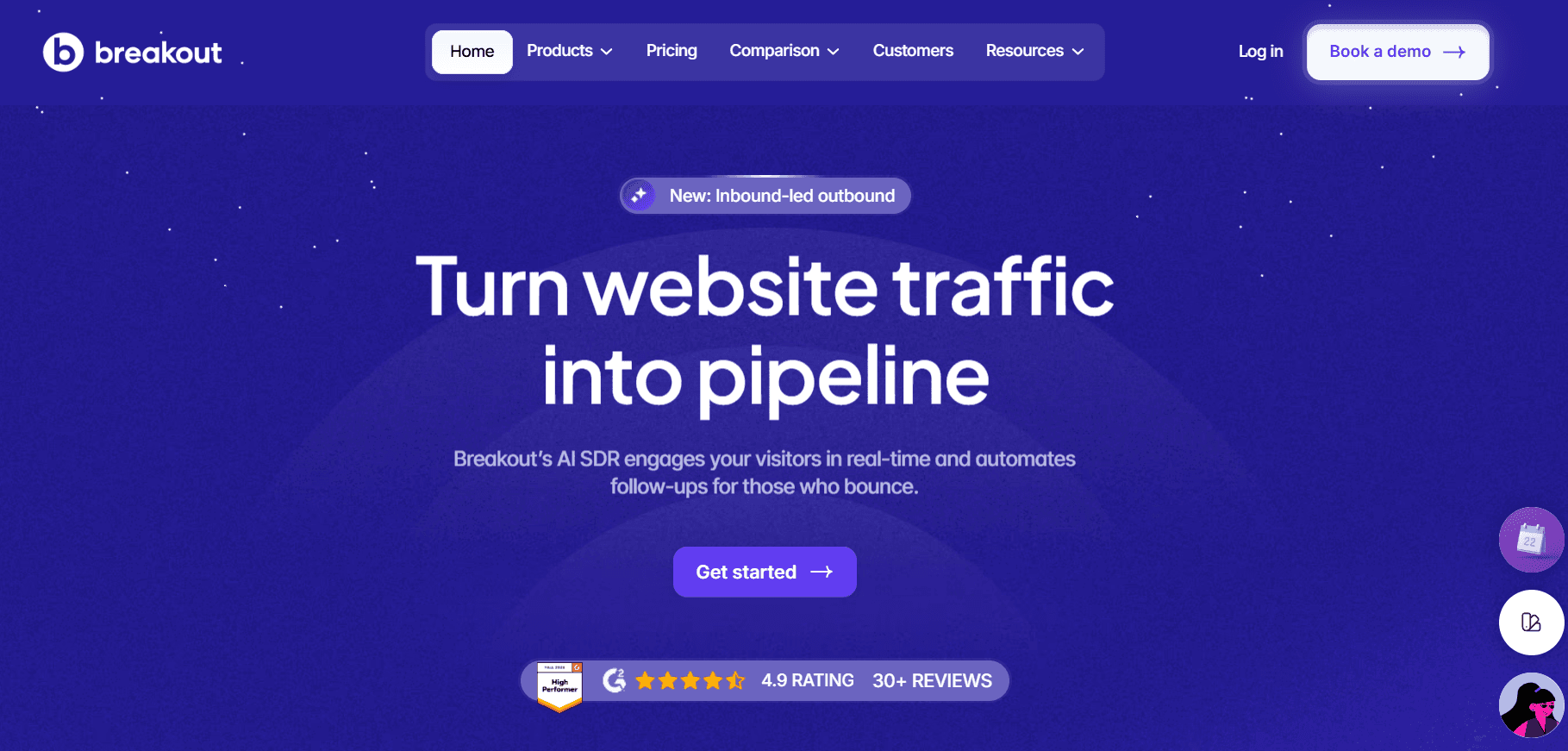
Breakout is built for teams that want their website to create pipeline actively.
It identifies visitors at the company level and engages them instantly using an AI SDR. Instead of waiting for a form fill, Breakout qualifies buyers while intent is highest.
The focus is speed, relevance, and outcomes.
Key features
Company-level visitor identification
AI SDR that qualifies visitors in real time
Page-aware, personalized conversations
Automatic routing and meeting booking
Works with multiple CRMs
Limitations
Not designed for deep historical attribution analysis
Less useful if reporting is the only requirement
Pricing
Mid-range SaaS pricing. Value is tied to meetings booked, not reports generated.
When to use
Use Breakout when inbound drives a meaningful share of pipeline
When speed-to-lead directly impacts conversion rates
When SDR capacity is limited or expensive
If you want your website to behave like a revenue channel
2. HockeyStack
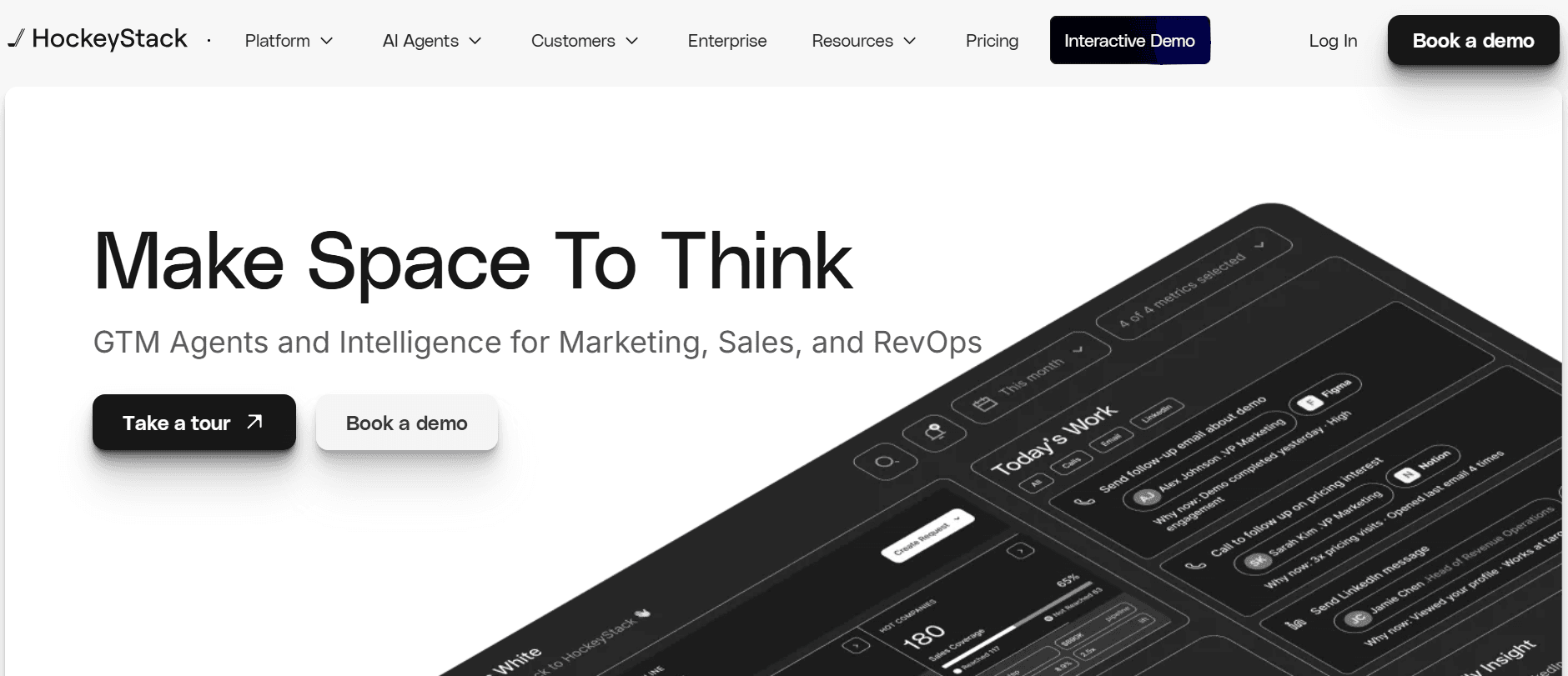
HockeyStack is designed for teams that care deeply about attribution accuracy.
It connects marketing, sales, and product data into a single revenue view. The product is built to explain what influenced revenue, not to influence buyers.
Key features
Multi-touch attribution across channels
Revenue reporting tied to campaigns
Funnel and cohort analysis
Product usage attribution
Limitations
No real-time visitor engagement
No on-site conversion or qualification
Pricing
Mid to high range. Costs increase as data complexity grows.
When to use
Use HockeyStack when leadership needs precise attribution reporting
When decisions depend on historical revenue analysis
When conversion happens mainly off-site
When analytics teams support marketing execution
3. Dreamdata
Dreamdata focuses on B2B revenue attribution with strong compliance standards.
It helps teams connect ad spend, pipeline, and closed revenue. It is commonly used by European SaaS companies with long sales cycles.
Key features
Multi-touch B2B attribution
Strong GDPR compliance
Ad spend to revenue visibility
Clear reporting for complex journeys
Limitations
No real-time engagement capabilities
Limited activation on the website
Pricing
Mid to high range. Often justified for compliance-driven teams.
When to use
When GDPR compliance is non-negotiable
When attribution accuracy outweighs conversion needs
Use it when operating mainly in European markets
4. 6sense
6sense is built for enterprise-scale account intelligence and ABM execution. It uses intent data and predictive models to identify in-market accounts.
Key features
Predictive account scoring
Intent and buying stage modeling
ABM orchestration at scale
Deep enterprise integrations
Limitations
Long setup and onboarding cycles
Requires strong ops maturity
High total cost
Pricing
Enterprise pricing only. Typically, six-figure annual contracts.
When to use
Use 6sense when running large ABM programs
When targeting hundreds or thousands of accounts
When intent data drives outbound strategy
5. Warmly
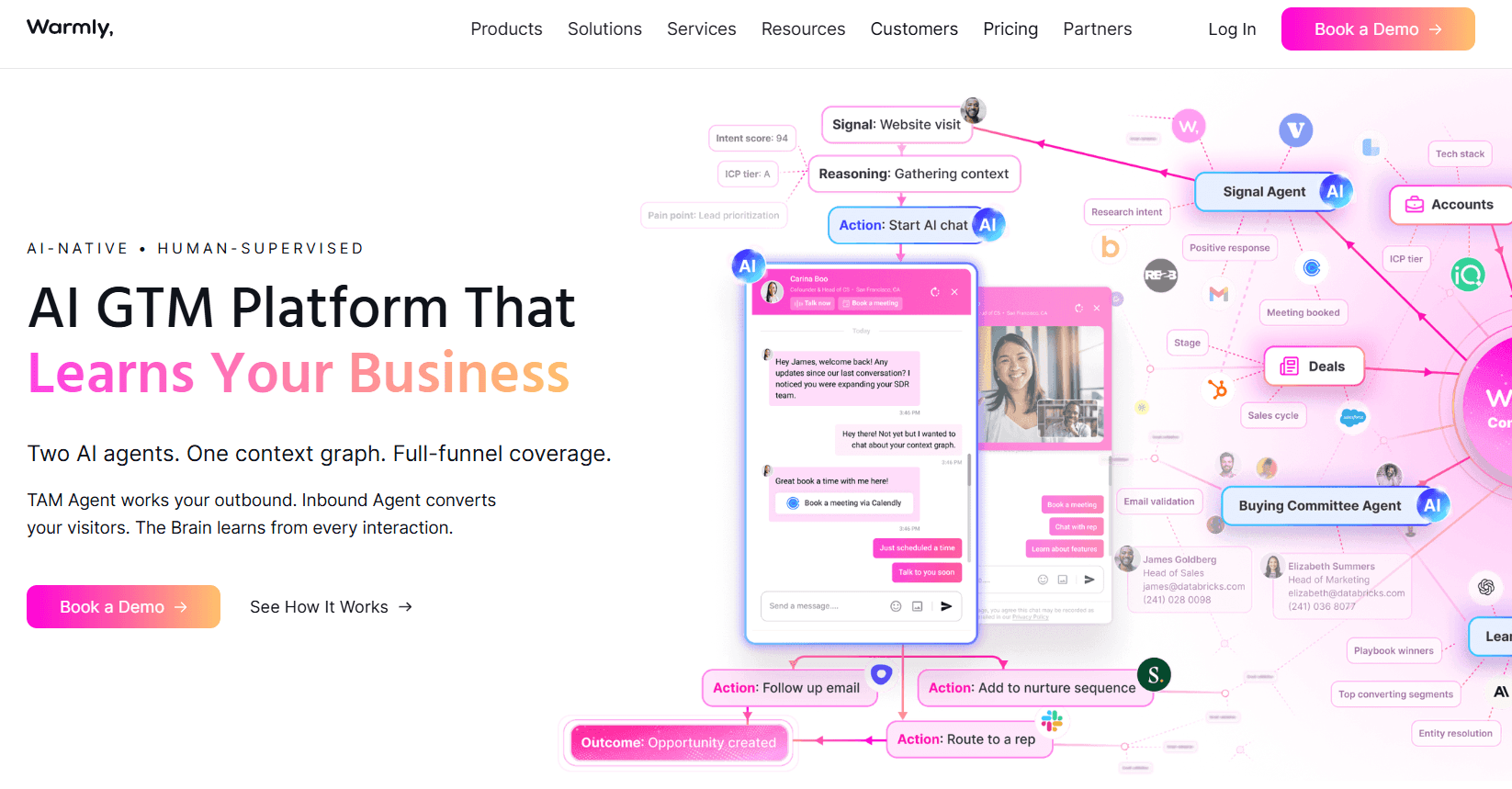
Warmly focuses on identifying visitors and triggering lightweight actions. It emphasizes alerts, chat, and internal visibility over deep qualification.
It is simpler than full SDR-style platforms.
Key features
Visitor identification
Chat overlays
Slack alerts for warm accounts
CRM enrichment
Limitations
Limited visitor qualification
Engagement is mostly chat-based
Pricing
Mid-range pricing. Lower than enterprise ABM tools.
When to use
When teams want fast signal visibility
When Slack alerts drive sales action
When chat is the primary engagement method
Use it for early-stage intent capture
6. HubSpot Marketing Hub
HubSpot Marketing Hub combines attribution, automation, and analytics. It works best for teams already committed to the HubSpot ecosystem.
For many teams, its attribution is good enough.
Key features
Native attribution reporting
Marketing automation
CRM-native workflows
Campaign analytics
Limitations
Limited visitor deanonymization
Less flexible outside HubSpot
Pricing
Starts affordable. Costs increase quickly at scale.
When to use
Use HubSpot when it is your primary CRM
When simplicity matters more than depth
When teams want one platform
When attribution needs are basic
7. RB2B
RB2B answers a simple question.
→ Who visited your website?
It avoids complex attribution and focuses on lead visibility. The product is built for speed and ease.
Key features
Company-level visitor identification
Gives out lead lists
CRM syncing
Limitations
No engagement layer
No multi-touch attribution
Pricing
Lower-cost. Accessible for small teams.
When to use
Use RB2B when simplicity is the priority
When teams want quick lead lists
When attribution is unnecessary
Use it for basic outbound follow-up
8. Vector
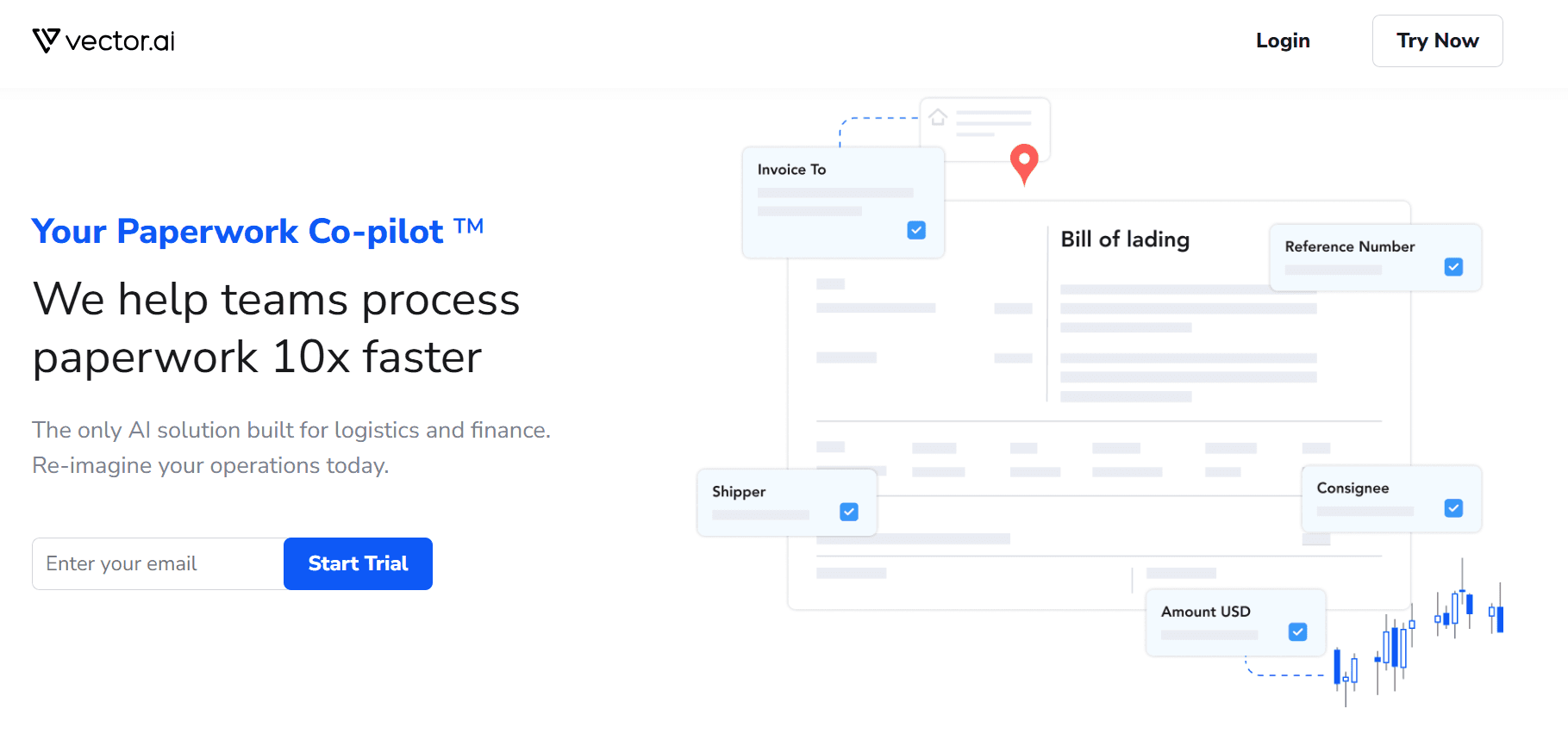
Vector focuses on activating visitor data inside paid media. It helps teams retarget accounts that show on-site intent.
The product is ad-focused, not conversion-focused.
Key features
Visitor identification
Account-based ad targeting
Ad platform syncing
Limitations
No on-site engagement
Limited attribution depth
Pricing
Mid-range pricing. Often tied to ad spend.
When to use
When paid media drives pipeline
When ad targeting efficiency matters most
Use it when activation happens off-site
Use it for account-based advertising strategies
Comparison table: Factors.ai features vs Factors.ai alternatives features
The table below shows how Factors.ai compares with its alternatives across these core capabilities. It highlights where each platform focuses and, just as importantly, where it stops.
Some tools are strong at attribution and reporting, but do not help convert visitors. Others focus on visibility or light engagement. A smaller group uses visitor data to actively influence website outcomes.
This comparison makes one thing clear. Visitor identification alone is no longer the differentiator. What matters is whether the platform helps turn that intent into revenue.
Platform | Visitor identification | Attribution and reporting | Conversion to pipeline |
Factors.ai | Yes | Yes | No |
Breakout | Yes | Limited, but uses the data to simplify and improve on-site conversion | Yes, identifies, qualifies, and converts visitors into meetings |
HockeyStack | Yes | Strong | No |
Dreamdata | Yes | Strong | Limited |
6sense | Yes | Strong | Limited |
Warmly | Yes | No | Limited |
HubSpot Marketing Hub | Yes, but limited | Moderate | No |
RB2B | Yes | No | No |
Vector | Yes | Limited | No |
How to Choose the Best Factors.ai Alternative for your Goal?
The right Factors.ai alternative depends on what you actually want your website to do.
Some teams want faster conversion
Some want cleaner attribution
Some want a mix of insight and light engagement
Before comparing tools, be clear on the outcome you care about most. That choice narrows the field quickly.
Below is a simple way to break it down.
1. If your priority is converting faster
Choose Breakout.
Breakout is built for teams that want their website to create pipeline, not just collect data. It identifies visitors, engages them while they are still on the site, and converts intent into meetings. This works especially well when inbound traffic is strong and speed-to-lead matters.
Choose this path if your goal is more meetings without adding SDR headcount.
2. If your priority is pure identification and attribution
Look at tools like HockeyStack and Dreamdata.
These platforms are strong at showing who visited, where they came from, and how revenue is influenced over time. They are useful for reporting, planning, and budget decisions. They are not designed to engage or convert visitors in real time.
Choose this category if insight and attribution accuracy matter more than immediate conversion.
3. If you want identification, attribution, and chatbot-style engagement
Tools like Warmly and HubSpot Marketing Hub fit well here. Breakout also works in this category, with the added advantage of deeper qualification and conversion, not just chat-based engagement.
They help identify visitors and offer basic engagement through chat or automation. This works for teams that want some action on-site but do not need full qualification or meeting booking.
Choose this option if you want visibility plus light engagement, without a full inbound SDR motion.
In short, attribution tools explain what happened. Conversion-focused platforms influence what happens next.
The best alternative is the one that matches how you want your website to drive growth.
Why Breakout Stands Out as the Best Factors.ai Alternative
Factors.ai gives you the data, but Breakout engages and converts using the data.
Instead of just showing a dashboard that says “Company X visited,” Breakout actively engages that visitor while they are still on your site. The AI agent uses page context to start a relevant conversation, qualify intent, and route qualified buyers to a meeting.
This is the real shift teams are making in 2026. Website deanonymization and attribution can be complex. It isn't enough to create pipeline.
Breakout is built for teams that want their website to influence the buying journey, not just track it.
Stop staring at dashboards and start talking to your visitors. Implement Breakout to deanonymize and convert website traffic today.
FAQs
1. Why are teams moving away from Factors.ai if it is good at attribution?
Factors.ai is strong at attribution. It clearly shows which companies visited, how they arrived, and what they engaged with.
The challenge is not data quality. It is what happens next.
Most teams now want tools that help them act on intent while the buyer is still on the site. Attribution-only tools surface insights after the visit is over, which limits their impact on conversion and pipeline.
2. Is visitor identification still important in 2026?
Yes. Visitor identification is still foundational.
What has changed is expectations. High-performing teams treat identification as the starting point, not the finish line. Knowing who visited matters, but influencing what happens during that visit matters more.
3. What is the biggest limitation of attribution-only tools?
Attribution-only tools are backward-looking.
They explain what happened, which channels influenced revenue, and how buyers moved through the funnel. They do not influence the visit itself. By the time teams review the data and act, buyer intent has often cooled or shifted elsewhere.
4. Do I need to replace Factors.ai, or can I layer another tool?
This depends on your primary goal.
If your focus is on reporting, forecasting, and understanding performance trends, layering another tool can work. If your goal is pipeline creation and faster conversion, many teams choose to replace attribution-first tools with platforms designed to engage and convert traffic directly.
5. How is Breakout different from traditional visitor identification tools?
Breakout starts with visitor identification, but it does not stop there.
It uses that data to engage visitors in real time, qualify intent, and route qualified buyers into meetings automatically. The focus is not on dashboards or reports. The focus is on turning website traffic into pipeline.
6. Which type of team should prioritize conversion-focused tools?
Teams where inbound plays a major role in growth benefit the most. This includes teams with limited SDR capacity, high inbound traffic, or long response times. It also applies to teams where speed-to-lead directly impacts win rates and revenue.
7. Are attribution tools still useful for RevOps and leadership reporting?
Yes. Attribution tools remain valuable for planning, budgeting, and performance reviews.
They help leaders understand where revenue came from and how different channels contribute over time. What they do not do is generate pipeline on their own. They support decisions, not execution.
8. How should ABM teams think about Factors.ai alternatives?
ABM teams need two things. Visibility and timing.
Knowing which accounts are visiting is useful. Acting on that information while those accounts are actively researching is what creates an advantage. Tools that combine identification with engagement tend to perform better for ABM execution.
9. Is chatbot-style engagement enough to replace attribution tools?
Chat tools help capture attention, but they are often limited.
Most chat experiences focus on surface-level interaction. They rarely qualify intent deeply or route buyers effectively. Teams that care about booked meetings, not just conversations, usually need stronger qualification and conversion workflows.
10. How do I choose the right Factors.ai alternative for my business?
Start with the outcome you want from your website.
If your priority is insight, attribution-first tools make sense. If your priority is meetings and pipeline, choose platforms built to engage visitors and convert intent into action.
The best alternative is the one that matches how you want your website to drive growth.