

All Blogs
A quick look at better options than Warmly.

Evan Marshall
Senior Growth AI Strategist
Published On

Most high-performing websites experience bounce rates of 41% to 55%.
In other words, even with an excellent user experience, more than half of visitors leave without contributing to pipeline.
Websites struggle not because of traffic but due to limited visibility.
Without knowing who is visiting, what accounts they belong to, and which pages signal intent, teams are forced to rely on form fills and delayed follow-ups.
When visitor identity and engagement data are clear, conversion becomes easier.
Even incremental gains in visitor identification and intent qualification can materially improve pipeline efficiency. This is the core value proposition of website visitor identification tools like Warmly.
Warmly has established itself as a leading B2B visitor identification platform, particularly strong in mapping anonymous traffic to known accounts and enabling human-led sales outreach.
This article explores why teams seek Warmly alternatives and reviews the top tools with a head-to-head comparison.
It also highlights how all-in-one inbound platforms like Breakout deliver stronger, more measurable results.
So why do teams look for Warmly alternatives?
Despite its market position, Warmly presents several operational and scaling gaps:
1. Human dependency
Warmly surfaces visitor identity and intent signals, but qualification and follow-up still rely on human SDR execution.
This introduces delays, inconsistency, and operational overhead for teams trying to run a faster, more automated inbound motion.
2. Limited engagement
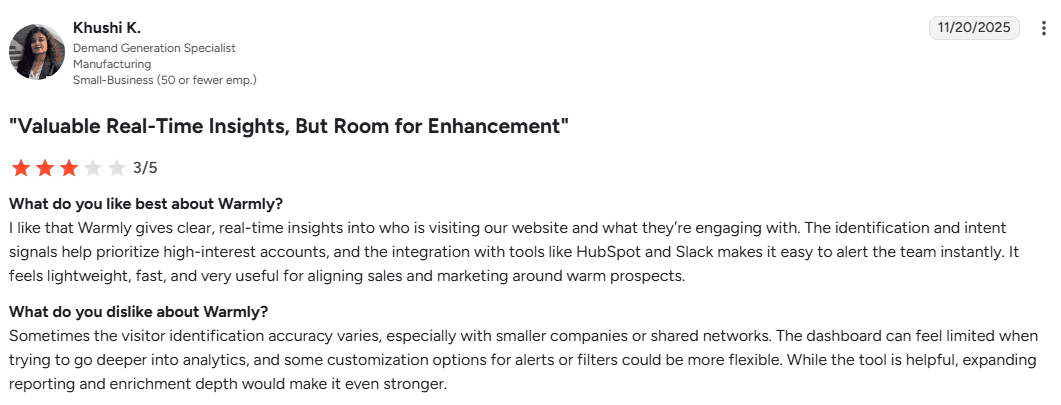
The platform primarily reports surface insights, such as which company visited the site.
Visibility into deeper engagement patterns, multi-visit behavior, and intent progression is limited, and some users report concerns around data precision when prioritizing accounts.
3. Costs rise quickly as usage expands
The pricing increases materially when teams add AI agents, advanced integrations, or API access.
For mid-market and enterprise teams, annual spend commonly reaches $10,000 to $25,000+, making scalability a budget consideration rather than a given.

4. Partial coverage of the inbound funnel
Most visitor identification tools and AI SDRs stop at identification and routing.
They do not cover conversational qualification, real-time engagement, and automated handoffs, forcing teams to stitch together multiple tools and workflows.
Platforms like Breakout manage the full inbound funnel, from first interaction through qualification and conversion, within a single system.
This allows founders and revenue leaders with an AI-first mindset to reduce tooling sprawl and move faster on inbound demand.
HackerEarth CEO Vikas Aditya adopted this approach by replacing forms and static chat with Breakout’s AI-led conversations.
The shift delivered a 2.5% lift in engagement, a 10%+ engagement-to-lead conversion rate, and influenced 21% of the Q1 pipeline.

Returning to Warmly’s limitations, it’s natural to ask which alternatives deliver better results. We researched the market to identify the most effective Warmly alternatives in 2025 that directly address these gaps.
Top Warmly Alternatives You Can Use in 2025
This section compares the most practical Warmly alternatives available in 2025.
Each tool is evaluated based on its role in the inbound funnel.
We consider the level of automation and its impact on the pipeline. This helps teams identify which option aligns best with their GTM motion and operational maturity.
1. Breakout: All-in-one Inbound ADR
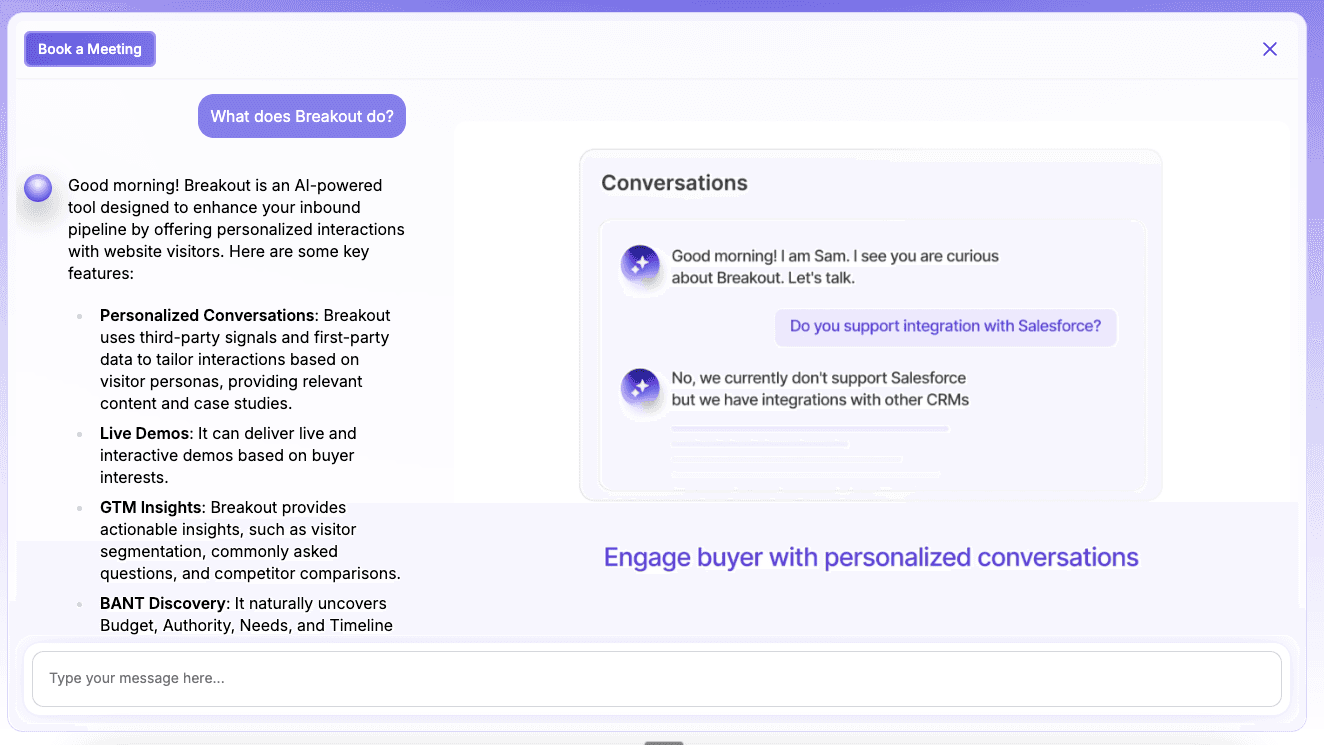
As we mentioned, Breakout goes beyond Warmly by owning the entire inbound motion.
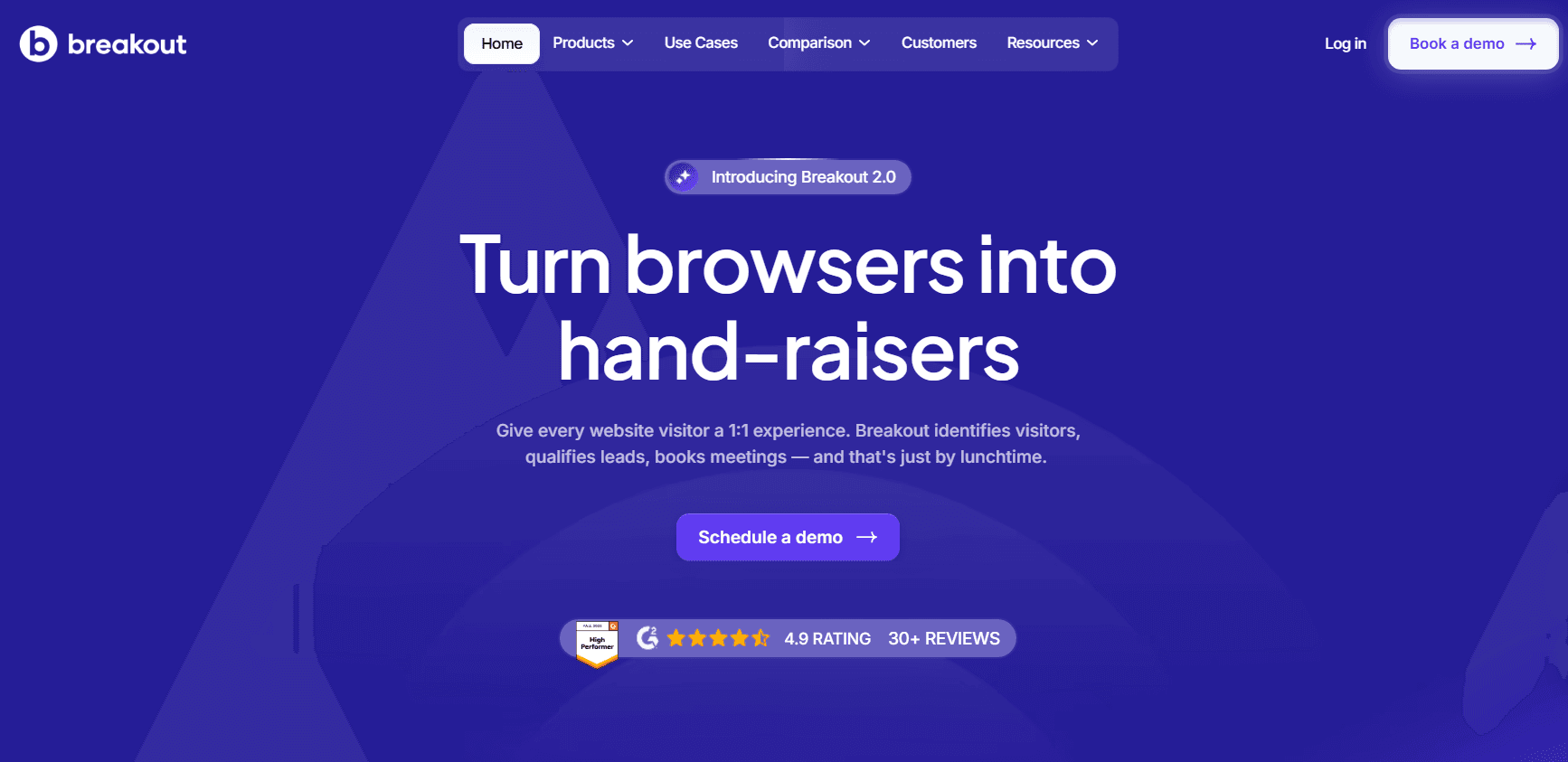
It identifies visitors in real time, runs adaptive AI conversations, qualifies intent, and books meetings automatically. Every interaction captures structured, actionable data for sales teams without relying on forms or SDR follow-up.
Unlike Warmly, Breakout converts engagement directly into measurable pipeline impact.
It personalizes conversations based on visitor role and funnel stage.
Breakout consolidates visitor identification, AI chat, qualification, and booking in a single platform.
Teams experience higher engagement, deeper qualification, and faster conversion.
Pros
Covers identification, engagement, qualification, and conversion in one platform
Real-time deanonymization enables contextual, personalized conversations
Reduces SDR workload and tool sprawl
Fast deployment with minimal setup
Cons
Requires a shift toward an AI-first inbound motion
Less manual control for teams used to rule-based flows
Review
Breakout has transformed Talowiz’s inbound conversion by turning website visitors into real-time conversations. Setup was effortless, integrating with HubSpot and Slack, while conversation summaries and lead intelligence enable precise follow-ups. The team praises its seamless execution, real-time alerts, and measurable impact on pipeline growth.
Shubhanshu S.
Founder, CEO, Talowiz
Takeaway
Breakout automates the entire inbound motion, from visitor identification to meeting booking. It delivers personalized conversations, captures actionable data, and reduces SDR workload.
Teams achieve higher engagement, faster qualification, and measurable pipeline impact without adding tools or manual effort.
2. Clearbit (HubSpot)
Clearbit enriches anonymous and known visitors with firmographic and demographic data, commonly embedded within HubSpot-centric stacks.
Pros
High data accuracy for enrichment
Shortens forms through progressive profiling
Strong HubSpot integration
Cons
Expensive at scale
No native engagement or qualification layer
Data must be activated through other tools
Review
Clearbit provides valuable visibility into website visitors, helping sales and marketing teams optimize outreach. Integration with HubSpot and Google Analytics enhances campaign targeting, while AEs can monitor active prospects. Some recent UX changes and credit-based reporting make certain visitor insights harder to read and use effectively.
Alice K.
Sr. Marketing Manager
Takeaway
Clearbit makes sense when enrichment is the priority and your workflows already live inside HubSpot. It’s most useful for improving data quality and shortening forms, not for engaging or converting visitors on its own.
3. Demandbase
Demandbase is an account-centric platform combining visitor identification, intent data, and advertising orchestration for enterprise ABM teams.
Pros
Strong third-party intent coverage
Deep enterprise integrations
Powerful account targeting
Cons
High cost and long onboarding
Complex to operate
Visitor ID is a small part of a large system
Review
Demandbase One offers an intuitive interface for targeted account-based advertising, allowing precise display ad campaigns and seamless integration with third-party platforms. While highly effective for ABM strategies, the initial setup is complex and requires technical expertise, making implementation challenging for teams without dedicated support.
Oscar F.
Marketing Specialist EMEA & LATAM
Takeaway
Demandbase is a strong fit for teams already running mature, account-centric ABM programs. If your motion revolves around target accounts, ads, and intent coverage rather than inbound conversations, this is where it shines.
4. RB2B
RB2B identifies individual visitors by name, role, and LinkedIn profile to enable fast outbound follow-up.
Pros
Person-level identification
Easy setup and Slack alerts
Strong free tier
Cons
Limited to US data
No integrated engagement or qualification
Outbound-first workflows
Review
RB2B helps sales teams uncover qualified contacts and convert website visits into deals. Setup is simple, Slack integration is seamless, and data accuracy is high. Minor effort is needed to filter bot or spam traffic, but it does not hinder overall performance or results.
Alyssa P.
Marketing Lead + Customer Success Manager
Takeaway
RB2B works well when identifying individual visitors quickly is more important than engaging them on-site. Teams using it typically rely on outbound follow-ups triggered by website activity rather than real-time interaction.
5. Vector
Vector aggregates intent signals from multiple data sources and ranks accounts and leads. It helps teams focus on high-potential opportunities and make data-driven prioritization decisions for their GTM strategy.
Pros
Combines multiple data providers
Strong scoring and prioritization logic
Cons
No engagement or execution layer
Requires manual or external activation
Review
Vector simplifies identifying and acting on buyer intent with straightforward setup and easy-to-use data. It integrates seamlessly with marketing and sales tools, requiring minimal manual work, allowing teams to prioritize leads efficiently without additional complexity or technical hurdles.
Akhil G.
Senior Marketing Manager
Takeaway
Vector is best used when lead and account prioritization is the main problem you’re solving. If your focus is on feeding high-intent accounts into ads or GTM workflows, rather than capturing demand on the website itself, it fits naturally.
6. Snitcher
Snitcher tracks visiting companies and provides visibility into website traffic. It enables teams to understand audience patterns, monitor engagement at the company level, and identify potential opportunities for follow-up.
Pros
Lightweight and easy to deploy
Affordable for SMBs
Clean, simple UI
Cons
Limited enrichment
No AI engagement or qualification
Minimal reporting depth
Review
Snitcher provides clear insights into website visitors and identifies potential ICPs. The platform is easy to use, supports multiple implementations, and comes with excellent customer support and team training. GDPR limits personal-level tracking, but Snitcher effectively surfaces actionable company-level lead data.
Gabriel S.
Business Development Manager
Takeaway
Snitcher is a good option for teams that want lightweight visibility into which companies are visiting their site. It’s simple, affordable, and useful early on, but not built for qualification or conversion.
7. ZoomInfo
ZoomInfo provides a comprehensive B2B contact and company database with intent insights. It helps sales and marketing teams identify prospects, plan outreach, and support large-scale account targeting initiatives.
Pros
Broad contact coverage
Strong outbound enrichment
Established enterprise presence
Cons
High contract costs
Visitor ID is secondary
Data freshness varies by segment
Review
ZoomInfo Sales helps teams quickly locate prospect contact information and improves email open rates with AI-powered messaging. Webtracks provides insights into website visitors for better nurture campaigns. While the volume of data can feel overwhelming, refining searches allows teams to efficiently prioritize and act on leads.
Tammy F.
Sales Director
Takeaway
ZoomInfo is typically chosen for its breadth of contact data and outbound reach. Visitor identification exists, but it’s secondary to its role as a large-scale prospecting and enrichment platform.
Why Breakout Works Better for Modern Inbound Teams
Modern inbound teams need systems that execute, not tools that only surface insights.
Breakout automates qualification, engagement, and conversion, reducing dependence on SDR availability and manual routing.
It converts deanonymized visitor data into immediate action, not delayed follow-ups.
The platform reads real-time intent signals, including page depth, repeat visits, and content engagement. These signals are injected into the AI knowledge layer, for instance, personalized qualification.
The AI agent asks qualifying questions, captures BANT data, and automatically books meetings. High-intent demand is acted on instantly, not queued or lost outside business hours.
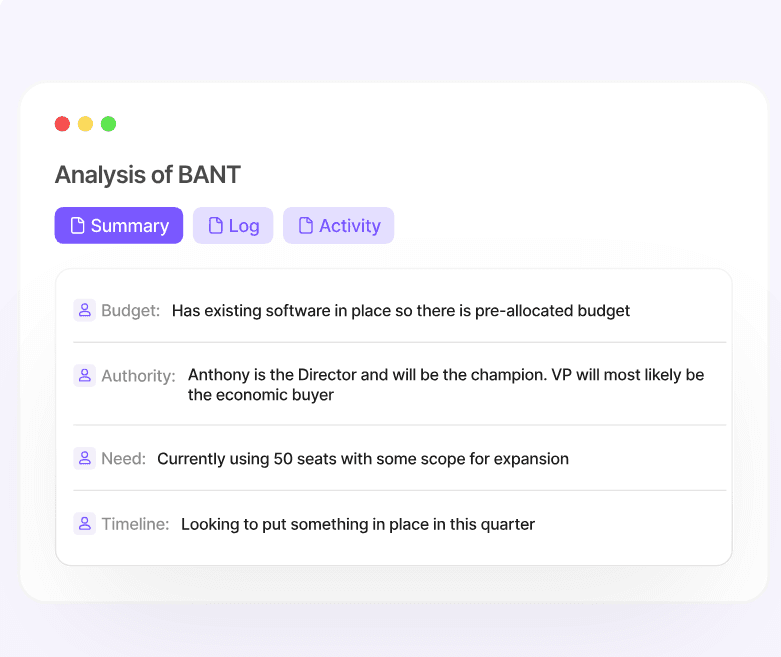
It consolidates visitor identification, AI chat, qualification, and booking into one platform. This eliminates the need for multiple inbound tools, simplifying the GTM tech stack. AI-first autonomy reduces human SDR dependency and lowers long-term operational costs.
Setup is fast, with minimal technical effort required from marketing or RevOps teams.
How Barti Modernized Inbound Conversion with Breakout
Barti rethought its inbound motion by removing manual friction across the website. Breakout replaced forms and passive chat with AI-driven, contextual conversations that guided product discovery, qualified visitors in real time, and captured demand automatically. The result was continuous inbound conversion without adding SDR headcount or expanding the tech stack.

Comparing Warmly Alternatives by Data Depth and Automation (2025)
When evaluating Warmly alternatives, teams must strike a balance between data depth, automation, and platform coverage.
Some tools excel at identifying visitors but offer limited automation. Others combine real-time B2B website visitor identification with AI-led qualification and conversion.
This table helps you compare personal-level identification, AI autonomy, all-in-one inbound coverage, and enterprise cost. It enables selection of the solution that fits your team size, inbound strategy, and pipeline goals.
Tool | Personal Level ID | AI Autonomy | All-in-One Platform | Enterprise Cost |
|---|---|---|---|---|
Breakout | Partial (derived via intent/behavior) | Full (qualify, engage, convert) | Yes (end-to-end inbound) | Moderate (scalable without extra headcount) |
Warmly | Limited (company level) | Partial (ID + routing, manual follow-up) | No (requires other tools) | High ($10K–$25K+ mid/enterprise) |
Clearbit (HubSpot) | Partial (contact reveal where available) | No (data layer only) | No (requires activation tools) | High (bundled with HubSpot Pro/Enterprise) |
Demandbase | Account-level only | No (intent + ABM signals) | Partial (ABM suite, visitor ID is one module) | Very High (enterprise pricing & setup) |
RB2B | Yes (person names/roles, US only) | No (signal only) | No (no qualification or conversion) | Low-Moderate (affordable entry plans) |
Vector / 5x5 | No (signal layer only) | No (scoring only) | No (no execution) | Moderate (depends on use case) |
Snitcher | No (company only) | No (visibility only) | No ( no qualification or conversion) | Low (SMB-friendly pricing) |
ZoomInfo | Partial (contacts in database) | No (data + outbound focus) | No (needs other tools) | Very High (enterprise contracts) |
Choose the Right Tool for Your Inbound Strategy
Your choice among Warmly alternatives depends on what you expect inbound to deliver.
Some tools surface visitor data. Others stop at routing or alerts.
Breakout is built for teams that want inbound to execute end-to-end. It uses real-time, deanonymized data to qualify visitors, run conversations, and book meetings autonomously.
Where Warmly gives you insight, Breakout turns that insight into meetings and measurable pipeline impact. No forms, no manual SDR handoffs, no fragmented GTM stack.
If you want to see how Breakout’s AI SDR qualifies and books meetings in real time.
Book a demo here.
FAQs
1. What are the best alternatives to Warmly?
Some of the most commonly used Warmly alternatives include Clearbit, Demandbase, RB2B, ZoomInfo, and Breakout. They all help identify website visitors, but differ significantly in how much they automate engagement, qualification, and conversion.
2. How do Warmly alternatives identify anonymous website visitors?
Most visitor identification tools match IP addresses, firmographic data, and browsing behavior to known companies or individuals. This helps teams understand who’s visiting their site without forcing visitors to fill out forms.
3. Is there a Clearbit Reveal alternative for real-time visitor identification?
Yes. Tools like Demandbase and Leadfeeder offer company-level visitor identification and enrichment. However, they mainly surface data. Breakout goes a step further by engaging visitors in real time and qualifying intent through AI-driven conversations.
4. What’s the real difference between Breakout and Warmly?
The main difference comes down to execution. Breakout combines visitor identification with AI-led conversations that qualify leads and book meetings automatically. Warmly, by comparison, surfaces intent signals but often depends on SDRs to follow up and convert that interest.
5. Can any Warmly alternatives fully automate AI sales workflows?
Most tools support parts of the workflow, like identification or scoring. Breakout is one of the few platforms that automates the entire inbound flow end to end, from identifying visitors to qualifying intent, routing leads, and booking meetings.
6. Which Warmly alternatives actually have visitor identification?
Clearbit, Demandbase, ZoomInfo, RB2B, and Snitcher all offer visitor identification in different forms. In most cases, teams still need additional tools to turn that data into conversations or conversions.
7. Do Warmly alternatives work with HubSpot or Salesforce?
Yes. Most popular alternatives integrate with CRMs like HubSpot and Salesforce, allowing teams to sync visitor data, enrich leads, and track pipeline impact across tools.
8. Are Warmly alternatives suitable for small or mid-sized B2B teams?
They can be. Tools like Snitcher and RB2B are often used by smaller teams because they’re easier to deploy and don’t require complex setups. Enterprise tools like Demandbase are better suited for larger, ABM-heavy organizations.
9. How do these tools capture intent and turn it into leads?
Most alternatives track signals like page views, repeat visits, and firmographic matches. Few tools convert that intent directly. Breakout stands out by turning intent into real-time conversations that result in a qualified pipeline automatically.
10. How should I choose the right Warmly alternative in 2025?
Start by asking what you actually need. If you only want visibility into who’s visiting your site, many tools can do that. If your goal is automated qualification, fewer tools, fewer handoffs, and measurable pipeline impact, Breakout is worth a closer look.