All Blogs
A simple breakdown of UserGems pricing without the confusing fine print.

Paige Rankwell
GTM Analyst
Published On
You are paying $30K+ a year to know when someone changes jobs, yet your pipeline still depends on whether an SDR catches it within 48 hours.
Miss that window, and the “high-intent signal” you paid for quietly turns into another lost deal you will never even know existed.
You are not short on data, you are short on timing.
Signals sit in your CRM, alerts get ignored in Slack, and by the time outreach happens, the buyer has already shortlisted vendors or made a decision.
In this guide, you will break down UserGems pricing in 2026 and see whether you are paying for real pipelines or just expensive notifications.
Quick Look
The difference between paying for signals and paying for outcomes:
UserGems pricing starts around $33K/year and scales up to $120K, but it only gives you signals, not actual pipeline or meetings.
You are paying for visibility into job changes and champion movements, while your team still handles research, outreach, and follow-ups manually.
Most companies end up spending $25K–$75K annually, but total cost increases significantly when you add outreach, enrichment, and engagement tools.
The biggest gap is timing, because signals lose value quickly if your SDR team does not act within a short window.
ROI depends entirely on outbound execution, which means inconsistent follow-up leads to missed opportunities and wasted spend.
Breakout stands out by engaging buyers during and after intent, qualifying them instantly, and booking meetings without manual effort.
How Much Does UserGems Cost In 2026?
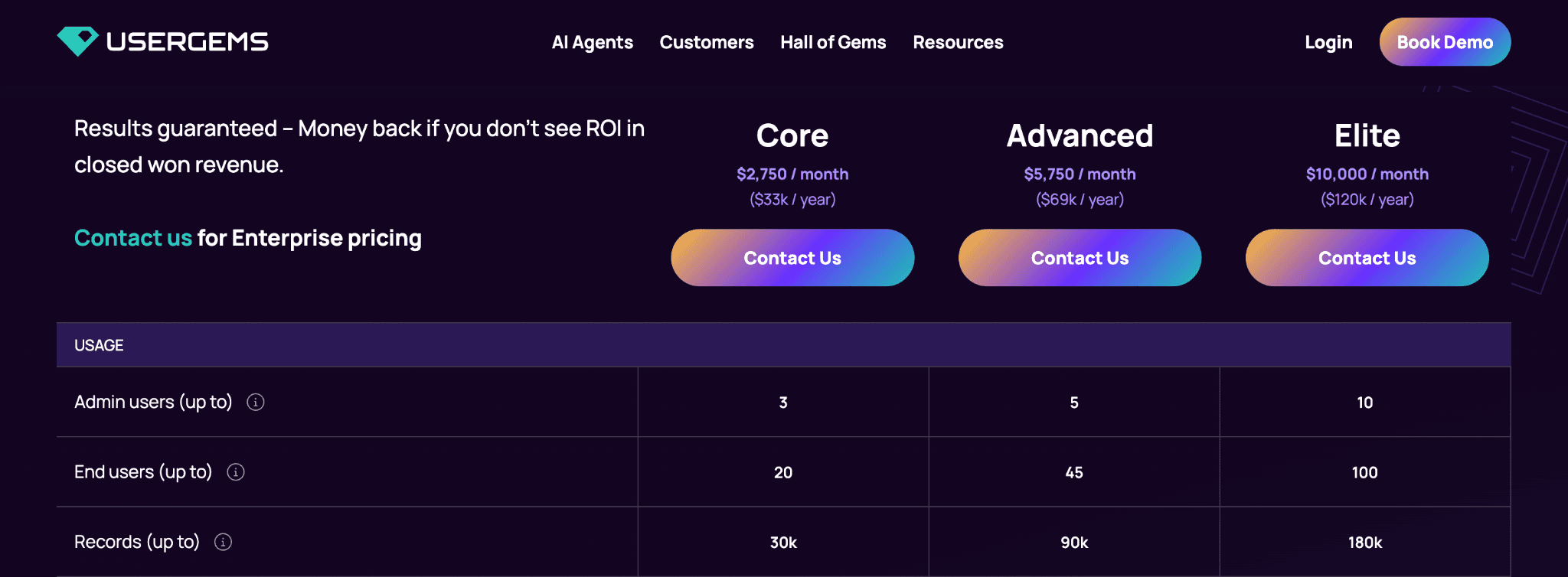
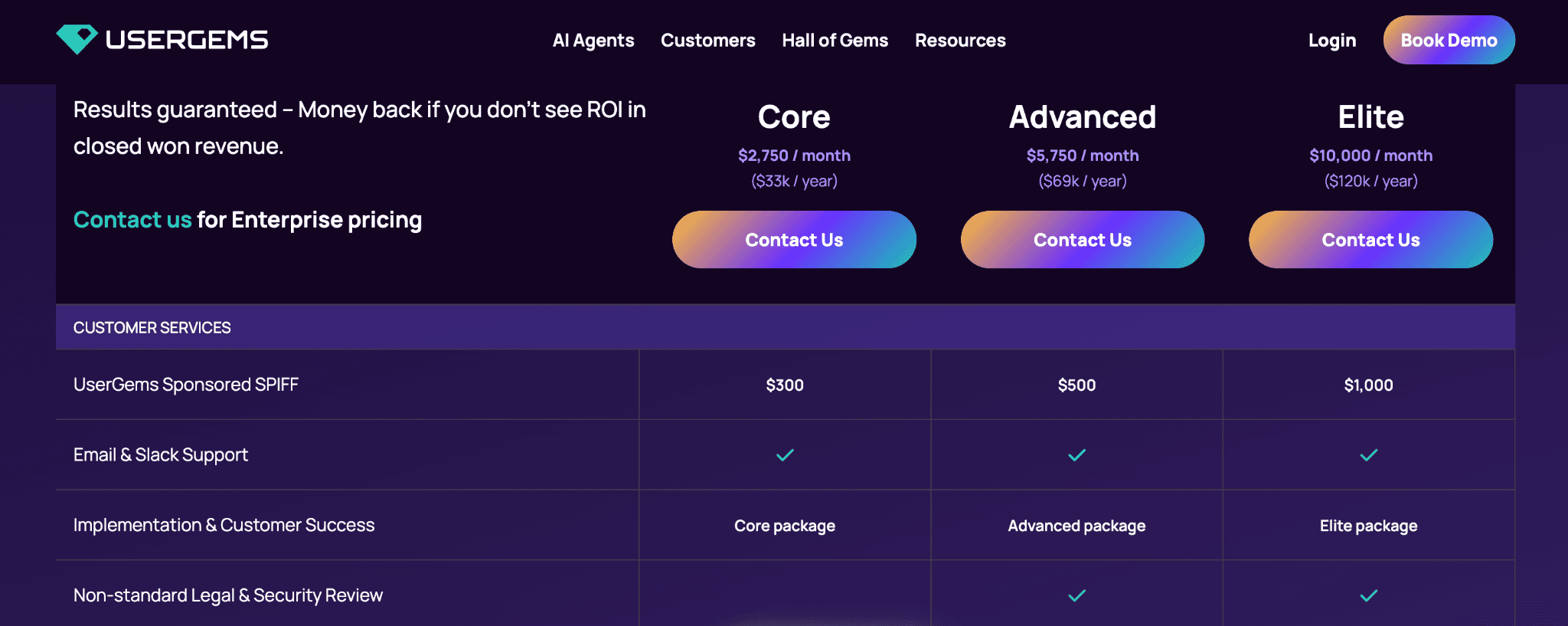
UserGems pricing is structured across three main tiers, but it is not transparently listed for easy comparison. Costs depend on CRM size, tracked accounts, and signal volume. The pricing starts at around $33,000 annually and scales significantly with usage.
Each tier increases data coverage and reporting, but conversion still depends on manual outbound execution. Here is how UserGems pricing tiers are structured in detail:
Tier 1: Core Plan
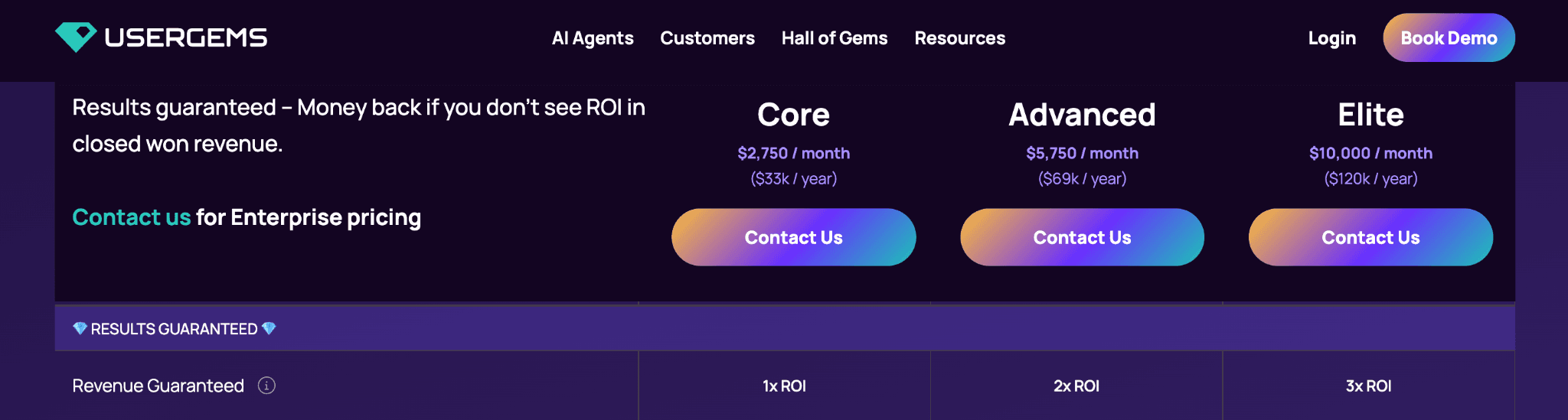
The Core plan starts at $2,750 per month, which totals approximately $33,000 per year. This tier is designed for small to mid-market teams that want to start tracking job-change signals within their CRM.
What’s Included
Job change tracking across CRM contacts
Champion monitoring for account expansion
Basic integrations with Salesforce and HubSpot
Limited admin users, typically around three seats
ROI guarantee tied to a 1x revenue benchmark
What This Means In Practice
You get visibility into when contacts move companies, but your SDR team still needs to research, reach out, and convert every opportunity manually.
Tier 2: Advanced Plan
The Advanced plan starts at $5,750 per month, which totals approximately $69,000 per year. This tier is built for growing teams that want to expand signal coverage and scale outbound workflows.
What’s Included
Everything included in the Core plan
Increased user access and higher data limits
Expanded signal tracking and enrichment capabilities
Enhanced analytics and reporting dashboards
ROI guarantee tied to a 2x revenue benchmark
What Changes Here
You get more signals and better reporting, but the workflow still depends entirely on outbound execution and SDR follow-up.
Tier 3: Elite Plan
The Elite plan starts at $10,000 per month, which totals approximately $120,000 per year. This tier is designed for enterprise teams managing large CRM databases and complex sales workflows.
What’s Included
Everything included in the Advanced plan
High-volume contact tracking across large datasets
Premium onboarding and dedicated support
Advanced customization for workflows and reporting
ROI guarantee tied to a 3x revenue benchmark
What This Unlocks
You get broader coverage across accounts and contacts, but there is still no automated engagement, qualification, or conversion layer included.
What’s Included In UserGems
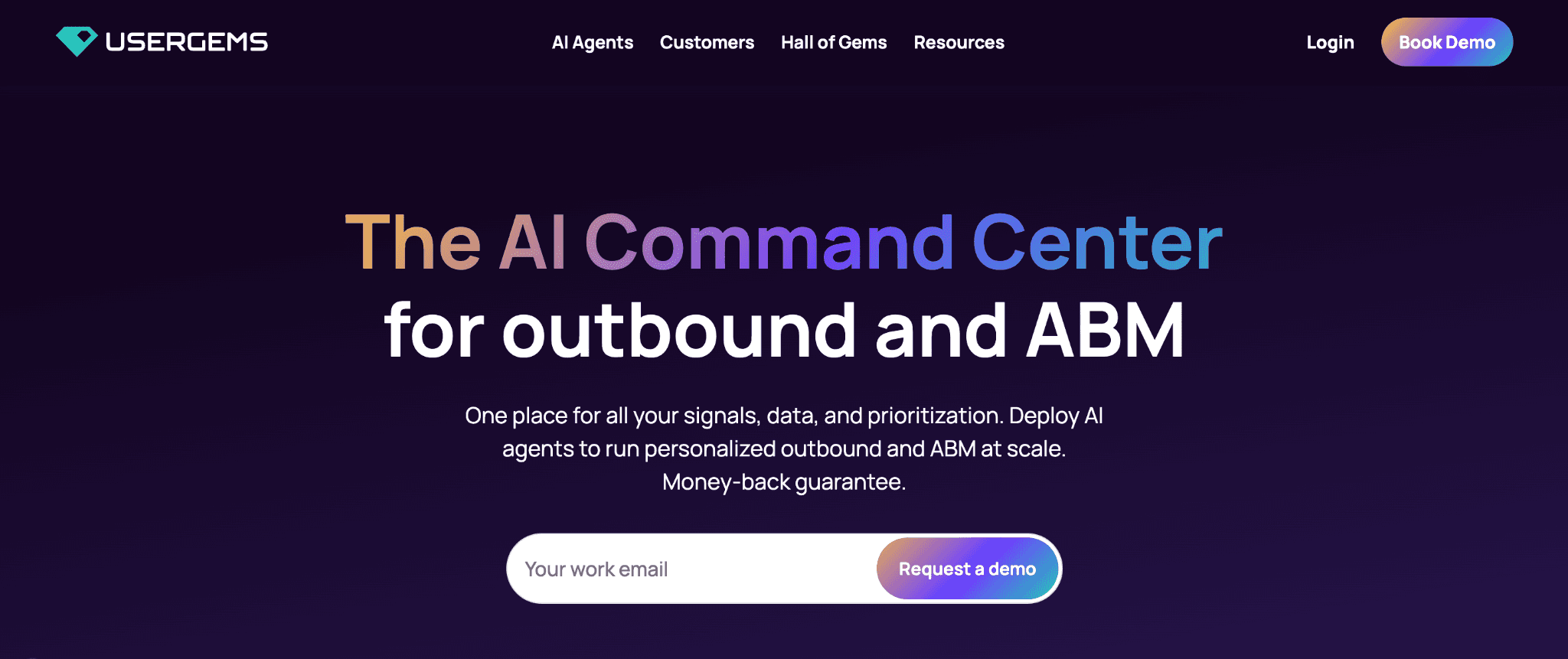
UserGems focuses on signal detection and CRM enrichment, which means you are paying for visibility into buyer activity rather than direct engagement or conversion.
The platform helps you identify opportunities based on job changes and account movement, but it does not execute or convert those opportunities into meetings without manual follow-up.
Here is what you are actually paying for in UserGems:
Job Change Tracking Identifies Potential Buying Signals
UserGems continuously monitors your CRM contacts and detects when key individuals change roles or companies. This helps you identify potential re-entry points into accounts where you already have relationships or prior engagement.
Champion Tracking Highlights Expansion Opportunities
The platform tracks when your existing champions move to new organizations, which creates new outbound opportunities for your team. This allows you to prioritize accounts where there is already some level of trust or product familiarity.
CRM Integrations Connect Signals To Your Workflows
UserGems integrates with platforms like Salesforce and HubSpot, allowing signals to sync directly into your existing sales workflows. This ensures your team can access signal data without switching tools or manually updating records.
Automated Alerts Notify Your Team In Real Time
The platform sends alerts when relevant signals are detected, helping your team stay updated on potential opportunities. These alerts act as triggers for outreach, but they do not initiate or automate engagement.
Analytics And Reporting Track Signal Impact
UserGems provides reporting that connects signals to pipeline activity, helping you understand which signals lead to opportunities. However, attribution depends on your team’s ability to act on those signals and convert them into meetings.
Pipeline Attribution Links Signals To Revenue Outcomes
The platform attempts to attribute pipeline and revenue back to detected signals, which helps justify spend. This gives visibility into performance, but it does not change the fact that execution still relies on manual effort.
What’s Not Included In UserGems
This is where most teams experience the gap between cost and outcomes. UserGems provides strong signal detection, but it does not include execution or conversion capabilities.
You still need additional tools and manual workflows to turn signals into meetings, which increases operational overhead and slows down your ability to act on buyer intent.
Here is what the platform does not include:
No Real-Time Engagement With Buyers
UserGems does not interact with buyers while they are actively researching your product or comparing alternatives on your website. This means you miss the moment when intent is highest and conversion is most likely to happen, which reduces your chances of turning interest into meetings.
No Automated Qualification Of Leads
The platform does not qualify leads based on behavior, context, or real-time interactions beyond detecting job-change signals. Your SDR team must manually review each signal, assess relevance, and prioritize outreach, which slows down response time and increases dependency on human effort.
No Meeting Booking Capability
UserGems does not convert identified signals into scheduled meetings automatically. Your team still needs to initiate outreach, handle responses, and coordinate scheduling, which adds friction between identifying an opportunity and actually converting it into a sales conversation.
No Inbound Conversion Workflows
The platform does not capture or convert website visitors who are already showing active buying intent. This creates a disconnect between inbound traffic and pipeline generation, where high-intent visitors leave without engagement because there is no system to act on them.
No AI-Led Conversations Or Engagement
UserGems does not engage buyers through contextual conversations or dynamic interactions. It only surfaces signals, leaving all engagement to manual workflows, which limits your ability to respond instantly and adapt messaging based on buyer behavior or intent signals.
No Automated Follow-Up Beyond Alerts
The platform stops at notifying your team when a signal is detected and does not execute follow-up actions automatically. This increases reliance on SDR bandwidth and consistency, which can lead to missed opportunities when signals are not acted on quickly.
What Do Companies Typically Pay For UserGems?
UserGems pricing varies based on team size, CRM volume, and contract scope, which means most companies do not pay a fixed price. Costs scale with usage, and total spend increases as your team grows and tracks more accounts or contacts.
Here is how pricing typically looks across segments:
Small Teams Operate At Lower Entry Costs
Smaller teams typically spend between $10,000 and $25,000 annually depending on CRM size and signal volume. This usually reflects limited data coverage and fewer users, but still requires manual effort to convert signals into pipeline.
Mid-Market Teams Invest In Scaling Signals
Mid-market companies usually spend between $25,000 and $75,000 annually as they expand data coverage and team usage. This increases visibility into signals, but it also increases reliance on outbound execution to generate pipeline.
Enterprise Teams Pay For Scale And Coverage
Enterprise organizations often spend $75,000 or more annually depending on CRM size and contract customization. Costs increase significantly with scale, but conversion still depends on SDR workflows rather than automated engagement.
Pricing Increases With Data And Usage Growth
UserGems pricing scales based on tracked accounts, contacts, and signal volume. As your CRM grows, your subscription cost increases, which means long-term spend can rise significantly without guaranteeing proportional pipeline growth.
The Hidden Costs Beyond Subscription
The subscription price is only part of what you actually pay for UserGems. Additional costs come from implementation, tools, and operational effort required to convert signals into pipeline, which often has a larger impact on ROI than the platform itself.
Here are the key cost drivers beyond subscription:
SDR Time And Follow-Up Effort Increase Operational Cost
Every signal requires manual research, outreach, and follow-up, which increases SDR workload and headcount costs. This slows down execution and creates dependency on consistent follow-through to convert opportunities into pipeline.
Additional Tools Are Required To Complete The Workflow
You still need tools for outreach, enrichment, and engagement to act on signals effectively. This increases your overall technology spend and adds complexity to your stack, which can reduce efficiency across your sales process.
One-Time Onboarding And Setup Fees Apply
UserGems includes onboarding and implementation costs depending on plan complexity. These one-time fees increase your initial investment and require additional resources to fully integrate the platform into your workflows.
Delayed Conversion Reduces Effectiveness
Signals lose value quickly if your team does not act immediately. Delays in outreach reduce the likelihood of conversion, which leads to missed opportunities and lowers the overall return on your investment.
Annual Contracts Increase Financial Commitment
UserGems typically requires annual contracts without flexible trial options. This increases financial risk, especially if the platform does not deliver expected results within your specific workflow or sales motion.
Scaling Costs Increase Over Time
Pricing increases as your CRM grows, your team expands, and your usage scales. This means long-term costs can rise significantly, even if pipeline growth does not increase at the same rate.
Does UserGems Pricing Actually Translate To Pipeline?
UserGems delivers strong signal quality, but the value depends entirely on execution. The platform identifies opportunities, but it does not convert them, which creates a gap between insight and outcome that directly impacts pipeline generation.
Here is how the ROI plays out in practice:
Signals Identify Opportunity But Do Not Create Pipeline
UserGems tells you when something changes within your accounts, which helps identify potential opportunities. However, it does not engage or convert those opportunities, which means pipeline creation depends entirely on your team’s actions.
Execution Determines Whether Signals Convert
Your SDR team must research, reach out, and follow up on every signal. If execution is inconsistent or delayed, those opportunities often disappear before they can be converted into meaningful pipeline.
ROI Depends On Outbound Performance
If your outbound workflows are strong, you may generate pipeline from signals. If not, the platform becomes an expensive alert system that provides visibility without delivering consistent revenue outcomes.
Timing Is The Biggest Limiting Factor
Signals are only valuable if acted on quickly within a short window. Delayed outreach reduces engagement rates and lowers the chances of converting interest into meetings or pipeline opportunities.
The Gap Between Signals And Meetings Remains
UserGems identifies who might be ready to buy, but it does not help convert them when intent is highest. This gap between insight and execution is where most pipeline is lost.
UserGems vs. Breakout: Where Should You Invest?
Choosing between UserGems and Breakout depends on one question: Are you paying for a to-do list or a calendar full of meetings?
UserGems is a premium "signal" platform. In 2026, their pricing starts at $33,000 per year just to tell you when a former champion changes jobs.
That is a significant "data tax" to pay before a single email is even sent. Once you get that alert, the work is still entirely on your plate. Your SDRs must manually research the lead, draft an email, and chase them down to book a meeting.
If your team is slow to react, that $33k investment yields zero ROI.
The Problem With The "Signal-Only" Stack
When you invest in UserGems, you aren't just paying their platform fee. To actually generate pipeline, you are forced to build a "Frankenstein" tech stack:
UserGems: $33,000/year (for the signal)
Sales Engagement (Outreach/Salesloft): ~$15,000/year (to send the email)
Data Enrichment (ZoomInfo/Apollo): ~$20,000/year (to find the actual email address)
Total Cost: $68,000+ before you’ve even booked your first demo.
The Breakout Difference: Action Over Alerts
Breakout doesn't just give you a notification; we provide the execution layer.
While UserGems identifies a "warm" lead for you to chase later, Breakout’s AI SDRs engage with your highest-intent buyers the moment they arrive on your website. We don't just tell you that a prospect is interested, we qualify them and book the meeting on your calendar in real time.
Investment Point | UserGems | Breakout |
Primary Goal | Identify a potential opportunity | Secure a booked meeting |
Starting Cost | ~$33,000 / year | Free |
Effort Required | High (SDR must manually follow up) | Minimal (AI handles the conversion) |
Time to Lead | Hours or days (delayed signals) | Instant (real-time engagement) |
Success Metric | Number of alerts sent | Number of meetings booked |
Final Verdict
If you have a massive budget and a surplus of human SDRs who need more outbound leads to call, UserGems is a solid database. However, signals alone do not create pipelines unless your team acts on them quickly and consistently.
This is where most opportunities are lost, not because of lack of data, but because of delayed execution.
Nevertheless, if you want to scale your pipeline without adding headcount, Breakout is the superior investment. Instead of paying a "signal tax" for a list of names, you invest in a system that turns existing intent into revenue automatically.
Breakout changes this by engaging buyers during and after their visit, qualifying them, and booking meetings automatically so stop paying for signals you cannot convert. Start turning intent into pipeline.
Start a free trial with Breakout.
FAQs
Q. What is UserGems pricing in 2026?
UserGems pricing typically starts around $33,000 per year for the Core plan and can go up to $120,000 annually for enterprise tiers. Pricing varies based on CRM size, tracked records, and usage, and most contracts are annual with custom quotes required.
Q. Why is UserGems pricing considered expensive?
UserGems charges for access to signals like job changes and champion tracking, not for actual pipeline generation. In addition to subscription costs, teams often spend more on SDR effort, outreach tools, and enrichment, increasing total cost significantly.
Q. What do companies actually pay for UserGems?
Most companies spend between $25,000 and $75,000 annually, depending on team size and data volume. Larger enterprises can exceed $80,000 or more per year as pricing scales with CRM records and headcount.
Q. Does UserGems pricing include pipeline generation?
No, UserGems pricing covers signal detection and alerts, not execution or conversion.
Your team still needs to research, reach out, and follow up manually, which means pipeline depends on outbound performance rather than the platform itself.
Q. Is there a better alternative to UserGems for ROI?
If your goal is pipeline generation instead of signal tracking, Breakout is a stronger alternative.It engages visitors during and after intent, qualifies them automatically, and books meetings, reducing reliance on manual follow-up.