

Quick Summary
If you're looking for a quick answer, here's the takeaway:
Choose Calendly if you need a simple, affordable scheduling platform that works across sales, recruiting, customer success, and the rest of your organization.
Choose Chili Piper if your revenue team needs advanced lead routing, qualification, and inbound scheduling workflows to improve speed-to-lead.
Choose Breakout if your goal is to generate more pipeline from existing website traffic. Instead of waiting for buyers to fill out a form, Breakout identifies anonymous visitors, engages them with AI, qualifies buying intent, and books meetings automatically.
Feature | Chili Piper | Calendly | Breakout |
Best for | Mid-market and enterprise revenue teams | Organization-wide scheduling | Converting website visitors into qualified pipeline |
Primary use case | Lead routing and inbound scheduling | Meeting scheduling | Inbound AI SDR and buyer engagement |
Starting price | Starts at $15,000/year | Free plan available; paid plans start at $10/user/month | Custom pricing |
Free plan | No | Yes | No |
Meeting scheduling | Advanced sales scheduling | Self-service scheduling | AI-powered meeting booking |
Anonymous visitor identification | No | No | Yes |
Lead routing | Advanced routing and territory management | Routing forms | AI-powered qualification and routing |
Lead qualification | Rule-based qualification | Routing forms | Real-time AI qualification |
CRM integrations | Salesforce, HubSpot, and others | Salesforce, HubSpot, and others | Salesforce, HubSpot, and leading CRM platforms |
AI capabilities | AI meeting preparation and conversational experiences | Limited AI capabilities | AI conversations, buyer qualification, and meeting booking |
Integration ecosystem | Revenue-focused | 100+ business integrations | Fits into existing GTM stack |
G2 rating | 4.6/5 | 4.7/5 | 5/5 |
Chili Piper and Calendly both simplify meeting scheduling, but they're built for different parts of the buyer journey.
While Calendly focuses on making appointments easy to book, Chili Piper is designed to route, qualify, and distribute inbound leads instantly.
In this guide, we'll compare Chili Piper vs Calendly across scheduling, lead routing, automation, integrations, pricing, and ideal use cases to help you choose the right platform for your GTM strategy.
Chili Piper Overview
Chili Piper helps B2B revenue teams convert inbound leads faster.

It automatically qualifies, routes, and schedules meetings with the right sales rep, reducing lead response times and improving conversion rates.
It's best suited for companies with high inbound lead volume that want to streamline handoffs between marketing and sales.
Best known for: Automated lead routing and inbound meeting scheduling.
Calendly Overview
Calendly helps teams eliminate the back-and-forth of scheduling meetings.
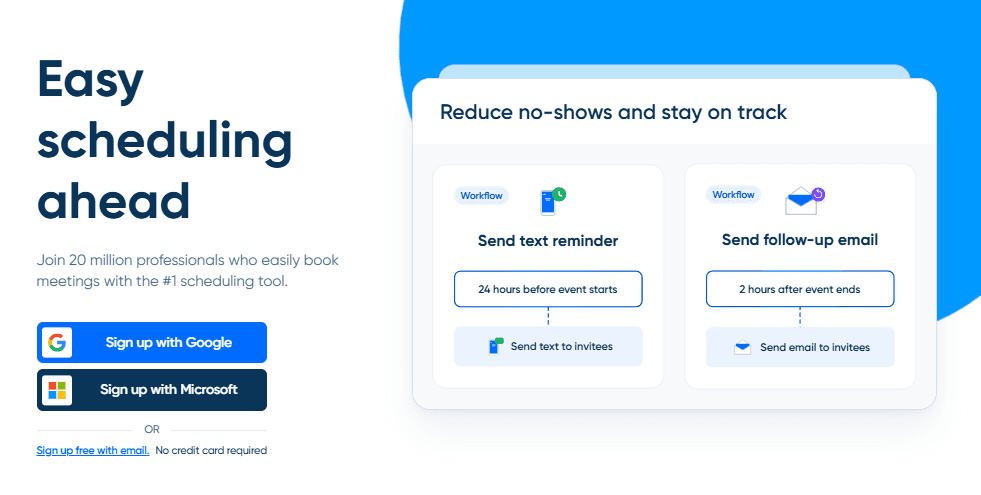
It lets prospects, customers, and partners book time based on real-time availability while automating reminders and calendar coordination.
It's a strong choice for businesses that need a simple, reliable scheduling solution without complex routing logic.
Best known for: Simple meeting scheduling and calendar automation.
Chili Piper vs. Calendly: Feature Comparison
Chili Piper and Calendly share many of the same core capabilities.
Both help businesses automate meeting scheduling, sync calendars, integrate with popular CRMs, and reduce the manual work involved in booking meetings.
However, the two platforms differ in how they approach lead management, workflow automation, and team collaboration.
1. Meeting Scheduling
Both platforms simplify meeting scheduling by eliminating back-and-forth emails. Users can share booking links, sync calendars, detect time zones automatically, and prevent double bookings.
Calendly focuses on making scheduling simple and accessible for any team. Chili Piper combines scheduling with revenue workflows, allowing businesses to connect meetings directly to their inbound sales process.
Verdict: Tie. Calendly is simpler, while Chili Piper offers more sales-focused scheduling.
2. Lead Routing and Qualification
Lead routing is one of Chili Piper's biggest strengths. It automatically qualifies inbound leads and routes them to the right sales representative using territory rules, account ownership, round-robin distribution, and custom routing logic.
Calendly also offers routing forms that qualify prospects before booking a meeting. However, its routing capabilities are designed for simpler scheduling workflows rather than complex revenue operations.
Verdict: Chili Piper.
Both tools depend on a visitor taking action first, usually by filling out a form or booking a meeting. If reducing form dependency is a priority, you'll need a different category of tool.
Breakout, for example, focuses on helping revenue teams start conversations with high-intent visitors before they convert.
3. CRM and Business Integrations
Both platforms integrate with leading CRMs, including Salesforce and HubSpot, as well as Google Calendar, Outlook, Microsoft 365, Zoom, and Microsoft Teams.
Calendly offers a broader integration ecosystem that extends beyond revenue teams to recruiting, collaboration, productivity, and payment platforms. Chili Piper's integrations are more focused on supporting sales and marketing workflows.
Verdict: Calendly.
Breakout also integrates with Salesforce and HubSpot, but its goal isn't simply syncing booked meetings.
It helps sales teams work from richer buying signals inside the CRM instead of relying only on form submissions.
4. Workflow Automation
Both platforms reduce manual work through automation, but they focus on different workflows.
Chili Piper automates inbound sales processes by connecting lead qualification, routing, meeting assignment, and sales handoffs.
Calendly automates the scheduling experience with reminders, confirmations, follow-up notifications, and calendar coordination.
Verdict: Chili Piper for revenue automation. Calendly for scheduling automation.
The biggest difference is where automation begins. Calendly and Chili Piper automate scheduling once a prospect enters the funnel.
Breakout focuses on the stage before that, helping revenue teams make better use of website traffic that would otherwise leave unnoticed.
5. Team Scheduling
Both Chili Piper and Calendly support round-robin scheduling, collective availability, and team booking pages, making it easy to distribute meetings across multiple team members.
Chili Piper provides greater flexibility for sales organizations that need advanced meeting distribution rules. Calendly prioritizes ease of setup and works well for teams across different departments.
Verdict: Tie.
6. Analytics and Reporting
Both platforms provide reporting to help businesses understand scheduling performance.
Chili Piper focuses on revenue metrics such as lead routing efficiency, meeting distribution, and inbound conversion. Calendly provides scheduling analytics that help teams track booking activity and user adoption across the organization.
Verdict: Chili Piper for revenue-focused insights.
7. Cross-Functional Support
Chili Piper is built primarily for sales and marketing teams managing inbound demand.
Calendly supports the same revenue teams while also serving recruiting, customer success, HR, IT, finance, and other departments. Its broader feature set makes it easier to standardize scheduling across the entire organization.
Verdict: Calendly.
8. Ease of Implementation
Calendly is designed for quick deployment and requires minimal configuration, making it easy for teams to get started.
Chili Piper typically requires more setup because of its routing logic, CRM integrations, and advanced revenue workflows. While implementation takes longer, it provides greater flexibility for businesses with more complex sales processes.
Verdict: Calendly.
Chili Piper vs. Calendly Pricing
Pricing is one of the biggest differences between Chili Piper and Calendly. While both offer scheduling and routing capabilities, they follow very different pricing models.
Calendly uses a traditional per-seat pricing structure that scales as your team grows.
You can start with a free plan, upgrade as needed, and only pay for the seats you use. Advanced routing features become available on the Teams plan, making it a practical option for growing sales teams.
Chili Piper, on the other hand, has moved away from its older per-product pricing model. Instead, it now offers platform-based plans with annual contracts and a minimum spend.
Rather than paying per feature, businesses purchase a bundled platform that includes routing, scheduling, and other revenue workflows.
As a result, Calendly is typically the more affordable option for startups and smaller revenue teams, while Chili Piper is designed for larger organizations that can justify its higher upfront investment.
Prices below were last verified in July 2026 from the official Calendly and Chili Piper pricing pages.
Calendly Pricing
Plan | Annual Billing | Monthly Billing | Includes Lead Routing? |
Free | $0 | $0 | No |
Standard | $10/user/month | $12/user/month | No |
Teams | $16/user/month | $20/user/month | Yes |
Enterprise | Custom (starts around $15,000/year) | Annual only | Yes |
Good to know
Lead routing and qualification forms are only available on the Teams plan and above.
Enterprise adds features like SSO, SCIM, audit logs, and advanced security controls.
Chili Piper Pricing
Plan | Starting Price | Seats Included | Additional Seats | Billing |
Routing & Scheduling | $1,250/month ($15,000/year) | 15 | $45/user/month | Annual only |
Enterprise | $3,500/month | 30 | $50/user/month | Annual only |
ChiliCal | $12/user/month | Minimum 200 seats | - | Annual only |
Good to know
Chili Piper no longer sells Concierge, Distro, and Handoff as separate products.
Platform plans bundle scheduling, routing, and other revenue workflows into a single subscription.
There is no free plan for the Routing & Scheduling platform.
Platform plans require an annual commitment, with discounts available for multi-year contracts.
Cost Comparison for a 10-Person Revenue Team
For most buyers comparing these platforms, the key question is how much it costs to support a growing revenue team with lead routing and meeting scheduling.
Platform | Cost for 10 Users |
|---|---|
Calendly Teams | $160/month ($1,920/year |
Chili Piper Routing & Scheduling | $1,250/month ($15,000/year) |
For a 10-person team, Chili Piper costs nearly eight times more than Calendly. That's because the Routing & Scheduling plan includes up to 15 seats at a fixed annual price, regardless of whether your team has 3 users or 15.
For smaller businesses, Calendly's per-seat pricing is significantly more cost-effective because costs increase only as additional users are added.
Pricing Verdict:
Choose Calendly if you want predictable, per-seat pricing that scales with your team and delivers strong scheduling and routing capabilities at a lower cost.
Choose Chili Piper if your organization has a larger revenue team and needs advanced inbound routing, territory management, and enterprise-grade revenue workflows.
While the upfront investment is considerably higher, the platform is built for organizations managing complex inbound sales operations.
Chili Piper vs. Calendly: Reviews and Reputation
Both Chili Piper and Calendly are well-regarded scheduling platforms, but they earn praise for different reasons.
Calendly is consistently recognised for its ease of use and broad adoption across teams, while Chili Piper is valued for helping revenue teams improve lead routing and inbound conversion.
To get a balanced view, it's worth looking beyond a single review platform. G2, Capterra, TrustRadius, and Trustpilot each attract different types of users, from enterprise buyers to SMBs and end users.
Review scores below were last verified in July 2026.
Review Platform | Calendly | Chili Piper |
G2 | 4.7/5 (2,699 reviews) | 4.6/5 (736 reviews) |
Capterra | 4.7/5 (4,082 reviews) | 4.4/5 (128 reviews) |
TrustRadius | 9.1/10 (620 reviews) | 8.7/10 (98 reviews) |
Trustpilot | ~4.0/5 (~480 reviews) | No meaningful listing |
Software Advice | 4.7/5 | 4.4/5 |
*Software Advice and Capterra are both part of Gartner Digital Markets and share the same underlying review database.
What Users Like About Calendly
Across G2, Capterra, and TrustRadius, reviewers consistently praise Calendly for its simplicity.
Users highlight how easy it is to schedule meetings, eliminate back-and-forth emails, prevent double bookings, and onboard new team members quickly.
Many also appreciate its clean interface, reliability, and wide range of integrations.
One recurring criticism appears on Trustpilot, where some users mention slow customer support and occasional frustrations with account management.
However, these concerns are generally about the service experience rather than the scheduling functionality itself.
What Users Like About Chili Piper
Chili Piper receives strong feedback from sales and RevOps teams that rely on advanced lead routing.
Reviewers frequently mention improvements in response times, automated lead assignment, and smoother inbound sales workflows after implementation.
The most common criticism is the learning curve. Compared to Calendly, Chili Piper requires more configuration, and some administrators note that routing rules and terminology can take time for new users to understand.
Where Both Chili Piper and Calendly Fall Short
Both Chili Piper and Calendly are capable scheduling platforms, but neither is designed to solve the entire buyer journey. Your choice ultimately depends on whether your biggest challenge is scheduling meetings or converting more qualified pipeline.
Chili Piper Limitations:
Chili Piper is purpose-built for revenue teams, and that focus comes with trade-offs.
The platform has a higher entry price, making it less accessible for startups and smaller sales teams.
Advanced routing and automation require more setup and ongoing administration than simpler scheduling tools.
It's best suited for organizations with mature inbound sales processes, so smaller teams may not use its full capabilities.
While it automates lead routing and scheduling, it still relies on prospects filling out a form or entering an existing workflow before automation begins.
Calendly Limitations:
Calendly excels at simplifying scheduling but offers fewer capabilities for managing complex inbound sales workflows.
Advanced lead routing and qualification are only available on higher-tier plans.
It's designed primarily as a scheduling platform rather than a complete inbound revenue workflow solution.
Revenue teams with complex territory rules or account-based routing may find its routing capabilities limiting.
While Calendly makes it easy to book meetings, it doesn't identify anonymous website visitors or proactively engage buyers before they request a meeting.
Where Breakout Fits In
If your biggest challenge is simply scheduling meetings, either Calendly or Chili Piper can be a good fit.
But if your website already attracts qualified buyers and your goal is to convert more of that traffic into pipeline, you'll need more than a scheduling platform.
Breakout complements both tools by engaging buyers before they book a meeting.
Instead of waiting for visitors to complete a form or click a scheduling link, Breakout identifies high-intent anonymous visitors. It starts personalised conversations, qualifies buying intent in real time, and books meetings automatically.
What Breakout Does Differently
Identifies anonymous website visitors instead of waiting for buyers to fill out a form before routing them.
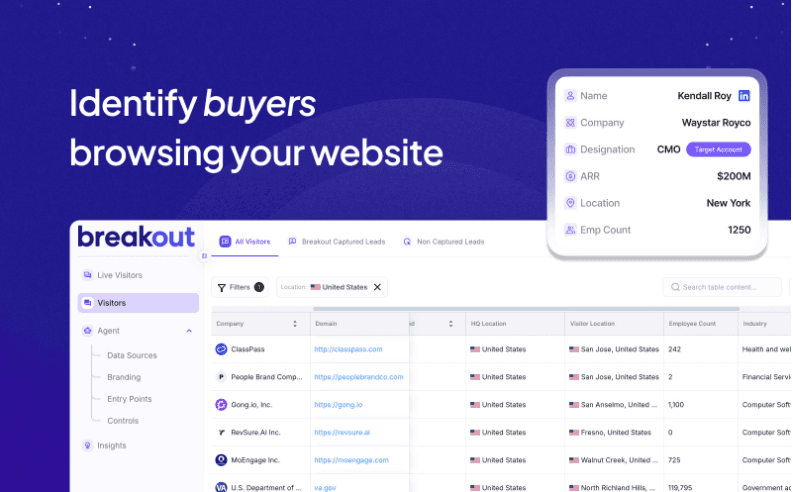
Qualifies buying intent through AI conversations, not static routing forms or qualification questions.
Combines visitor identification, qualification, and meeting booking in a single workflow, helping revenue teams convert more existing website traffic into pipeline.
Works alongside your CRM and GTM stack, enriching visitor data and routing qualified buyers to the right sales representative automatically.
Who Breakout Is Best For
Breakout is built for B2B SaaS companies with meaningful website traffic and a dedicated sales team.
It's best suited for founders, CROs, RevOps leaders, and marketing teams that want to increase pipeline from existing demand rather than generate more top-of-funnel traffic.
See it in action:
HackerEarth used Breakout to turn more website visitors into qualified pipeline. After deploying Breakout's Inbound AI SDR, the company achieved a 10% engagement-to-lead conversion rate, increased website visitor engagement by 2.5x, and saw 21% of its Q1 pipeline driven or influenced by Breakout.
Instead of replacing scheduling software, Breakout extends it by helping revenue teams engage high-intent buyers at the moment they're most likely to convert.

Final Verdict
Both Chili Piper and Calendly are excellent products. The better choice depends on the problem you're trying to solve.
Choose Calendly if:
You want the fastest way to eliminate scheduling back-and-forth.
You need one scheduling platform for sales, recruiting, customer success, and the rest of the business.
You prefer transparent, per-seat pricing that grows with your team.
Your scheduling needs are straightforward, and advanced revenue workflows aren't a priority.
Choose Chili Piper if:
Your biggest bottleneck is routing and qualifying inbound leads.
You run a high-volume sales organisation with complex territories, ownership rules, and handoffs.
Your team is willing to trade simplicity for deeper revenue automation.
You're comfortable paying an enterprise price for specialised sales workflows.
But here's the bigger question: “Are scheduling and lead routing really your biggest growth challenges?”
Neither platform identifies anonymous website visitors, engages buyers before they fill out a form, or converts existing website traffic into pipeline. That's where Breakout comes in.
Breakout identifies high-intent visitors, starts personalised AI conversations, qualifies buying intent in real time, and books meetings automatically.
Instead of simply making scheduling more efficient, it helps revenue teams create more pipeline from the demand they already have.
If your goal isn't just booking more meetings but generating more qualified pipeline, see how Breakout can turn your website into your highest-performing revenue channel.
FAQs
1. How does Chili Piper compare to Calendly?
Both Chili Piper and Calendly automate meeting scheduling, but they serve different use cases.
Calendly focuses on simplifying scheduling for teams across an organization, while Chili Piper is built for revenue teams that need advanced lead routing, qualification, and inbound sales automation.
2. Which is better: Chili Piper or Calendly?
Neither platform is universally better. Calendly is ideal for businesses looking for an easy-to-use scheduling solution with predictable pricing. Chili Piper is better suited for companies with complex inbound sales workflows and advanced lead routing requirements.
3. How much does Chili Piper cost?
Chili Piper's Routing & Scheduling plan starts at $1,250 per month ($15,000 annually) and includes up to 15 seats. Additional seats are billed separately, and annual contracts are required.
4. Is Calendly cheaper than Chili Piper?
Yes. Calendly's Teams plan starts at $16 per user per month with annual billing, making it significantly more affordable for small and mid-sized businesses. Chili Piper is positioned as an enterprise solution with a much higher starting investment.
5. What are the biggest drawbacks of Calendly?
Calendly is excellent for scheduling but offers less flexibility for complex lead routing and revenue workflows. Advanced routing features are also only available on higher-tier plans.
6. Is Chili Piper easy to use?
Chili Piper is designed for revenue teams and offers powerful routing capabilities. However, its advanced workflows require more setup and configuration than Calendly, resulting in a steeper learning curve for administrators.
7. Does Chili Piper use AI?
Yes. Chili Piper includes AI-powered capabilities such as meeting preparation, spam detection, and conversational experiences in its higher-tier plans. These features are designed to improve inbound sales efficiency.
8. What are the best alternatives to Chili Piper?
Some of the most popular Chili Piper alternatives include Calendly, HubSpot Meetings, Qualified, LeanData, and Breakout. The right choice depends on whether your priority is scheduling, lead routing, or converting website visitors into pipeline.
9. Why is Calendly so popular?
Calendly is known for its intuitive user experience, broad integrations, and simple pricing. It makes scheduling meetings easy for individuals, small businesses, and enterprise teams without requiring extensive setup.
10. Is there a better option than Calendly?
If your primary need is meeting scheduling, Calendly remains one of the strongest options.
However, if your goal is to convert anonymous website visitors into a qualified pipeline rather than simply book meetings, platforms like Breakout address a different stage of the buyer journey with AI-powered visitor identification, engagement, qualification, and meeting booking.