
Quick Summary
6sense helps revenue teams identify accounts showing buying intent. Its predictive analytics and intent data help prioritize accounts most likely to convert.
Demandbase provides a broader account-based marketing platform. It combines account identification, advertising, engagement, and sales intelligence into a single solution.
Consider Breakout if your goal is converting anonymous website visitors into pipeline. It identifies visitors, enriches account data, and engages prospects through AI-powered SDR workflows.
For most organizations, the choice depends on your primary objective. You may need buying-intent insights, ABM execution capabilities, or website visitor conversion tools.
Here’s a quick feature overview:
Feature | 6sense | Demandbase | Breakout |
Primary Focus | Buying intent | ABM execution | Inbound AI SDR tool |
Best At | Predictive analytics | Account-based advertising | Website visitor conversion |
Anonymous Visitor Identification | Yes | Yes | visitor deanonymization |
Intent data | Excellent | Excellent | Website intent |
Predictive analysis | Yes | Limited | No |
ABM Capabilities | Account prioritization | End-to-end ABM execution | Personalized ABM engagement |
Real-Time Engagement | No | No | Autonomous AI conversations |
Lead Qualification | Manual | Manual | AI-powered qualification |
Meeting Booking | No | No | Automatic meeting booking |
Best For | Prioritizing in-market accounts | Scaling ABM programs | Turning website visitors into qualified pipeline |
Most B2B sales teams face the same challenge.
They spend too much time on leads that aren't ready to buy while high-intent prospects slip through the cracks.
The problem isn't a lack of leads. It's knowing which accounts are actively in-market, which ones fit your ideal customer profile (ICP), and how to engage them at the right time with the right message.
That's where platforms like 6sense and Demandbase come in.
6sense helps revenue teams identify accounts showing signs of buying intent. It uses behavioral and intent signals to help sales and marketing teams focus on the accounts most likely to convert.
Demandbase helps teams identify target accounts, understand their behavior, and engage them through account-based marketing campaigns across multiple channels.
While both platforms help revenue teams generate more pipeline, they take different approaches. Choosing between them comes down to three key questions:
Do you primarily want to identify buyers showing intent?
Do you need tools to engage and nurture target accounts?
Are you looking for an all-in-one platform that combines both?
In this 6sense vs Demandbase comparison guide, we'll break down their features, pricing, strengths, limitations, and real-world use cases.
We'll also explore which platform is the better fit for different types of businesses and highlight alternative solutions to consider.
What Is 6sense?
6sense is a revenue intelligence platform designed to help sales and marketing teams identify accounts that are actively researching solutions.
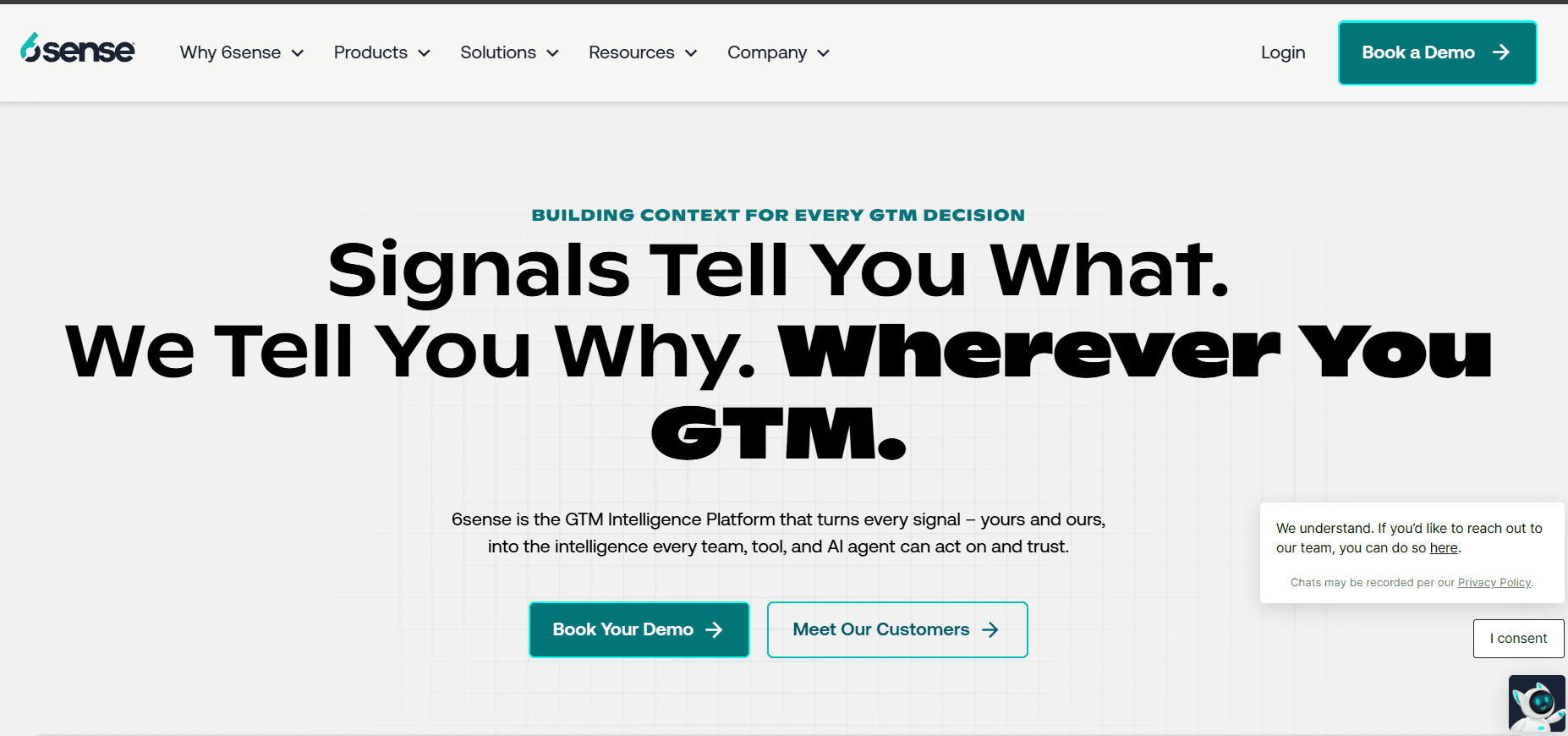
Instead of relying solely on form fills and inbound leads, it analyzes buying signals across the web to predict which accounts may be entering a buying cycle.
Its biggest strength is helping teams answer a critical question:
“Which accounts should we focus on right now?”
For organizations with limited sales resources, that prioritization can significantly improve efficiency.
What Is Demandbase?
Demandbase is an account-based marketing and sales platform built around identifying, targeting, and engaging high-value accounts.

While it also provides intent data and account insights, its core strength lies in helping companies execute ABM strategies across multiple channels.
Demandbase allows teams to:
Build target account lists
Run account-based advertising campaigns
Personalize buyer experiences
Track engagement across the customer journey
Rather than focusing primarily on prediction, Demandbase focuses on engagement and activation.
6sense vs Demandbase: Feature Comparison With User Reviews
1. Intent Data
Intent data is one of the biggest reasons companies evaluate these platforms.
Both providers collect and analyze signals that indicate whether a company may be researching a particular category or solution.
6sense places a heavier emphasis on uncovering buying intent and surfacing accounts that are likely entering a purchase journey.
"6sense helps us focus on accounts that are actively showing buying intent. It improves targeting, makes outreach more relevant, and helps align marketing and sales efforts. However, data coverage in LATAM is limited, and contact information can be incomplete, making it difficult to rely on the platform for outbound prospecting alone."
- Alex D.
Marketing Operations Specialist, Mid-Market Company
"6sense does a great job of highlighting in-market accounts, making it easier to prioritize the right prospects at the right time. It helps make outreach more focused and effective. That said, some intent signals lack transparency, the interface can feel cluttered, and contact-level data isn't always accurate."
- Connor H.
Sales Development Representative (SDR), Mid-Market Company
Demandbase also offers intent insights but typically integrates them more closely with broader ABM campaigns and account engagement efforts.
"Demandbase gives us a complete view of account intent, engagement, and firmographic data in one place. It helps sales and marketing stay aligned and focus on the right accounts. The onboarding and customer support were strong, and the implementation process was surprisingly simple. However, the platform can feel overwhelming at first because of the number of features and dashboards available."
Patricia P.
CEO & Founder, Mid-Market Software Company
"Demandbase provides valuable intent data and account insights that help identify which accounts are actively researching solutions. It improves sales and marketing alignment and supports better-timed outreach. However, the platform is complex, expensive, and often requires dedicated resources to unlock its full value."
Sebin S.
Video Editor & Motion Graphics Professional, Small Business
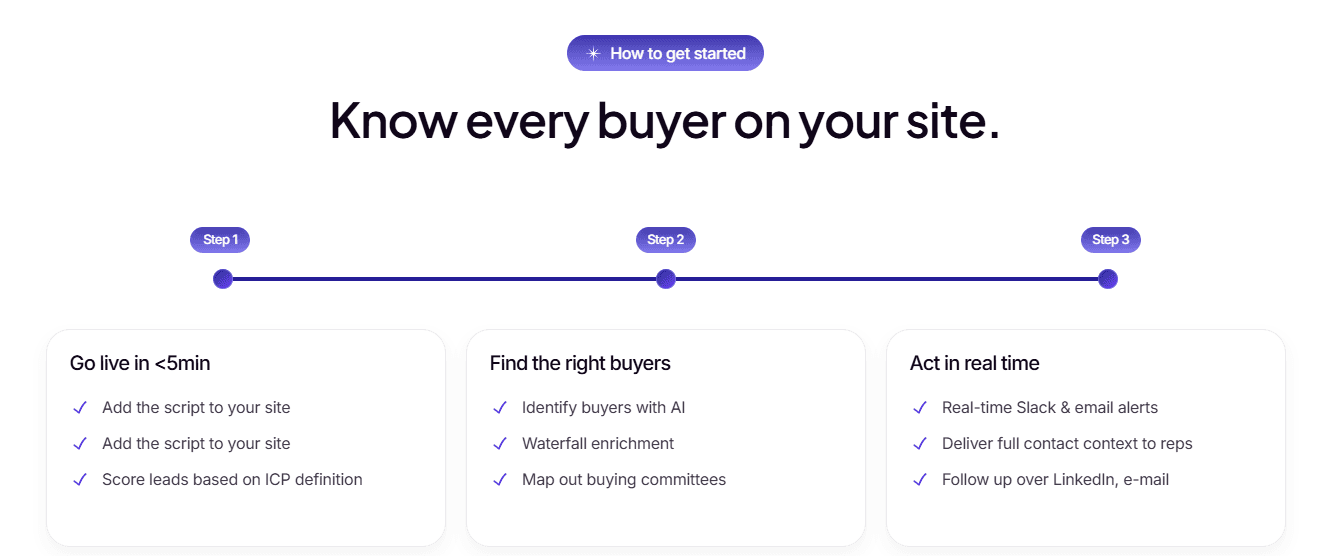
If your goal is converting buying intent into pipeline, Breakout takes a different approach. It instantly identifies anonymous website visitors, engages them, and books meetings automatically.
2. Predictive Analytics
This is where 6sense truly differentiates itself.
The platform is known for its predictive models that estimate where an account is in the buying journey and how likely it is to convert.
Many users specifically choose 6sense because they want better visibility into future opportunities rather than simply tracking current engagement.
"6sense provides valuable buying-intent insights that show what prospects are researching and which competitors they are evaluating. The account activity data helps make prospecting more informed and targeted. However, contact syncing with Salesforce can be slow, delaying outreach when timing matters most."
Vaneet J., Sales Executive, Mid-Market Company
"The timeline and signals intelligence features provide useful visibility into account research activity and buying behavior. They help sales teams understand where prospects are in their journey. However, the user interface can make saved searches difficult to find, and additional training resources would improve adoption."
Dominic C., Sales Development Representative, Enterprise Company
Demandbase offers predictive capabilities through its account intelligence and intent data features.
However, predictive analytics is not the platform's primary focus.
Most customers choose Demandbase for its broader ABM capabilities rather than its forecasting or account-prioritization models.
3. Advertising (Account-Based)
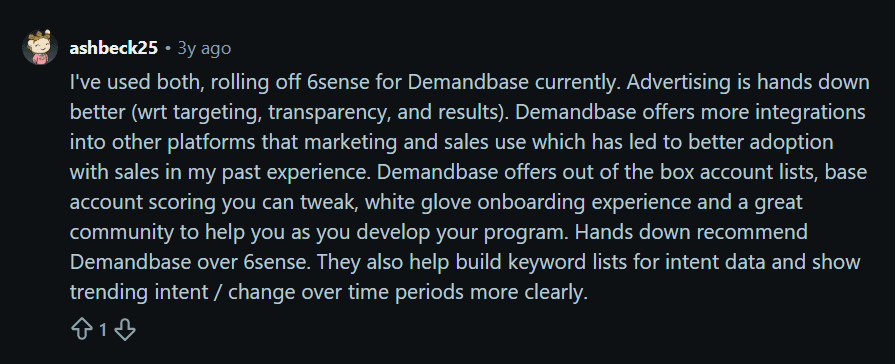
Demandbase has long been recognized as one of the leading platforms for account-based advertising.
Teams can build highly targeted campaigns and reach specific accounts across multiple channels.
For organizations heavily investing in ABM advertising, Demandbase often provides greater flexibility and control.
"Demandbase helps teams target specific accounts across advertising channels and activate audiences with ease. Its integrations streamline account-based advertising campaigns. However, the initial setup can be complex and often requires dedicated technical support."
Oscar F., Marketing Specialist EMEA & LATAM, Mid-Market Company
6sense supports advertising as well, but it is not typically the primary reason companies purchase the platform.
4. Account Identification
Both platforms help teams identify and understand target accounts.
Users can uncover company-level insights, monitor engagement, and better prioritize outreach.
The difference is in how those insights are used.
6sense uses account data to prioritize likely buyers.
"6sense helps identify in-market prospects, uncover account insights, and connect with the right stakeholders. It makes prospecting more efficient by helping prioritize the right accounts. However, improvements to contact accuracy would make the platform even stronger."
Prerna J., Sales Development Representative, Enterprise Company
Demandbase uses account data to support broader engagement and advertising initiatives.
"Demandbase provides strong account-level visibility by helping teams analyze target accounts, track engagement, and prioritize companies showing the highest interest. However, the platform has a steep learning curve, and engagement signals work best when combined with other data."
Nijat I., Full-stack Developer, Small Business
Both platforms identify target accounts for sales teams.
Platforms like Breakout identify anonymous website visitors and engage them instantly, eliminating the need for manual follow-up.
Here’s the proof:
Barti replaced demo-form friction with real-time AI conversations. Breakout reduced bounce rates by 5.7%, achieved a 9.82% average lead capture rate, eliminated response delays, and influenced more than 19% of pipeline within the first three months.

5. Account-Based Marketing (ABM) Capabilities
Both 6sense and Demandbase support account-based marketing strategies, but they approach ABM differently.
6sense focuses on helping teams identify in-market accounts and prioritize outreach based on buying intent.
Its ABM capabilities are closely tied to predictive analytics and account intelligence, helping sales and marketing teams engage the right accounts at the right time.
“6sense helps teams prioritize target accounts using firmographics, intent signals, buying stages, and account fit. This makes account targeting more precise and improves campaign planning. However, organizations may need additional training to maximize the platform's capabilities."
Tiffany M., Senior Marketing Technologist, Enterprise Company
Demandbase takes a broader approach to ABM.
The platform combines account targeting, audience segmentation, advertising, engagement tracking, and campaign orchestration in a single solution.
This makes it easier for teams to run and measure account-based campaigns across multiple channels.
For organizations running mature ABM programs, Demandbase often provides more comprehensive execution capabilities.
"Demandbase provides a unified account view by combining engagement data, Salesforce insights, and account activity in one dashboard. This helps teams make more informed ABM decisions and improve account engagement. However, customization options are limited, and occasional syncing issues can delay data updates."
Stefano C., Senior Marketing Manager, Mid-Market Company
"Demandbase makes it easy to target specific accounts across advertising channels and activate audiences through third-party platforms. This improves campaign precision and supports account-based marketing efforts. However, the initial setup can be complex and requires technical resources."
Oscar F., Marketing Specialist EMEA & LATAM, Mid-Market Company
Demandbase is the stronger choice for mature ABM programs and campaign execution.
On the other hand, Inbound AI SDR platforms like Breakout focus on the buyers already showing interest.
Breakout focuses on converting inbound demand.
It personalizes every conversation and captures key buying signals, including budget, decision-makers, business needs, and purchase timeline.
Sales teams enter every meeting with richer context and less qualification work.
6. Pricing
Neither 6sense nor Demandbase publicly lists pricing on their websites. You'll need to contact their sales teams for a custom quote based on your business size, requirements, and product configuration.
Based on G2 reviews, both platforms are positioned as enterprise solutions and require a significant investment. However, pricing appears to be a more common concern among Demandbase users.
6sense users generally focus more on adoption, training, and getting the most value from the platform than on pricing itself. In contrast, several Demandbase reviewers mention that the platform can be expensive and is better suited for organizations with larger budgets.
For smaller businesses and growing teams, the lack of transparent pricing can make it difficult to estimate total costs before speaking with sales.
6sense Review:
"Provides advanced account intelligence and targeting capabilities that many teams find valuable. Users are more likely to mention the learning curve and platform adoption than pricing, suggesting they see strong value despite the investment."
Tiffany M., Senior Marketing Technologist, Enterprise Company
Demandbase Review:
"Brings sales, marketing, customer success, and revenue teams together on a single platform, making cross-functional collaboration easier. The AI-powered account scoring is a valuable addition, but the platform can be expensive and is better suited for organizations with larger budgets."
Romeo P., Business Administrator, Small Business
The Gap Between Intent and Pipeline
Intent data helps identify accounts that may be researching a solution.
But identifying interest is not the same as generating pipeline.
Most intent platforms stop at surfacing signals and prioritizing accounts. Sales teams still need to identify the right contacts, initiate conversations, qualify buyers, and book meetings.
As a result, the path from intent signal to sales opportunity often remains manual.
Many companies invest in intent data to improve targeting, yet struggle to consistently convert those insights into pipeline and revenue.
The challenge is not finding intent. The challenge is turning intent into conversations, qualified opportunities, and booked meetings.
AI SDR tools help bridge the gap between buying intent and pipeline.
Instead of passing buying signals to sales teams for manual follow-up, they engage interested buyers the moment they show intent.
Breakout takes this a step further.
It transforms your website from a passive destination into an active pipeline generation channel, helping revenue teams capture and convert demand while buyers are still evaluating their options.
The result is a faster path from buying intent to qualified pipeline, with fewer manual handoffs and fewer missed opportunities.
Why Intent Signals Need Immediate Action
Today's buying journey is more complex than ever.
B2B buying cycles often span several months and involve multiple decision-makers.
By the time a prospect visits your website, they may have already:
Researched competitors
Compared pricing options
Read customer reviews
Built an internal shortlist
At this stage, timing becomes a competitive advantage.
A delay of hours can reduce the chances of starting a meaningful sales conversation.
The companies that engage buyers first often win more opportunities.
This is where AI SDRs are changing how revenue teams respond to buying intent.
The Shift From Intent Intelligence to Intent Activation
Buying intent doesn't create pipeline.
It creates an opportunity to engage.
Platforms like 6sense and Demandbase help revenue teams identify which accounts are researching solutions and showing signs of purchase intent. But they don't start the conversation.
That next step still depends on someone reaching out, qualifying the buyer, and booking a meeting. Every delay increases the chance of losing a high-intent prospect.
For years, the process looked like this:
Intent Signal → SDR Follow-Up → Qualified Meeting
Today, more revenue teams are removing that delay with AI SDRs.
Instead of waiting for an SDR to respond, AI SDRs engage buyers the moment they show interest. They answer questions, qualify prospects, and book meetings while buying intent is still high.
The workflow is increasingly becoming:
Intent Signal → AI SDR → Qualified Meeting
Breakout is one example of this shift.
Rather than simply surfacing intent signals, it helps revenue teams engage qualified buyers automatically through an inbound AI SDR.
How Breakout Activates Buying Intent
6sense and Demandbase help revenue teams understand which accounts are showing buying intent.
Breakout helps revenue teams act on that intent.
It identifies anonymous website visitors, engages buyers in real time, qualifies opportunities, and books meetings automatically.
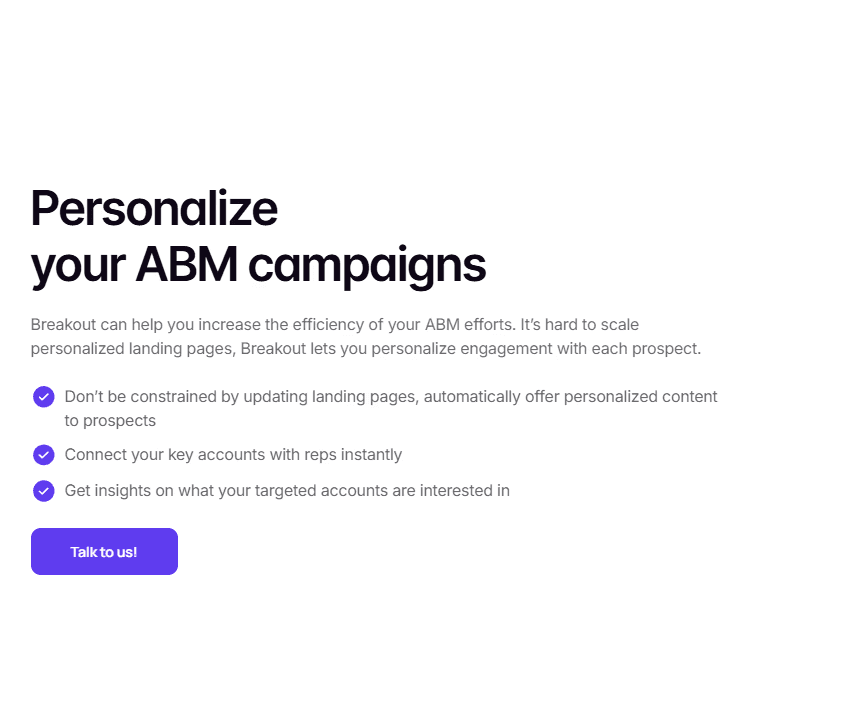
Beyond automating the sales workflow, Breakout personalizes every buyer interaction across your website, ABM campaigns, outbound emails, and paid landing pages.
Instead of relying on forms or delayed follow-up, buyers receive relevant answers the moment they engage. Sales teams receive qualified opportunities with valuable buying context.
1. Capture More Value From Website Traffic
Many high-intent buyers leave without booking a meeting because they can't quickly find the information they need.
Breakout turns your website into an AI-powered buying experience.
It adapts conversations using page context, visitor behavior, firmographic data, traffic source, and other buying signals.
This helps visitors find relevant answers, discover the right resources, and move forward faster.
2. Personalize ABM Engagement
ABM doesn't end when a target account reaches your website.
Breakout personalizes conversations for every account using company context and intent signals.
It can surface relevant content, connect buyers with the right sales representative, and capture qualification details such as budget, decision-makers, business needs, and purchase timeline.
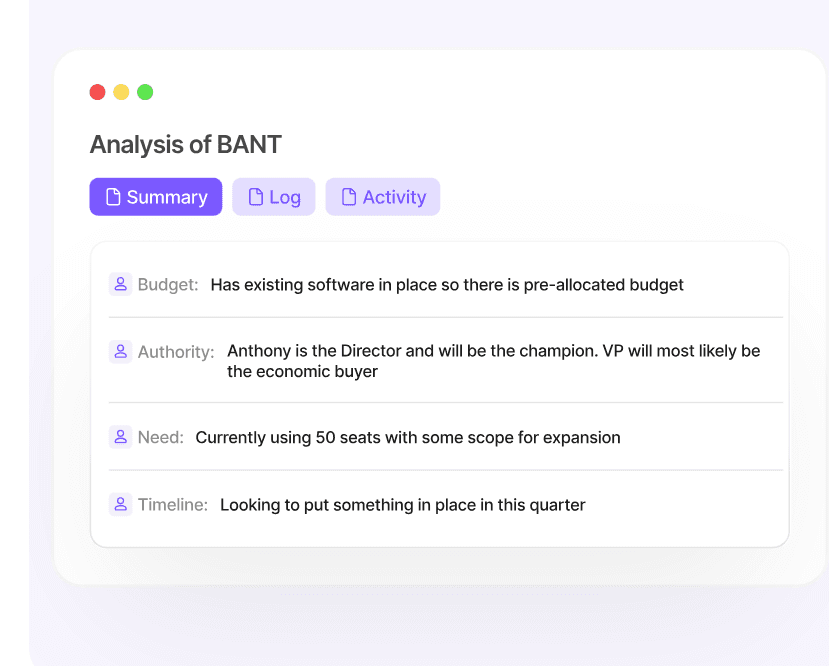
Sales teams start every conversation with richer context instead of gathering basic information.
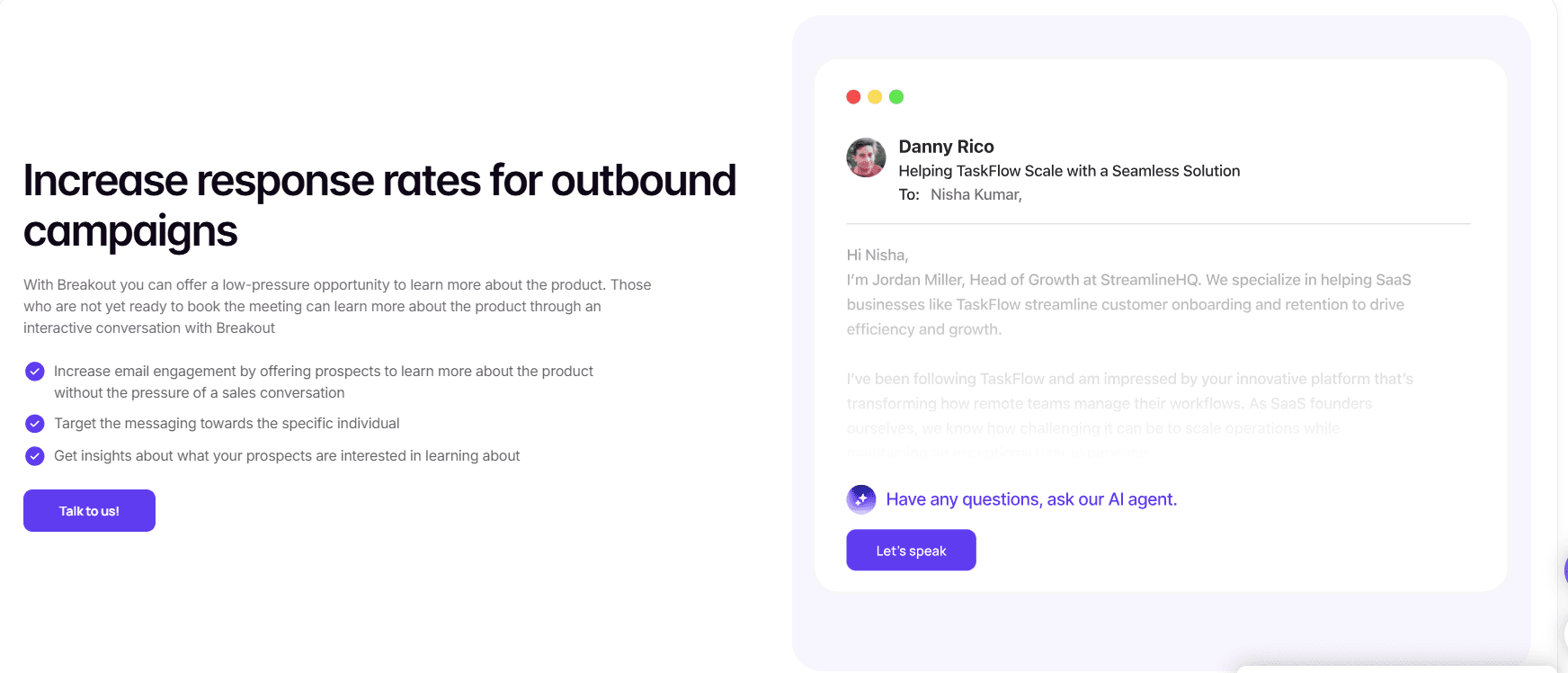
3. Improve Outbound Performance
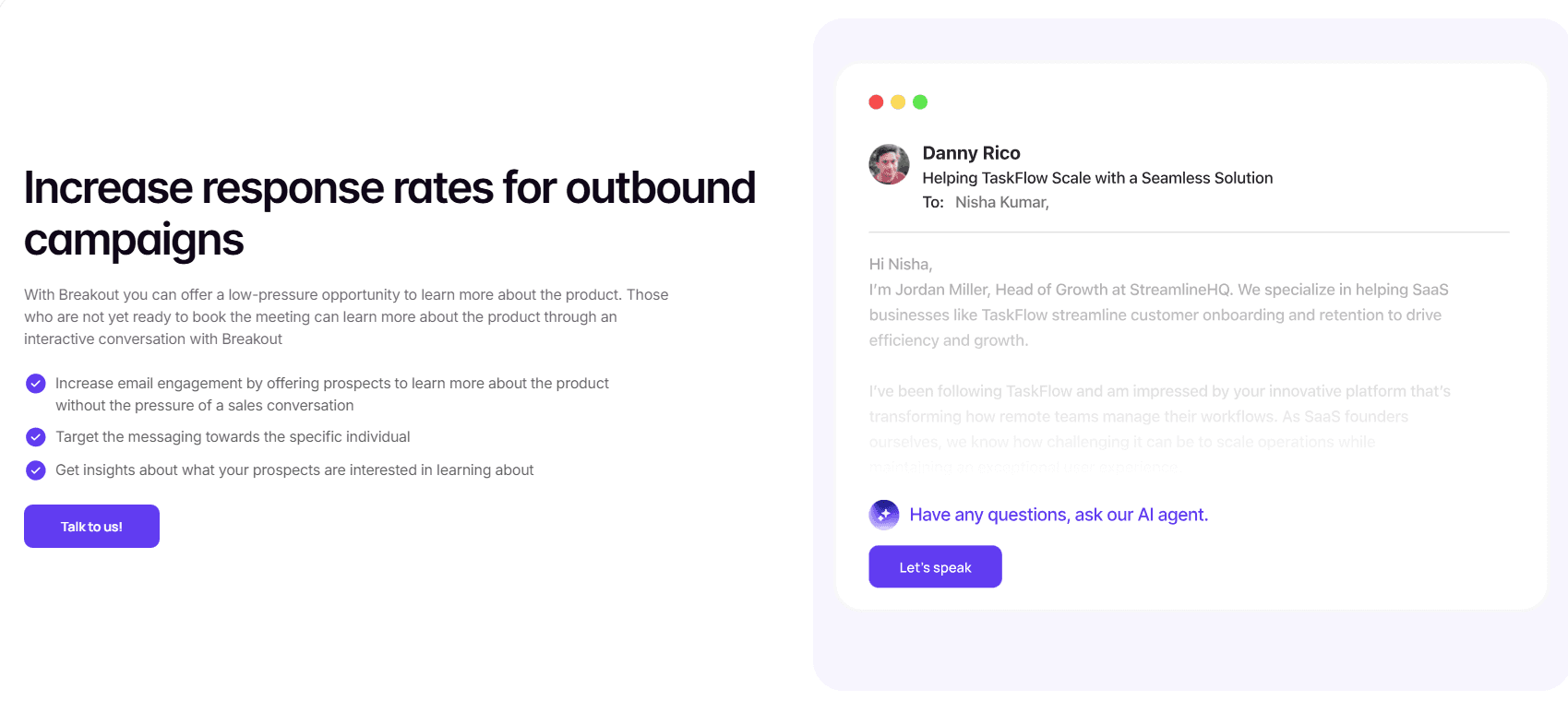
Not every prospect is ready to book a meeting after opening an email.
It gives buyers a low-pressure way to continue the conversation.
Prospects can ask questions, explore the product, and receive personalized answers before speaking with sales.
This increases engagement while helping sales teams focus on buyers who are ready to move forward.
4. Increase Returns From Paid Campaigns
Breakout extends personalized conversations to ad landing pages.
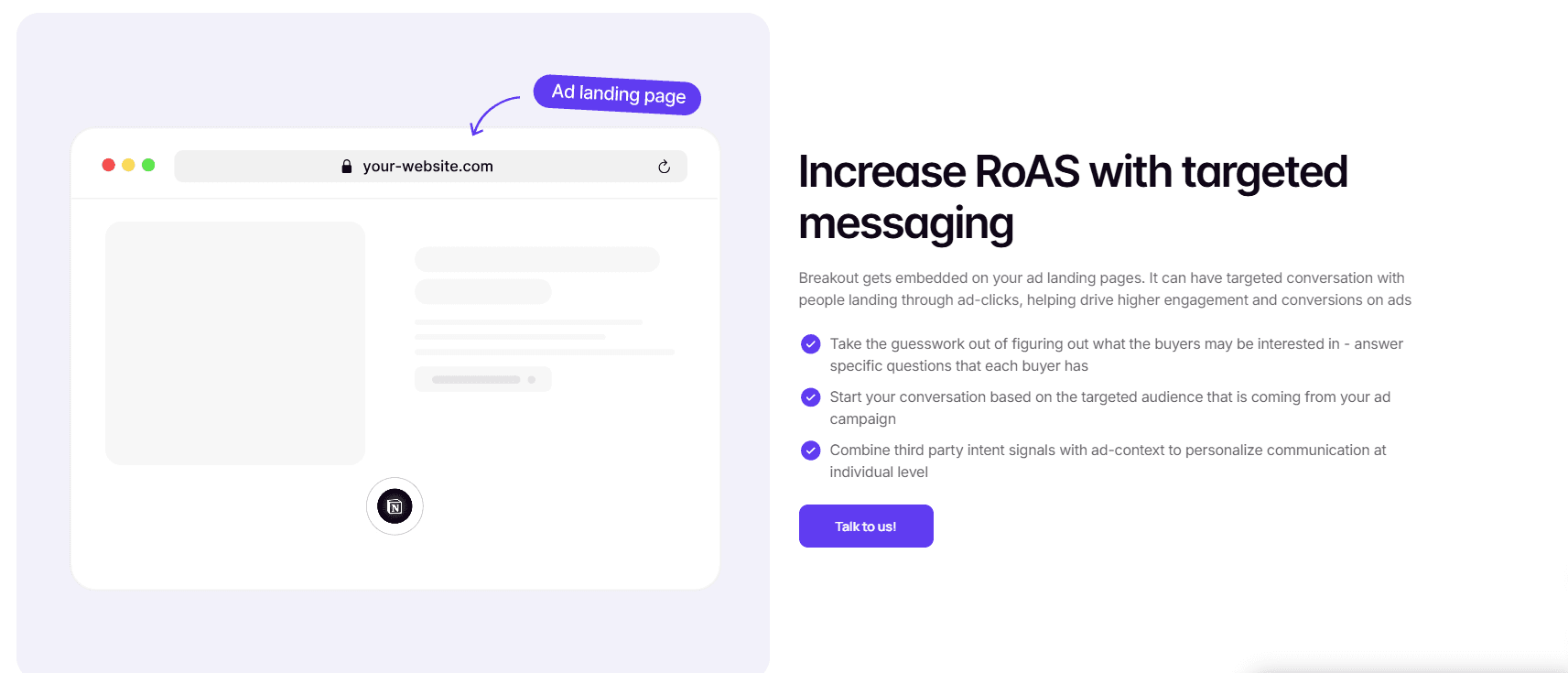
Instead of showing the same experience to every visitor, it adapts messaging based on campaign context and audience attributes.
This creates more relevant buying experiences and helps improve conversion rates from paid traffic.
The Result
Instead of treating buying intent as another sales signal, Breakout turns it into a personalized buying experience.
Revenue teams capture more value from website traffic, ABM programs, outbound campaigns, and paid advertising without increasing SDR workload.
Best Choice By Use Case
Choose 6sense If
Predictive analytics is your top priority
You want deeper buying intent insights
Your sales team needs better account prioritization
You already have strong outbound processes
Choose Demandbase If
You run mature ABM programs
Advertising is a major part of your strategy
You need broader account engagement capabilities
Marketing and sales work closely together on account-based initiatives
Consider Breakout If
You want to convert more website traffic into meetings
Speed-to-lead is a priority
You want to automate qualification and routing
You're looking to capture demand instead of just identifying it
6sense vs Demandbase: Which Platform Should You Choose?
6sense and Demandbase are both strong platforms for understanding buyer intent and supporting account-based marketing.
Based on user reviews, Demandbase has a slight edge, particularly for organizations running mature ABM programs that need advertising, campaign orchestration, and account engagement in one platform.
However, identifying buying intent is only the first step.
Revenue teams still need to engage buyers while interest is high and convert that intent into qualified pipeline.
That's where inbound AI SDRs are changing the buying experience.
Most intent platforms stop at surfacing buying signals. Breakout goes a step further by identifying anonymous website visitors and engaging them in real time. It qualifies buyers, answers questions, and books meetings automatically.
If your goal is to turn more website visitors into qualified pipeline instead of simply identifying buying signals, Breakout is worth exploring.
FAQs
1. What is the difference between 6sense and Demandbase?
6sense focuses on predictive analytics and buying-intent signals. Demandbase offers a broader ABM platform with advertising, engagement, and sales intelligence capabilities.
2. Which is better: 6sense or Demandbase?
The better platform depends on your goals. Choose 6sense for account prioritization and intent insights. Choose Demandbase for end-to-end ABM execution.
3. Is 6sense good for account-based marketing?
Yes. 6sense helps teams identify in-market accounts, understand buying stages, and prioritize outreach based on intent data.
4. Is Demandbase an ABM platform?
Yes. Demandbase is one of the most established ABM platforms and supports account identification, advertising, engagement, and sales intelligence.
5. Does 6sense provide intent data?
Yes. Intent data is one of 6sense's core strengths. It helps sales and marketing teams identify accounts actively researching relevant topics.
6. Does Demandbase provide intent data?
Yes. Demandbase includes intent data alongside account intelligence, advertising, and engagement features.
7. Which platform is easier to use?
Ease of use depends on your team's needs and technical setup. Both platforms require onboarding and integration to unlock their full value.
8. Is 6sense worth the investment?
6sense can deliver strong ROI for teams that rely on buying-intent data and account prioritization to drive pipeline growth.
9. Is Demandbase worth the investment?
Demandbase is often a good fit for organizations running mature ABM programs that need multiple capabilities in one platform.
10. Can 6sense and Demandbase identify anonymous website visitors?
Both platforms provide visitor identification capabilities, though coverage and data depth can vary depending on the account and region.
11. What are the alternatives to 6sense and Demandbase?
Popular alternatives include Terminus, RollWorks, ZoomInfo Marketing, and Breakout. Unlike traditional intent and ABM platforms, Breakout focuses on converting buying intent into pipeline by identifying anonymous website visitors, engaging them in real time, and booking qualified meetings automatically.
12. Who should use 6sense and Demandbase?
These platforms are best suited for B2B companies that want to identify target accounts, understand buyer intent, and improve account-based marketing performance.