
All Blogs
A guide for B2B teams on building n8n lead qualification chatbots—covering the build process, maintenance trade-offs, and when Breakout is the better fit.

Senior Growth AI Strategist
Published On

Your website is pulling in visitors right now, and most of them will leave without your team ever knowing who they were. An n8n chatbot can change that, but building one that stays accurate as your ICP evolves takes more ongoing work than most teams plan for. Here's what the build actually looks like, and where it tends to break down.
TLDR:
An n8n lead qualification workflow captures intent signals, scores leads, and routes them to your CRM, but takes weeks to build from scratch.
Every logic branch, prompt, and CRM field mapping is yours to own, so when criteria change or something breaks, the fix falls on your team.
n8n makes sense if you have dedicated engineering resources and complex, non-standard qualification logic that off-the-shelf tools won't support.
Breakout handles qualification conversations autonomously, with routing and CRM sync built in, removing the need for a separate automation layer.
The Goal: What You're Trying to Accomplish
Before any automation is worth building, you need to be clear on what you actually want it to do.
The goal here is straightforward: when a visitor lands on your site, you want to know whether they are worth pursuing. That means collecting enough context to make a routing decision, without making the visitor fill out a form or wait for a human to respond.
A well-scoped lead qualification workflow should handle three things:
Capture firmographic and intent signals during the conversation, such as company size, role, use case, and urgency, so your team receives a lead with full context instead of only a contact record.
Score or categorize the lead based on your own criteria, so that high-fit prospects get immediate follow-up and poor-fit visitors get a graceful off-ramp. See how to score and route marketing leads faster.
Pass qualified leads to the right destination automatically, whether that is a CRM record, a Slack alert, a calendar booking link, or all three. Effective B2B website visitor identification makes this step far more reliable.
The n8n ai chatbot workflow approach gives you control over every one of those steps. The trade-off is that you are responsible for building and maintaining each node yourself, which is a meaningful time investment before you see any results.
The DIY Approach: Building It in n8n
Here is what makes n8n appealing for this use case: it gives you full control over your lead qualification logic without paying per-seat or per-conversation fees. You can connect an AI node to your website chat widget, route responses through conditional logic, and push qualified leads directly into your CRM. It is also worth comparing dedicated B2B AI chatbot tools built for revenue teams before committing.
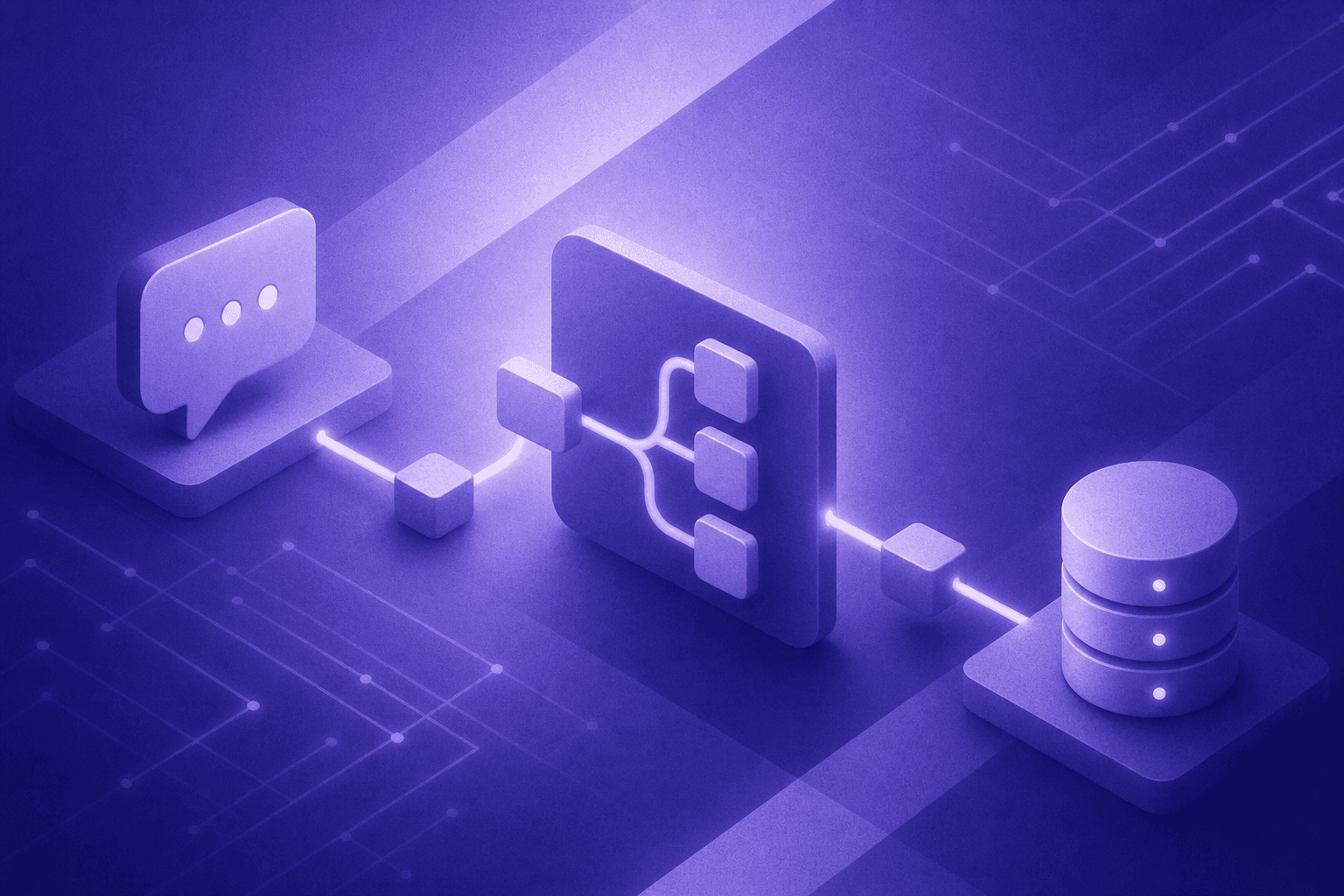
A typical n8n lead qualification workflow looks something like this:
A visitor submits a message through your website chat, which triggers the n8n workflow via webhook.
An AI node processes the message, extracting intent signals like budget range, company size, or urgency based on prompts you define.
Conditional branches route the conversation depending on whether the lead meets your qualification criteria. For a broader view, compare lead routing tools for 2026 before committing to a DIY approach.
Qualified leads get written to your CRM with enriched fields; unqualified visitors receive a fallback response.
That structure is genuinely flexible. You can adapt it to almost any qualification framework, whether you run BANT, MEDDIC, or something internal.
The trade-off is build time and maintenance. You own the prompt engineering, the webhook reliability, the error handling, and every CRM field mapping. When something breaks, and in complex workflows something eventually does, the fix falls on whoever built it.
Where It Breaks Down
The n8n build works, but it asks a lot of you. Every logic branch you want, whether that's routing by company size, filtering out competitors, or escalating high-intent visitors, has to be manually wired into the workflow. When your qualification criteria change, you update the nodes yourself. When the integration breaks, you debug it yourself.
For engineers or technically fluent ops teams, that trade-off is acceptable. The control is the point. But for most marketing and revenue teams, it creates a maintenance burden that quietly compounds. A workflow built by one person becomes a liability the moment they leave. Edge cases accumulate. The chatbot starts mis-routing leads that don't fit the original logic exactly, and nobody notices until pipeline quality drops. A faster fix is learning alert sales when prospects are online in real time.
There's also the conversation quality issue. n8n can connect to an LLM, but the chatbot experience is only as good as the prompts and branching logic you've designed. If a visitor asks something unexpected, the workflow either fails silently or routes them incorrectly. Handling nuance at scale requires iteration that most teams don't have bandwidth for.
The result is a system that technically qualifies leads but demands ongoing investment to stay accurate, which pulls time away from acting on qualified leads and toward maintaining the infrastructure that finds them.
The Purpose-Built Alternative
If your team has outgrown duct-taped n8n workflows and wants qualification logic that runs without a dedicated ops engineer babysitting it, Breakout was built for exactly that situation.
Breakout is an AI-native lead qualification layer that sits on your website and handles the full qualification conversation autonomously. It's one of the leading conversational marketing tools that turn visitors into meetings. Where an n8n chatbot requires you to pre-map every branching path, Breakout's AI reasons through each conversation in real time, asking follow-up questions based on what the prospect actually says, not what you anticipated they might say.
The practical difference shows up in a few specific ways:
Qualification criteria live in plain language, not node graphs. You describe your ICP the way you'd brief a sales rep, and Breakout translates that into conversation logic without requiring a workflow diagram. Compare lead scoring tools in 2026 to see where most fall short.
Routing happens inside the product. Once a lead meets your threshold, Breakout can book a meeting, assign to a rep, or trigger a CRM update without a separate automation layer stitching the handoff together.
Maintenance overhead drops to near zero. There are no nodes to rewire when your qualification criteria change, which means ops isn't pulled in every time sales updates its ICP.
If your current n8n setup is working and your team has the bandwidth to maintain it, that may be the right call. But if qualification is a growth priority and engineering time is scarce, a purpose-built tool removes the bottleneck entirely.
Side-by-Side Comparison
The table below maps each dimension to its practical meaning for pipeline outcomes, beyond technical setup alone.
Dimension | n8n DIY Chatbot | Breakout |
|---|---|---|
Setup time | Days to weeks (technical build required) | Live in days, no developers needed |
Visitor identity | None; visitor self-identifies only | Real-time deanonymization before conversation; see the best AI SDR software for inbound for a full comparison |
Qualification intelligence | Prompt-engineered LLM, static scoring logic | ICP-aware, custom-trained AI SDR per customer |
Real-time engagement | Reactive; waits for visitor message | Proactive nudges based on behavioral signals |
Off-site follow-up | Not available | Warm email and LinkedIn sequences built-in |
CRM sync | Manual node configuration, API maintenance | Native Salesforce, HubSpot, Marketo, and GongEngage |
Maintenance burden | High; APIs, prompts, and memory require upkeep | Zero; Breakout manages infrastructure |
When n8n Still Makes Sense
n8n is a legitimate choice for certain use cases, and it's worth being direct about when.
If your team has dedicated engineering resources, n8n gives you low-level control that most no-code tools won't. You can build a custom n8n AI chatbot website integration, wire it into your CRM, score leads against proprietary criteria, and trigger follow-up sequences exactly the way your sales process requires. For companies with complex, non-standard qualification logic, that flexibility has real value.
It also makes sense if you're already running n8n workflows elsewhere in your stack. Adding a lead qualification workflow on top of existing infrastructure is lower lift than adopting an entirely separate tool.
Where the Trade-offs Show Up
The real accounting here is time and maintenance. Building an n8n lead qualification workflow from scratch typically takes weeks, not hours. Every conditional branch, fallback state, and CRM field mapping is something an engineer has to write and own. When a field changes or a new lead source appears, someone has to update the workflow manually or it breaks.
That trade-off is acceptable if qualification logic is genuinely complex and your eng team has capacity. It becomes harder to defend when the underlying need is straightforward and speed to deployment matters.
Final Thoughts on n8n Chatbot Workflows for Lead Qualification
n8n is a solid choice when your team has the time and technical depth to build and own the workflow end to end. The challenge is that most revenue teams don't, and the maintenance burden compounds quietly until pipeline quality takes a hit. If that pattern sounds familiar, Breakout removes that overhead and lets your team focus on closing leads instead of debugging the system that finds them.
FAQ
What should I use to build an n8n AI chatbot for website lead qualification if my team doesn't have dedicated engineering resources?
If engineering bandwidth is limited, an n8n AI chatbot website build is the wrong starting point. The workflow requires ongoing prompt engineering, webhook maintenance, and manual CRM field mapping that compounds in cost over time. Breakout is built for exactly this situation: qualification criteria are set in plain language, routing happens inside the product, and CRM sync with Salesforce, HubSpot, and Marketo requires no separate automation layer.
n8n lead qualification workflow vs. Breakout: which makes sense for a revenue team scaling inbound pipeline?
n8n gives you low-level control and is a strong fit if you have dedicated engineering resources and genuinely non-standard qualification logic that a purpose-built tool won't accommodate. Breakout is the better fit if speed to deployment matters, your ICP evolves frequently, or you want proactive visitor engagement and off-site follow-up sequences that an n8n chatbot cannot deliver without substantial additional build work.
Can I build an n8n chatbot that qualifies leads without manually mapping every CRM field?
You can reduce the mapping burden through reusable sub-workflows, but the core architecture of an n8n lead qualification workflow still requires someone to own API connections, error handling, and field updates whenever your CRM schema or qualification criteria change. There is no way to fully remove that maintenance dependency without moving to a purpose-built tool that manages the infrastructure for you.
How does Breakout handle lead qualification differently from an n8n AI chatbot?
Breakout's AI reasons through each conversation in real time based on what a prospect actually says, instead of routing through pre-mapped conditional branches the way an n8n chatbot does. The practical result is that qualification holds up when visitors ask unexpected questions, ICP criteria changes don't require a developer to rewire nodes, and the handoff (meeting booking, CRM record creation, and Slack alert) happens inside a single connected layer without a separate automation stitching it together.
When does maintaining an n8n lead qualification workflow become a liability instead of an asset?
The maintenance cost tips from acceptable to a liability when the person who built the workflow leaves the team, when qualification criteria change faster than an engineer can update the nodes, or when mis-routed leads start affecting pipeline quality before anyone notices the logic has drifted. If any of those conditions describe your current situation, the time spent maintaining the workflow has already exceeded the cost of switching to a purpose-built qualification layer.


