All Blogs
Warmly was acquired by HubSpot in 2026, leaving non-HubSpot teams without a CRM-agnostic visitor ID tool. Breakout is the full-cycle AI SDR alternative.

Evan Marshall
Senior Growth AI Strategist
Published On

The version of Warmly you might have reviewed or purchased no longer exists as an independent product. It's inside HubSpot now, which is great news if you're a HubSpot shop and complicated news if you're not. Before you start assessing what comes next, it helps to understand what Warmly actually was, where it fell short even before the acquisition, and how full-cycle AI SDR tools compare to the signals-plus-human-rep model it was built on.
TLDR:
Warmly was acquired by HubSpot on June 30, 2026, making it a HubSpot-native tool, not an independent product.
If your stack runs Salesforce, Marketo, or any non-HubSpot CRM, Warmly is now a structural disqualification.
Warmly's core gap was execution: signals routed to reps, but autonomous follow-up required separate tools and manual triggers.
The entire independent visitor identification category consolidated into Salesforce or HubSpot in under seven months.
Breakout runs natively with Salesforce, HubSpot, and Marketo, closes the loop autonomously, and starts at $500/month with no annual contract.
What Is Warmly
Warmly was a B2B go-to-market tool built around a straightforward premise: most buyers visiting your website never fill out a form, and most sales teams have no way to know they were there. It combined website visitor identification, intent signal aggregation, and AI-driven outreach orchestration to turn anonymous traffic into named, actionable pipeline.
At its core, Warmly was a signals layer. It identified who was on your site, pulled in third-party intent data from sources like Bombora and G2, and routed those signals to sales reps or triggered automated outreach sequences.
That product no longer exists as a standalone company. Warmly announced it was being acquired by HubSpot on June 30, 2026, and is being folded into HubSpot's Smart CRM. What was once a CRM-agnostic signals tool is now a HubSpot-native capability, which changes the calculus considerably for teams not already running HubSpot.
How Warmly's Visitor Identification Works
Warmly's identification engine worked in layers. IP resolution matched a visitor's network IP against company databases to surface firmographic data like company name, size, and industry. Cookie matching and device fingerprinting added a second layer, cross-referencing known identifiers against Warmly's own data graph. Third-party intent partnerships with Bombora and G2 then layered in behavioral signals, showing which topics a company was actively researching across the broader web.
The result was a richer profile than IP resolution alone could produce. According to Factors.ai's 2026 visitor identification guide, roughly 98% of B2B website visitors leave without identifying themselves, which is the gap this architecture was designed to close. Company-level identification was generally more reliable than contact-level resolution, so person-level match rates remained variable depending on data source and traffic volume.
Warmly's Core Features
Warmly's product broke into two primary agents, each covering a different part of the buyer journey.
The Inbound Agent handled real-time engagement. When a known visitor landed on your site, the agent could trigger a conversation, surface relevant content, and route high-intent prospects to available reps. It also supported automated email follow-up when visitors left without converting, though outreach sequences were less sophisticated than dedicated AI SDR tools.
The TAM Agent ran outbound orchestration against your total addressable market, using ML intent scoring and AI ICP tiering to rank which accounts warranted outreach. Buying committee identification surfaced additional stakeholders, and adaptive audience segmentation kept lists fresh as firmographic data changed.
Across both agents, the product offered:
Visitor deanonymization at company and person level
Bombora and G2 intent signal integration
Real-time rep alerts via Slack and email
Lead routing with CRM write-back
Native Salesforce and HubSpot integrations
Automated email follow-up post-bounce
Salesforce was the deeper integration of the two. HubSpot support existed but was less mature, which is somewhat ironic given the acquisition outcome.
Warmly's Pricing Structure
Warmly's free plan deanonymized up to 500 visitors per month and included 10 Bombora intent signals per week, enough to test the product but not enough to run a real sales motion.
Paid plans required a meaningful commitment. According to Warmly's published pricing, the TAM tier started at $15,000 per year and the Inbound Agent tier at $30,000 per year, with custom pricing for the Full GTM bundle. All paid plans were annual contracts only, with no monthly billing option.
That gap between free and paid left no mid-range entry point, making the upgrade decision a hard call for teams still validating whether visitor identification would move their pipeline numbers.
Who Warmly Was Best Suited For
Warmly was built for a specific kind of sales team: growth-stage or mid-market B2B SaaS companies with enough inbound traffic to support a signals layer and enough SDRs to act on the alerts it generated. If your motion depended on reps acting on warm accounts the moment they hit your pricing page, Warmly's real-time identification and routing made that possible.
It fit best when:
You had a CRM-invested sales team already using Salesforce or HubSpot, where write-back worked without workarounds.
Your inbound traffic was substantial enough to surface meaningful intent patterns worth routing.
Human reps were the primary execution layer, with Warmly feeding them context instead of replacing their judgment.
Third-party intent data from Bombora or G2 was part of your account prioritization model.
Where Warmly showed strain was in fully automated follow-up. If you needed the system to pursue a bounced visitor across email and LinkedIn without a rep manually triggering a sequence, the outreach capabilities weren't built for that job. The signals were strong; the execution layer was limited. Teams on non-Salesforce, non-HubSpot CRMs faced a similar ceiling, as anything outside those two ecosystems required workarounds that eroded the real-time value of the identification data.
Warmly's Limitations and Gaps
Warmly's identification layer was genuinely strong. The execution layer is where the model started to show its limits.
The core architectural constraint was that Warmly routed signals to human reps and stopped short of closing the loop autonomously. When a high-intent visitor landed on your site, Warmly could surface who was there and provide relevant context. What it couldn't do was pursue that visitor independently if they left without booking, so response speed depended on rep availability, not system capability.
The chat interface was text-only and rule-based, following structured playbook logic with no ability to adapt to what a buyer actually said. Any deviation from expected inputs created friction that eroded the real-time value of the identification data Warmly had just surfaced.
Multi-channel outreach was the sharpest gap. Automated email sequences and LinkedIn follow-ups after a bounce required separate tools and manual triggers, which meant a meaningful share of high-intent visitors disappeared without further contact.
Warmly Is Now Part of HubSpot
On June 30, 2026, Warmly announced it had entered into an agreement to be acquired by HubSpot. According to HackingDemand's analysis of the deal, HubSpot's stated rationale was closing what it called one of its CRM's biggest blind spots: the 98% of visitors who leave without identifying themselves. The Warmly HubSpot acquisition carries real consequences for revenue teams across the market.
Structurally, this changes what Warmly is. Its independent roadmap is now subordinated to HubSpot's product priorities, and its agents are being folded into HubSpot's Smart CRM instead of continuing as a standalone product. Teams assessing Warmly today are assessing a HubSpot AI SDR capability, not an independent tool.
What the Acquisition Means for Non-HubSpot Teams
Teams running Salesforce, Marketo, Dynamics, or any other CRM have a straightforward problem: Warmly is no longer being built for them. The acquisition makes HubSpot a hard dependency, not a supported integration. As Warmly's agents get absorbed into HubSpot's Smart CRM, development resources follow HubSpot's roadmap priorities, not the needs of teams outside that ecosystem.
Three consequences follow directly:
CRM exclusion is now structural. Salesforce shops that relied on Warmly's identification layer to feed their pipeline motion can't assume that capability will remain accessible, making Warmly alternatives a pressing evaluation for many teams. or well-maintained as a non-HubSpot integration.
Pricing is genuinely unclear. HubSpot will repackage Warmly's capabilities into its own tiering, and how those features get bundled, gated, or repriced is not yet public. Teams budgeting against Warmly's current $15,000 to $30,000 annual tiers are pricing a product that may not exist in that form within a year.
The independent roadmap is frozen. Feature requests, integration improvements, and capability gaps that Warmly would have tackled as a standalone company now compete with HubSpot's broader agenda.
The practical read for a revenue operations leader: assessing Warmly today means assessing a HubSpot-native add-on with uncertain pricing and a subordinated roadmap. Teams outside that ecosystem should start evaluating purpose-built replacements now, before roadmap divergence creates a larger gap to close.
How Warmly Compares to Full-Cycle AI SDR Tools
Warmly was built to make human SDRs faster, not to replace what they do. The identification layer surfaced who was on your site, intent signals showed what they cared about, and a rep took it from there. That model works when your team has the capacity to respond immediately and follow up persistently. When it doesn't, the signal goes cold.
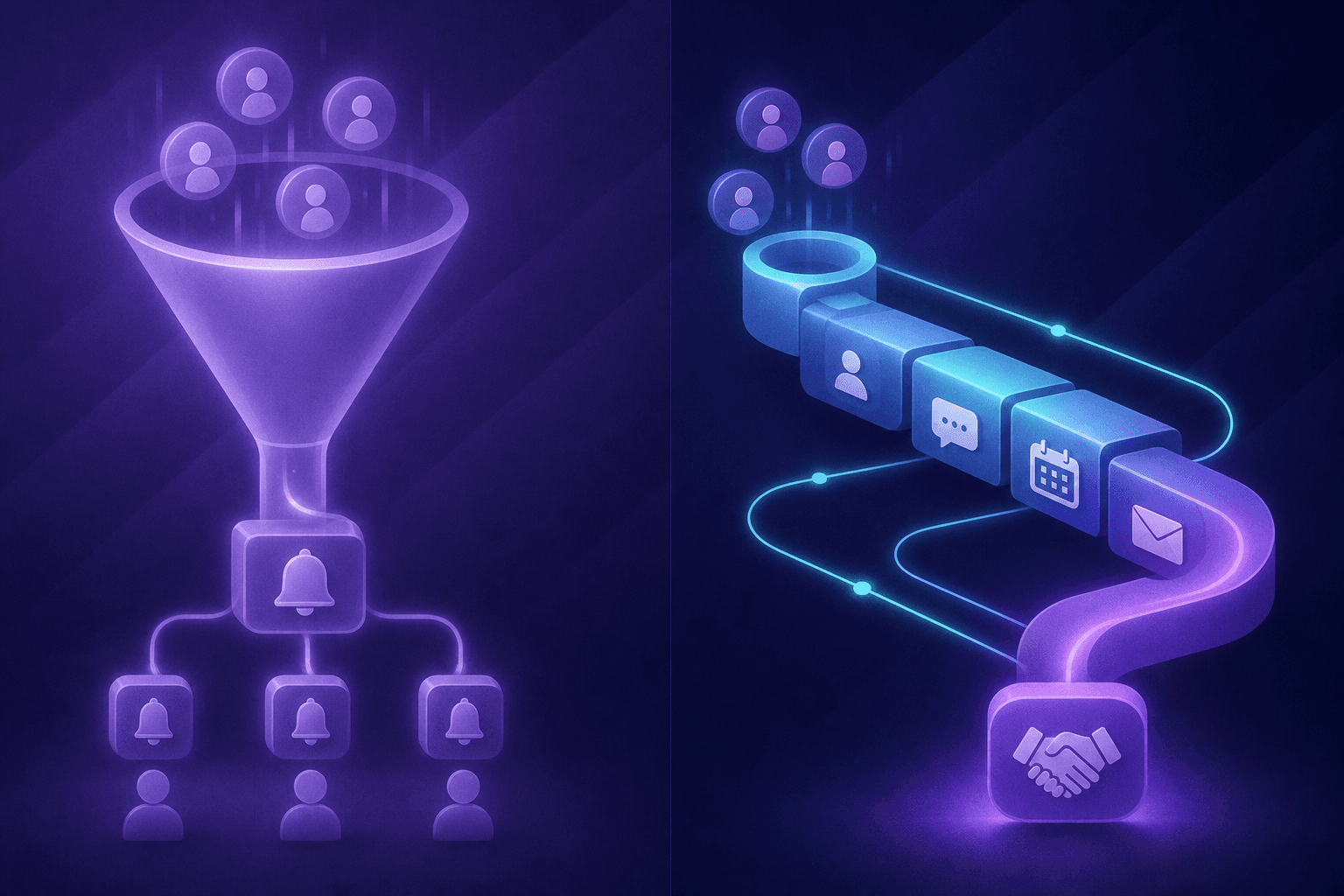
Full-cycle inbound AI SDR tools handle the engagement arc that Warmly handed off to humans. Where Warmly flagged a visitor and routed the alert, a full-cycle tool like Breakout opens the conversation, qualifies the prospect, handles objections, books the meeting, and fires a follow-up sequence across email and LinkedIn if the visitor bounces without a rep intervening at any step. The human enters after qualification, not before it.
The structural difference comes down to where autonomy ends. Warmly's autonomy stopped at the signal. Everything downstream, the outreach, the conversation, the follow-up, required a rep to act. A full-cycle AI SDR owns that entire sequence independently, which means pipeline generation doesn't pause when your team is in meetings, out of office, or simply outnumbered by inbound volume.
Human oversight still matters in both models, but the intervention point is different. In Warmly's model, reps are the execution layer. In a full-cycle model, reps are the closing layer.
The Broader GTM Consolidation Context
The GTM tools market has compressed fast. Within seven months, the major independent players in buyer intent and visitor identification either got acquired or shut down entirely.

Qualified was absorbed by Salesforce in April 2026. Intercom, rebranded as Fin, followed in June 2026 for approximately $3.6 billion, also folding into Salesforce's Agentforce. Warmly joined HubSpot at the end of that same month. Drift was sunset by Salesloft in March 2026. Koala was acquired by Cursor in July 2025 and shut down on September 30, 2025.
The pattern is clear: Salesforce and HubSpot each moved to own the buyer intent layer natively inside their CRM. What were once CRM-agnostic tools are now CRM-specific add-ons, with roadmaps and pricing controlled by their acquirers.
For revenue teams, the immediate question is dependency. Every one of these acquisitions converts a best-of-breed evaluation into a CRM commitment. If your stack sits outside those two CRMs, your independent options in this category have narrowed to near zero through consolidation, and through no decision you made. Finding a capable Warmly alternative has become urgent.
Even teams already running HubSpot or Salesforce face a different kind of risk: their visitor intelligence and AI SDR motion now depend on a single vendor's roadmap, pricing decisions, and product priorities. That's a meaningful concentration of risk for a capability that sits at the top of the pipeline.
How Breakout Fills the Gaps Warmly Left Behind
For teams that built their inbound motion around Warmly, the acquisition creates a gap that goes beyond replacing a single product. The signals layer, the outreach orchestration, and the buying committee identification are now inside HubSpot's ecosystem, which means teams on any other CRM stack are sourcing a replacement from scratch.
Breakout is built for exactly that replacement motion. It runs natively with Salesforce, HubSpot, and Marketo, so your CRM stack doesn't limit what you can deploy. For a detailed look at how these two products compare, see Breakout vs Warmly inbound sales tool analysis. Unlike Warmly's model, where signals fed human reps who then executed, Breakout closes the loop autonomously. It deanonymizes visitors before any form submission, opens personalized conversations trained on your specific ICP and sales playbooks, handles objections in-conversation, and books meetings directly. When a visitor bounces without booking, it triggers email and LinkedIn follow-up within minutes. No rep required until the meeting is already on the calendar.
Capability | Warmly (pre-acquisition) | Breakout |
|---|---|---|
CRM compatibility | Salesforce, HubSpot (now HubSpot-only) | Salesforce, HubSpot, Marketo |
Visitor deanonymization | Yes, at company and person level | Yes, including buying committee profiles |
Intent signal integration | Bombora and G2 | RB2B API + waterfall enrichment |
Outreach execution | Signals routed to human reps | Autonomous: AI handles outreach end-to-end |
Meeting booking | Rep-dependent | AI books directly in-conversation |
Post-bounce follow-up | Required separate tools and manual triggers | Automated email + LinkedIn within minutes |
Entry-level pricing | $15,000/year (TAM tier) | $500/month (Signals plan) |
Contract requirement | Annual only | No annual contract required |
Free trial | Free plan (500 visitors/month) | 30-day free trial |
Independent roadmap | No; subordinated to HubSpot | Yes |
The pricing is also straightforward: a free 30-day trial, a Signals plan at $500 per month, and a Growth plan at $2,000 per month, with no mandatory onboarding fees and no annual-only contracts. That's a materially different entry point than Warmly's $15,000 annual floor, and it doesn't require subordinating your roadmap to HubSpot's product priorities to access it.
Final Thoughts on Warmly's Acquisition and the AI SDR Gap It Left Behind
Warmly's story is less about one tool going away and more about how fast the independent options in this category have narrowed. The need it served, turning anonymous visitors into pipeline before they bounce, hasn't changed at all. What has changed is where you go to solve it if HubSpot isn't your CRM. Start a free Breakout trial to see how a full-cycle AI SDR handles identification, outreach, and meeting booking without the HubSpot dependency.
FAQs
What are the best AI tools for converting B2B website visitors into qualified leads in 2026?
The independent options in this category have narrowed sharply following a wave of acquisitions in 2026. Qualified was absorbed by Salesforce in April, Warmly was acquired by HubSpot in June, and Koala shut down entirely in September, leaving Breakout as the primary standalone alternative for teams that need visitor identification, qualification, and automated follow-up without being locked into a specific CRM. If your stack runs on Salesforce, HubSpot, or Marketo, Breakout deploys natively across all three and starts a real pipeline motion from a 30-day free trial.
What tools can automatically enrich, qualify, and route inbound leads from a B2B website in 2026?
A full-cycle inbound AI SDR like Breakout handles all three steps in a single connected workflow: it deanonymizes anonymous visitors before any form is submitted, opens a personalized AI conversation trained on your ICP, qualifies the prospect in-conversation including objection handling, and books the meeting directly. Visitor identification tools like Warmly handled the enrichment layer but required human reps to execute outreach, meaning a missed or slow response let high-intent visitors go cold. Dedicated routing tools like Chili Piper only activate after a form fill, so pre-form visitors never enter the workflow at all.
How does AI-powered website visitor deanonymization work for B2B revenue teams?
Deanonymization combines IP resolution, which matches a visitor's network IP to a company, with cookie matching and device fingerprinting to cross-reference known identifiers against a broader data graph. Person-level identification adds LinkedIn profile data and confidence scoring on top of company-level matching, though contact-level match rates vary by traffic volume and data source. Breakout layers person-level enrichment through its RB2B API integration and waterfall enrichment to build buying committee profiles, then acts on that data immediately through automated outreach instead of routing it to a queue for reps to process manually.
Is Warmly still a viable alternative to Breakout for teams not on HubSpot?
No. Warmly was acquired by HubSpot on June 30, 2026, making HubSpot a hard platform dependency going forward. Teams on Salesforce, Marketo, Dynamics, or any non-HubSpot CRM are structurally excluded from Warmly's roadmap, and Warmly's independent feature development is now subordinated to HubSpot's product priorities. For those teams, Breakout is the direct replacement: it runs natively across Salesforce, HubSpot, and Marketo, requires no mandatory onboarding fees, and deploys in days rather than weeks.
How does an AI SDR agent handle the handoff from real-time prospect discovery to a human sales rep?
A full-cycle AI SDR like Breakout qualifies the prospect completely before any rep is involved. The agent identifies the visitor, opens a personalized conversation, handles objections in real time, and books the meeting directly inside the conversation. The rep receives a fully qualified, scheduled prospect, not a raw alert or an enriched company record. In contrast, signal-routing tools like the pre-acquisition Warmly flagged who was on your site and handed that context to a rep to pursue manually, meaning response speed and follow-through depended on rep availability, not system capability.