TL;DR
Every GTM engineering tool claims to automate revenue operations.
In reality, each one solves a different part of the problem.
Some capture buying signals, others enrich customer data, orchestrate workflows, or execute AI-powered outreach.
The table below gives you a quick snapshot of where each platform fits before we break down their strengths, limitations, and ideal use cases.
Tool | Category | Best For |
Breakout | Inbound AI SDR | Converting anonymous website visitors into qualified pipeline with AI |
Clay | Data Enrichment & GTM Workbench | Building custom enrichment and outbound workflows |
Apollo.io | Sales Intelligence | Fast outbound prospecting for startups and SMBs |
Common Room | Signal Intelligence | Capturing product, community, and buying signals |
RB2B | Website Visitor Identification | Identifying anonymous website visitors in real time |
Census | Reverse ETL | Activating warehouse data across your GTM stack |
Hightouch | Reverse ETL | Enterprise-scale customer data activation |
n8n | Workflow Automation | Building advanced, customizable GTM workflows |
Zapier | No-Code Automation | Automating business processes with minimal setup |
Unify | AI Outbound Platform | Signal-based outbound prospecting and AI-driven outreach |
Every revenue team wants to scale faster.
Few realize their biggest bottleneck isn't headcount. It's infrastructure.
As companies add more tools, their go-to-market stack becomes increasingly fragmented. Lead data lives in one platform, intent signals in another, CRM records go stale, and outbound workflows rely on brittle automations that break with every process change.
Instead of accelerating growth, teams spend hours fixing workflows, enriching records, and moving data between systems.
That's exactly why GTM engineering has become one of the fastest-growing functions in B2B SaaS.
GTM engineers build the systems that connect sales, marketing, product, and customer data into a reliable revenue engine.
They automate lead routing, enrich accounts, orchestrate AI agents, maintain CRM hygiene, and eliminate manual work so revenue teams can focus on selling instead of operations.
The tools powering this function have evolved just as quickly.
Today's platforms do far more than enrich contact records or automate workflows.
They identify buying signals, coordinate AI-powered prospecting, sync data across dozens of systems, and help teams build scalable GTM infrastructure without relying on engineering for every change.
But not every GTM engineering tool solves the same problem.
Some excel at workflow automation. Others specialize in data enrichment, AI orchestration, CRM operations, or inbound pipeline generation.
The right choice depends on your team's technical maturity, GTM motion, and growth stage.
In this guide, we've compared the best GTM engineering tools based on workflow automation, data quality, AI capabilities, integrations, implementation effort, pricing, and overall business impact.
Whether you're building your first GTM engineering stack or replacing a patchwork of disconnected tools, this guide will help you find the platform that best fits your revenue strategy.
What GTM Engineering Tools Actually Need to Solve
Most GTM engineering articles compare tools by features.
The best GTM engineering teams don't buy tools to automate individual tasks.
They build systems that move data, surface buying signals, orchestrate workflows, and execute actions across the entire revenue engine.
That's why we've organized this guide around the five core jobs every modern GTM stack needs to perform.
Unlike traditional sales software roundups, this list intentionally excludes platforms like Salesloft, Outreach, Gong, and other sales execution tools.
Those products sit on top of the GTM stack.
GTM engineering focuses on the infrastructure underneath that makes those tools more effective.
Here's what today's GTM engineering platforms actually need to solve.
1. Capture data and buying signals
Every workflow starts with high-quality inputs.
GTM teams need to identify anonymous website visitors, detect product usage, monitor hiring activity, track intent signals, and collect engagement data from across their tech stack.
Without reliable signals, even the most sophisticated automation has nothing meaningful to act on.
2. Enrich and unify customer data
Raw signals are rarely enough.
They need to be matched to accounts, enriched with company and contact information, validated across multiple providers, and synced into a single source of truth.
Modern enrichment platforms combine data from multiple providers, improving accuracy while reducing gaps that come from relying on a single database.
3. Orchestrate workflows across the GTM stack
Once data is unified, it needs to move where it's needed.
This is where GTM engineering tools automate lead routing, update CRM records, trigger enrichment, and synchronize data between systems. They also coordinate workflows across sales, marketing, customer success, and product teams.
The goal isn't simply automation. It's ensuring every system stays aligned without manual intervention.
4. Execute personalized outreach
Modern GTM platforms increasingly extend beyond infrastructure into execution.
Instead of simply surfacing qualified accounts, they can trigger personalized emails, engage website visitors with AI, launch outbound sequences, notify SDRs in real time, or qualify inbound leads automatically.
Execution has become part of the platform rather than a separate workflow.
5. Power everything with AI
AI is no longer another feature in the GTM stack. It's becoming the orchestration layer that connects every stage of the revenue workflow.
Today's leading platforms use AI to qualify leads, enrich records, prioritize accounts, generate research, personalize outreach, and automate decisions that previously required manual effort.
The strongest GTM engineering tools don't just help teams work faster.
They enable autonomous workflows that continuously learn, adapt, and scale alongside your revenue operations.
The tools in this guide are evaluated against these five jobs. Some excel at enrichment, others at workflow orchestration, AI-powered execution, or signal capture.
Understanding where each platform fits will help you build a GTM stack that scales with your business instead of adding more operational complexity.
How We Evaluated These GTM Engineering Tools
The best GTM teams don't win because they have more tools.
They win because their stack moves faster, requires less manual work, and turns buying signals into pipeline with minimal friction.
That's the lens we used for this guide.
We didn't rank tools based on the number of integrations, AI features, or database size.
We evaluated whether they solve real GTM problems, reduce operational complexity, and scale as your revenue engine grows.
Here are the five criteria that matter most.
1. AI-Native vs. AI Add-On
This was our most heavily weighted criterion.
There's a growing gap between platforms built around AI and platforms that have simply added AI features.
AI-native products use AI to execute work. They qualify buyers, orchestrate workflows, enrich records, make decisions, and trigger actions autonomously.
Legacy platforms often bolt on AI assistants or copilots that generate content or answer questions, but the underlying workflows remain unchanged.
That difference isn't cosmetic. It's architectural.
As AI becomes the operating layer for GTM, AI-native platforms will continue to compound in value.
2. Time to Value
A platform isn't valuable because it has powerful capabilities. It's valuable when your team actually uses them.
If implementation takes months, requires engineering support, or depends on a lengthy services engagement, you've already delayed the return on your investment.
The best GTM tools deliver value quickly.
You should be able to connect your systems, automate critical workflows, and improve pipeline generation in days or weeks, not quarters.
3. Total Cost at Scale
Most pricing pages tell you what it costs to get started. They rarely tell you what it costs to grow.
As your GTM organization scales, so do seat licenses, enrichment credits, API limits, implementation costs, and operational overhead.
A platform that looks affordable today can become one of the most expensive parts of your stack tomorrow.
That's why we evaluated total cost of ownership, not just entry-level pricing.
4. Stack and Warehouse Compatibility
No GTM platform operates in isolation.
Your CRM, warehouse, product data, marketing automation platform, and AI tools all need to work together.
The best GTM engineering platforms fit naturally into your existing architecture through robust APIs, warehouse-native integrations, and flexible automation.
If a platform forces you to rebuild your stack around its limitations, it's solving the wrong problem.
5. Ability to Consolidate Your GTM Stack
Every new point solution adds another integration to maintain, another workflow to troubleshoot, and another vendor to manage.
The strongest GTM engineering platforms don't just automate work. They eliminate entire categories of work.
We prioritized tools that can replace multiple point solutions by combining enrichment, workflow automation, signal capture, AI execution, lead routing, and data synchronization into a single platform.
The 10 GTM Engineering Tools We Recommend in 2026
The best GTM engineering platforms don't just automate tasks.
They eliminate manual work, connect fragmented systems, and help revenue teams move from data to pipeline faster.
But no single platform does everything. Some excel at data enrichment, while others specialize in warehouse sync, workflow automation, signal intelligence, or AI-powered execution.
The right choice depends on the problem you're trying to solve and where it fits into your GTM stack.
To help you make that decision, we evaluated the leading GTM engineering tools based on AI capabilities, implementation speed, scalability, integrations, and overall business impact.
Here's how they compare.
1. Breakout
Best for: AI-native inbound pipeline generation and autonomous lead qualification.
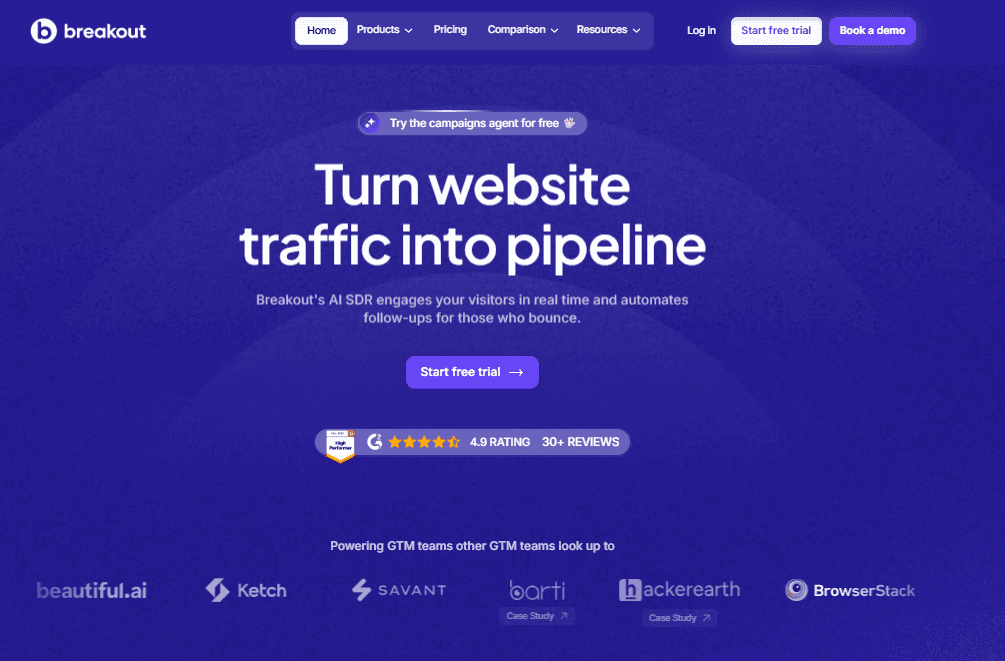
Most GTM tools stop at identifying buying signals. Breakout acts on them.
That's what makes it different.
Traditional GTM platforms surface high-intent visitors, enrich records, or notify your sales team when someone is ready to buy.
Its AI SDR engages visitors the moment they show intent, answers questions, qualifies leads, routes them to the right rep, books meetings, and follows up automatically if they leave before converting.
Instead of adding another dashboard for your team to monitor, Breakout becomes an extension of your sales organization.
It turns inbound traffic into qualified pipeline without increasing SDR headcount or slowing down response times.
This makes Breakout particularly valuable for B2B SaaS companies with strong inbound demand that want to capture more pipeline from the traffic they already have.
If your website is generating buying intent but your team can't respond fast enough, Breakout closes that gap automatically.
Standout Features
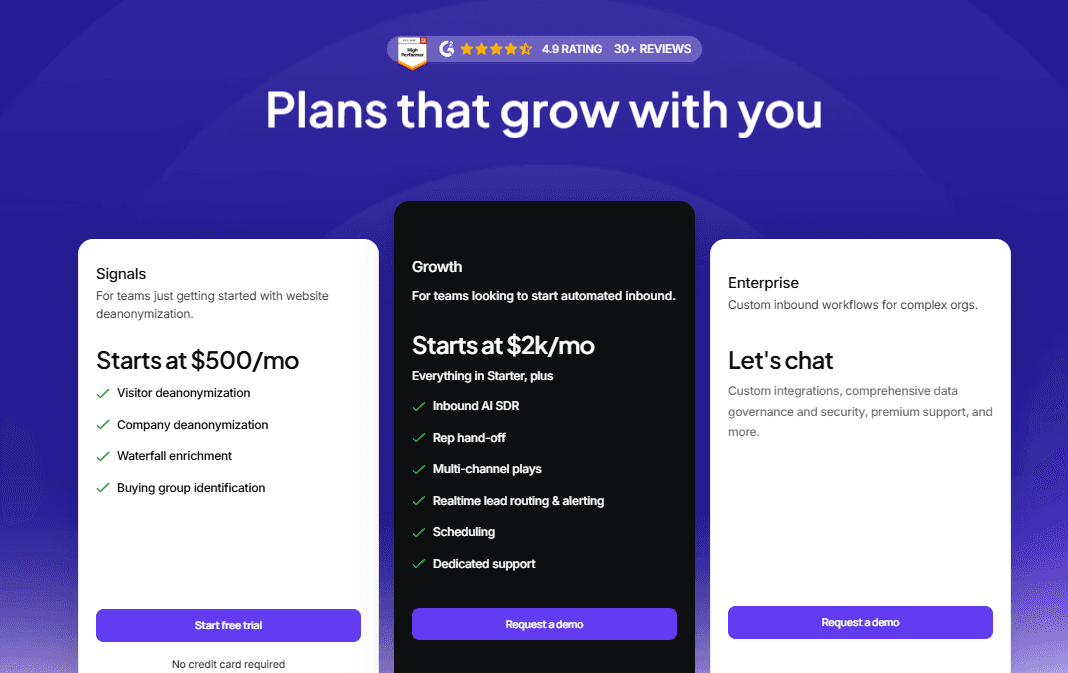
AI SDR that engages, qualifies, and books meetings autonomously
Real-time website visitor identification
AI-powered live chat that answers buyer questions naturally
Waterfall enrichment to identify accounts and buying committees
Automated email and LinkedIn follow-up for abandoned conversations
Intelligent lead routing based on your qualification rules
Native integrations with Salesforce, HubSpot, Slack, and 40+ GTM tools
Pricing
Custom pricing based on website traffic and usage. Plans typically start around $500/month, with a free trial available.
What Users Say
Users consistently praise Breakout for reducing lead response times and converting more website visitors into booked meetings without adding SDR capacity.
Many reviewers highlight the quality of AI conversations, saying prospects often don't realize they're interacting with an AI agent.
Some teams note that defining qualification logic upfront helps maximize results, especially for complex enterprise sales motions.
Bottom line
Breakout is the best choice if your goal is turning website traffic into qualified pipeline automatically.
It doesn't just identify buying intent. It engages buyers, qualifies opportunities, and books meetings, all from a single AI-native platform.
How Revenue Teams Use Breakout:
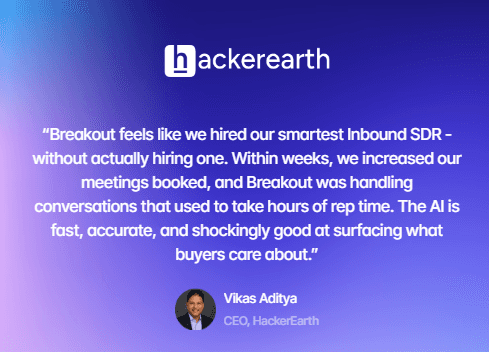
HackerEarth implemented Breakout in less than a day to engage high-intent website visitors with AI-powered conversations.
The results were immediate: 2.5% higher visitor engagement, a 10% lead capture rate from conversations, and 21% of Q1 pipeline either sourced or influenced by Breakout, without expanding its SDR team.
2. Clay
Best for: GTM teams that want complete control over data enrichment and outbound workflows.
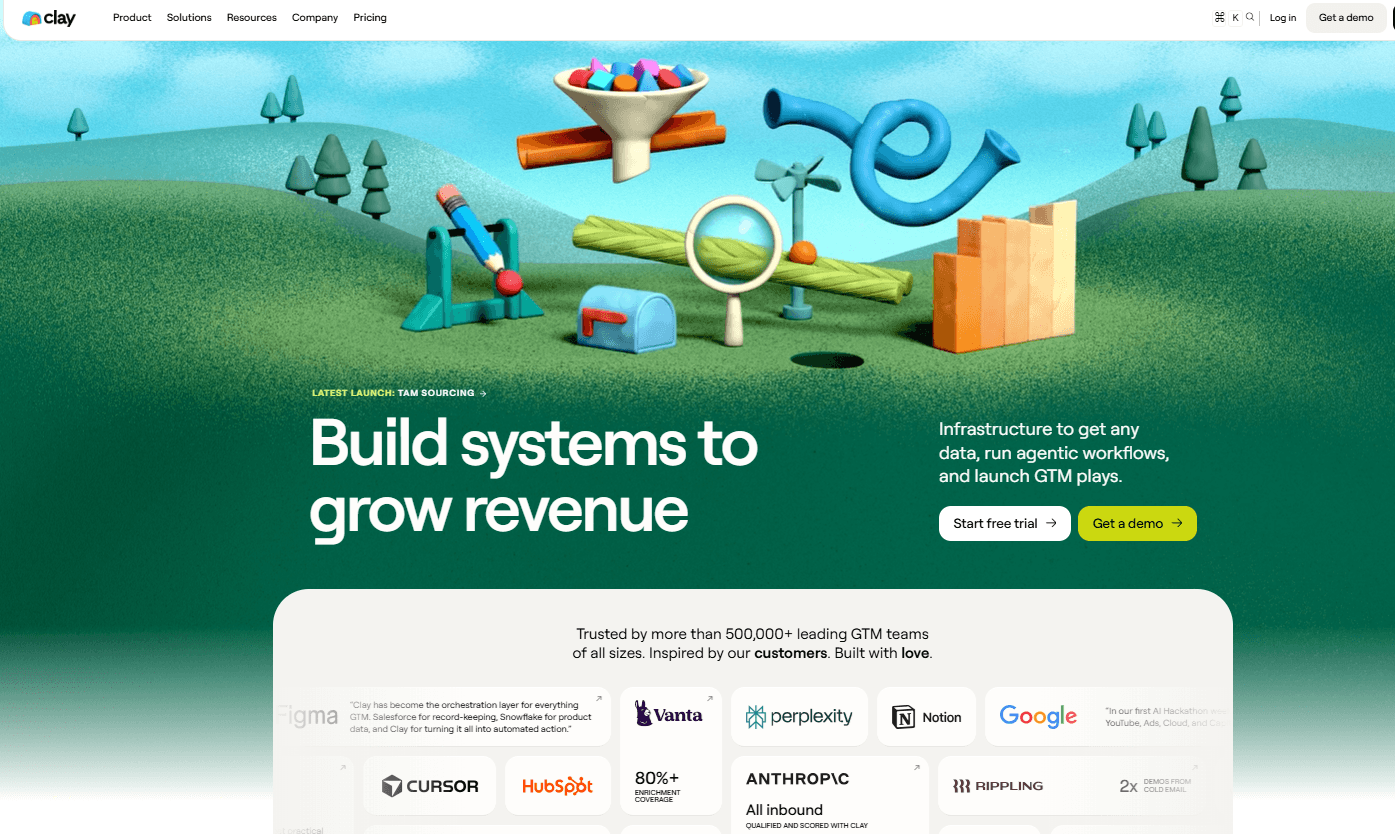
Clay has become the default workspace for many GTM engineers, and for good reason.
It combines waterfall enrichment across more than 100 data providers with AI, APIs, and workflow automation, giving technical teams the flexibility to build highly customized outbound motions.
The trade-off is complexity.
Clay isn't a plug-and-play platform, and teams often need time to build and maintain workflows. If you're willing to invest in that effort, it's one of the most powerful GTM engineering tools available.
Standout Features
Waterfall enrichment across 100+ providers
AI-powered data research and enrichment
Custom tables and workflow automation
Native integrations with major GTM platforms
API-first architecture
Pricing
Starts at $149/month, with usage-based pricing for larger teams.
What Users Say
Users love Clay's flexibility and enrichment accuracy, especially for account research and outbound prospecting.
Many also note that it has a steep learning curve and requires ongoing maintenance to get the most value.
Bottom line
Choose Clay if you want to build custom GTM workflows. Don't choose it if you're looking for an out-of-the-box AI SDR or autonomous pipeline generation
3. Apollo.io
Best for: Startups and SMBs looking for an all-in-one outbound sales platform.

Apollo combines a large B2B contact database with email sequencing, prospecting, and basic automation in a single platform.
That makes it one of the fastest ways to launch an outbound motion without stitching together multiple tools.
As teams mature, however, many outgrow Apollo's enrichment quality and workflow flexibility in favor of more specialized platforms.
Standout Features
Large B2B contact database
Email sequencing and engagement
Buyer intent filters
Chrome extension
CRM integrations
Pricing
Free plan available. Paid plans start at $59/user/month.
What Users Say
Users appreciate Apollo's value for money and ease of use. Common complaints include inconsistent contact accuracy and credit limitations.
Bottom line
Choose Apollo if you need outbound up and running quickly. Look elsewhere if you need advanced GTM orchestration or AI-native automation.
4. Common Room
Best for: Revenue teams that rely on product, community, and buying signals.

Common Room takes a different approach to GTM by helping teams identify buying intent across product usage, social engagement, communities, and website activity.
Instead of focusing solely on contact data, it gives sales teams richer context about when and why buyers are ready to engage.
It's particularly valuable for PLG and community-led growth companies.
Standout Features
Multi-channel buying signal detection
Product usage intelligence
Community engagement tracking
AI-powered account prioritization
CRM integrations
Pricing
Custom pricing.
What Users Say
Users praise Common Room's signal intelligence and visibility into buyer behavior. Some reviewers say it delivers the most value when paired with a mature GTM strategy.
Bottom line
Choose Common Room if buying signals drive your sales motion. Don't expect it to replace enrichment or automation platforms.
5. RB2B
Best for: Identifying anonymous website visitors in real time.
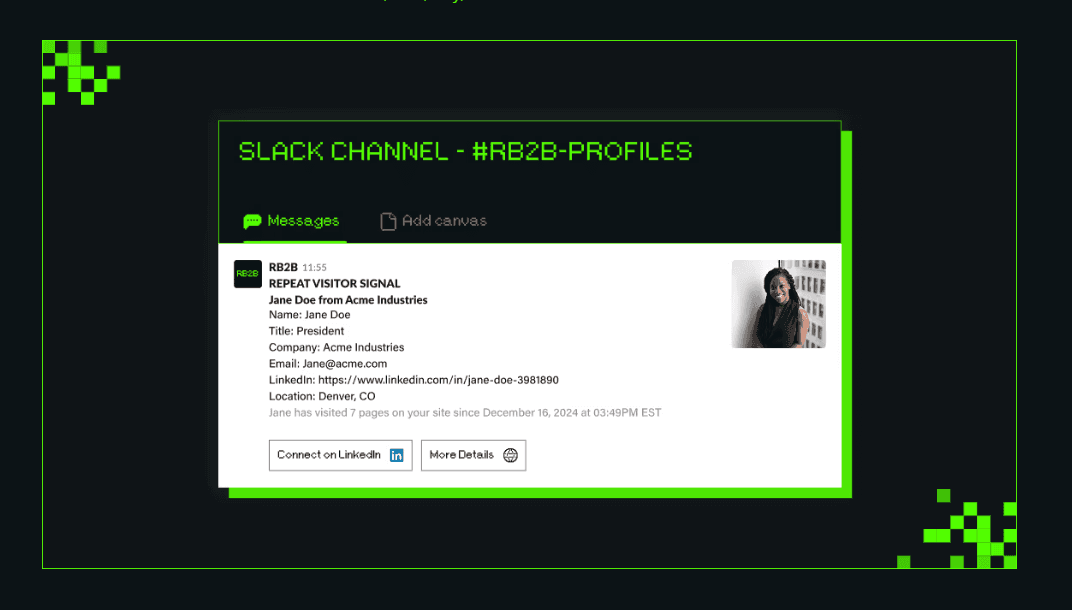
RB2B focuses on one problem: revealing who's visiting your website.
It identifies individual visitors and delivers those insights directly to Slack or your CRM, making it easy for sales teams to follow up quickly.
Its simplicity is its biggest strength, but you'll still need other tools to enrich data, automate outreach, or qualify leads.
Standout Features
Person-level visitor identification
Real-time Slack notifications
CRM integrations
Simple setup
Website intent tracking
Pricing
Free plan available. Paid plans start around $99/month.
What Users Say
Users consistently highlight how quickly RB2B starts delivering actionable visitor insights. Some wish it included more automation after visitor identification.
Bottom line
Choose RB2B if you want immediate visibility into website visitors. Pair it with another platform for execution.
6. Census
Best for: Warehouse-first GTM teams.
Census is now part of Fivetran.
It helps operationalize customer data by syncing information directly from your data warehouse into business applications. It's ideal for organizations that already treat the warehouse as their single source of truth.
Compared to Hightouch, Census is often praised for its ease of use and developer experience.
Standout Features
Reverse ETL
Warehouse-native architecture
Data activation workflows
Broad SaaS integrations
Sync monitoring
Pricing
Custom pricing.
What Users Say
Users appreciate Census for its intuitive interface and reliable sync performance. Some reviewers say pricing becomes expensive at larger volumes.
Bottom line
Choose Census if your GTM strategy starts with your data warehouse. It's less relevant for teams without a mature data infrastructure.
7. Hightouch
Best for: Enterprise-grade reverse ETL and customer data activation.
Hightouch helped define the reverse ETL category and remains one of the strongest options for enterprise organizations.
Its warehouse-native approach makes it easy to activate customer data across marketing, sales, and support systems without duplicating information.
Compared to Census, Hightouch generally offers deeper enterprise capabilities and governance controls.
Standout Features
Reverse ETL
Audience activation
Enterprise governance
Warehouse-native sync
Extensive integrations
Pricing
Custom pricing.
What Users Say
Customers praise Hightouch's scalability and enterprise reliability. Some mention that implementation can require more technical resources.
Bottom line
Choose Hightouch if you're running an enterprise data stack. Smaller teams may find Census easier to adopt.
8. n8n
Best for: Technical teams that want complete control over automation.
If Zapier prioritizes simplicity, n8n prioritizes flexibility.
Its open-source architecture lets GTM engineers build sophisticated workflows, connect custom APIs, and self-host automations when needed.
The trade-off is that it requires more technical expertise than no-code alternatives.
Standout Features
Open-source automation
Self-hosting
Custom API workflows
AI integrations
Extensive node library
Pricing
Free self-hosted version available. Cloud plans start at $24/month.
What Users Say
Users love the flexibility and customization options. The biggest drawback is the learning curve for non-technical users.
Bottom line
Choose n8n if your team is comfortable building automation. Choose Zapier if speed matters more than flexibility.
9. Zapier
Best for: No-code workflow automation.
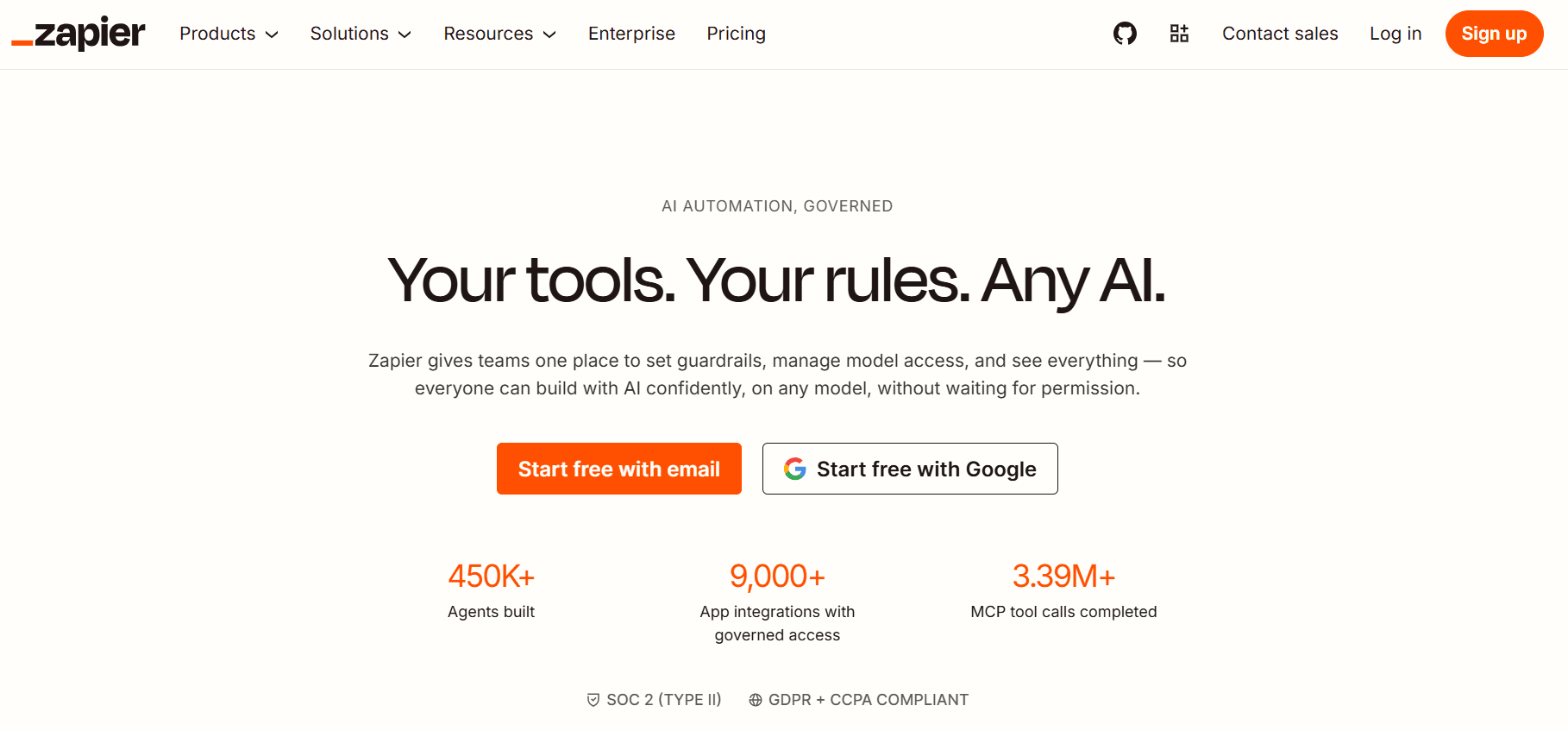
Zapier remains one of the easiest ways to connect SaaS applications and automate repetitive work.
With thousands of integrations and an intuitive interface, most teams can launch automations within minutes.
Its simplicity comes at the expense of flexibility for more advanced GTM workflows.
Standout Features
7,000+ integrations
No-code workflow builder
AI-powered automation
Multi-step workflows
Large template library
Pricing
Free plan available. Paid plans start at $29.99/month.
What Users Say
Users consistently praise Zapier's ease of use and broad integration ecosystem. Some note that complex workflows become expensive as task volume increases.
Bottom line
Choose Zapier if you need simple automation fast. Choose n8n if you need developer-level customization.
10. Unify
Best for: AI-powered outbound prospecting and signal-based sales execution.

Unify helps outbound teams move beyond static lead lists by combining buying signals, AI agents, and workflow automation.
Instead of relying solely on scheduled sequences, it prioritizes prospects based on intent and automates personalized outreach.
For teams building modern signal-based outbound programs, it offers a more autonomous approach than traditional sequencing platforms.
Standout Features
AI-powered outbound workflows
Buying signal detection
Automated prospect prioritization
Personalized outreach
CRM integrations
Pricing
Custom pricing.
What Users Say
Users highlight Unify's ability to uncover high-intent prospects and automate repetitive outbound tasks. Some reviewers note that it works best alongside a mature GTM data foundation.
Bottom line
Choose Unify if you're modernizing outbound with AI and buying signals. It's not designed to replace inbound AI SDR platforms like Breakout.
n8n vs. Zapier: Which Popular Automation Layer Should GTM Engineers Choose?
No GTM stack is complete without an automation layer.
Whether you're syncing CRM data, enriching accounts, routing leads, or triggering AI workflows, something has to connect all the moving pieces. That's where automation platforms come in.
Zapier and n8n are two of the most popular options, but they aren't built for the same type of team.
Comparing feature lists misses the point.
If your goal is to connect a handful of SaaS applications and automate repetitive tasks, Zapier is the obvious choice.
It has thousands of integrations, an intuitive interface, and lets RevOps teams launch workflows in minutes without writing code.
For many startups, that's more than enough.
But modern GTM engineering isn't just about moving data from one application to another.
You're enriching accounts across multiple providers, evaluating buying signals in real time, routing leads based on firmographic and behavioral data, syncing warehouse data, and automatically triggering AI agents to take action.
Those workflows quickly outgrow the limits of traditional no-code automation.
That's where n8n stands apart.
Its open-source architecture, custom API support, JavaScript functions, and self-hosting options give GTM engineers complete control over how workflows are designed and executed.
Instead of adapting your GTM motion to fit the platform, you can build workflows around the way your business actually operates.
That flexibility comes with a trade-off. n8n assumes someone on your team is responsible for building, testing, and maintaining those automations.
If you don't have technical resources, the additional control may become additional overhead.
Our Take
Choose Zapier if you want the fastest path to automation and your workflows are relatively straightforward.
It's a great fit for startups, lean RevOps teams, and businesses that prioritize speed over customization.
Choose n8n if you have dedicated GTM engineers or technical RevOps professionals building a warehouse-first, AI-native revenue stack.
As your workflows become more sophisticated, the additional flexibility becomes a competitive advantage.
There's another question worth asking, though.
How much of your GTM process should rely on workflows in the first place?
Many revenue teams still build long automation chains just to respond to a buying signal.
A visitor lands on the pricing page, another tool identifies them, another enriches the account, another creates a CRM record, another posts to Slack, and finally an SDR follows up.
Every handoff adds latency. Every workflow introduces another point of failure.
That's why AI-native platforms are changing how GTM stacks are built.
Instead of orchestrating a dozen automations after a buying signal appears, Breakout engages the buyer immediately.
Its AI SDR qualifies visitors, answers questions, routes leads, and books meetings autonomously, reducing the number of workflows your team has to build and maintain.
Automation platforms like Zapier and n8n will always have an important place in your GTM stack. But the next evolution of GTM engineering isn't about creating more workflows.
It's about building a stack that needs fewer of them.
How to Choose Your GTM Engineering Stack
Many companies make the mistake of buying enterprise-grade infrastructure before they've validated their GTM motion.
Others keep adding point solutions long after they've outgrown them. Both approaches create unnecessary complexity.
Instead, build your stack around the motion you're trying to scale.
If you're an early-stage company focused on outbound
At this stage, speed matters more than perfect architecture. Your priority is finding prospects, reaching them quickly, and learning what messaging converts.
A stack built around Apollo, Clay, and Zapier gives you everything you need to source leads, enrich data, and automate repetitive tasks without a large RevOps team.
As your outbound motion becomes more sophisticated, you can replace Zapier with n8n for greater flexibility and customization.
If you're generating inbound demand
Generating traffic is only half the challenge. Converting it into pipeline is what drives growth.
Many companies know high-intent buyers are visiting their website but still rely on SDRs to qualify leads, answer questions, and book meetings manually. Every handoff slows the buying journey and increases the chance of losing qualified prospects.
That's where an AI-native inbound platform makes the biggest impact.
Breakout doesn't just identify anonymous visitors or surface buying signals. It handles the entire inbound workflow.
It deanonymizes website visitors, engages them with an AI SDR, answers product questions, qualifies buying intent, routes qualified opportunities, and books meetings automatically.
Instead of stitching together multiple tools for visitor identification, conversational AI, lead routing, and follow-up, Breakout brings the entire inbound motion into a single platform.
That means fewer integrations, fewer workflows to maintain, and a faster path from website visit to qualified pipeline.
If you're scaling with a data warehouse
As your GTM organization grows, customer data becomes your competitive advantage.
Platforms like Census and Hightouch activate warehouse data across your CRM, marketing automation, and customer success tools, ensuring every team works from the same source of truth.
Add Clay for enrichment and n8n for advanced orchestration, and you have a flexible infrastructure capable of supporting complex, AI-powered GTM motions.
The key is resisting the urge to buy every new tool.
The strongest GTM stacks aren't the biggest. They're the ones where every platform has a clear purpose, integrates cleanly with the rest of the stack, and removes manual work instead of creating more of it.
Why the Modern GTM Stack Starts With Breakout
For years, GTM teams have invested in getting better at identifying buying intent.
They've added visitor identification tools, enrichment platforms, intent providers, CRMs, and automation software. Yet someone still has to qualify the lead, answer questions, and book the meeting.
That's the bottleneck.
The next generation of GTM platforms won't compete on who identifies the most signals. They'll compete on who acts on those signals first.
That's why AI inbound SDRs are becoming the foundation of modern revenue teams.
Instead of routing buying intent through a series of workflows and waiting for an SDR to respond, Breakout engages buyers instantly.
It qualifies leads, answers questions, routes opportunities, and books meetings autonomously, turning website traffic into pipeline while your team focuses on closing deals.
As AI reshapes GTM, the winning strategy isn't adding more tools. It's removing more handoffs.
If you're building an inbound revenue engine for 2026 and beyond, that's exactly where Breakout fits.
Ready to see it in action?
Book a demo and discover how Breakout can turn more of your website visitors into a qualified pipeline.
FAQs
1. What is a GTM engineering tool?
A GTM engineering tool helps revenue teams automate, connect, and optimize their go-to-market operations.
These platforms can enrich customer data, automate workflows, sync data across systems, identify buying signals, and even execute sales tasks using AI.
2. What do GTM engineers do?
GTM engineers build and maintain the technical infrastructure behind a company's revenue engine.
They connect sales, marketing, customer success, and product data, automate repetitive processes, and create scalable systems that help revenue teams operate more efficiently.
3. What is modern GTM engineering?
Modern GTM engineering goes beyond CRM administration and workflow automation.
It combines data engineering, AI, automation, and RevOps to build systems that identify buying intent, trigger actions, and improve pipeline generation with minimal manual work.
4. What are the best GTM engineering tools?
The best tool depends on your GTM motion.
Breakout is ideal for AI-native inbound pipeline generation; Clay excels at enrichment and outbound workflows; Apollo is a strong all-in-one outbound platform, while Census and Hightouch are leading warehouse-native data activation tools.
5. How do I choose the right GTM engineering platform?
Start by identifying your biggest bottleneck. If you're focused on inbound conversion, look for AI-native execution platforms like Breakout.
If outbound prospecting is your priority, tools like Clay and Apollo are better suited.
Companies with mature data infrastructure should also evaluate warehouse-native platforms such as Census or Hightouch.
6. What's the difference between GTM engineering and RevOps?
RevOps focuses on aligning revenue teams and improving operational efficiency.
GTM engineering is more technical, emphasizing automation, data infrastructure, APIs, AI, and system architecture that enable those revenue operations at scale.
7. What's the difference between Zapier and n8n for GTM teams?
Zapier is best for quickly automating common business workflows with little technical effort. n8n offers far more flexibility through custom APIs, JavaScript, and self-hosting, making it a better fit for organizations with dedicated GTM engineers or technical RevOps teams.
8. Do I need a data warehouse before investing in GTM engineering?
No. Early-stage companies can build effective GTM systems using CRM, automation, and enrichment tools. As your business grows, adding a warehouse with platforms like Census or Hightouch can improve data quality and support more advanced automation.
9. Why are AI-native GTM platforms becoming more popular?
Traditional GTM tools identify buying signals but still rely on people to take the next step. AI-native platforms can qualify leads, engage buyers, route opportunities, and book meetings automatically, reducing manual work and accelerating pipeline generation.
10. Can one GTM engineering tool replace my entire stack?
Usually not.
Most organizations use multiple tools for enrichment, automation, CRM, and data activation.
However, AI-native platforms are increasingly consolidating tasks that previously required several point solutions, helping teams reduce complexity and lower total cost of ownership.