All Blogs
Compares top Outreach alternatives for B2B revenue teams, highlighting inbound/outbound gaps and why Breakout covers both motions starting at $500/month.

Evan Marshall
Senior Growth AI Strategist
Published On

Somewhere between paying for four tools to fill in what Outreach doesn't cover and watching high-intent visitors leave your site without ever talking to anyone, the case for switching starts to write itself. The question is which alternative is actually solving your problem versus just moving it. Here's what each option does well and where it runs out.
TLDR:
Outreach works for enterprise outbound sequencing, but has no inbound visitor deanonymization, on-site engagement, or post-bounce follow-up.
Assembling a full Outreach stack costs $7,424 to $10,516 per user per year once the missing tools are added.
Most alternatives like Unify, Artisan, and 11X solve outbound-only problems and leave the same inbound gap open.
Warmly now requires HubSpot as a hard dependency, ruling it out for teams on Salesforce or Marketo.
Breakout covers inbound visitor identification, on-site AI SDR conversations, and post-bounce follow-up, with pricing starting at $500/month.
What Is Outreach and How Does It Work?
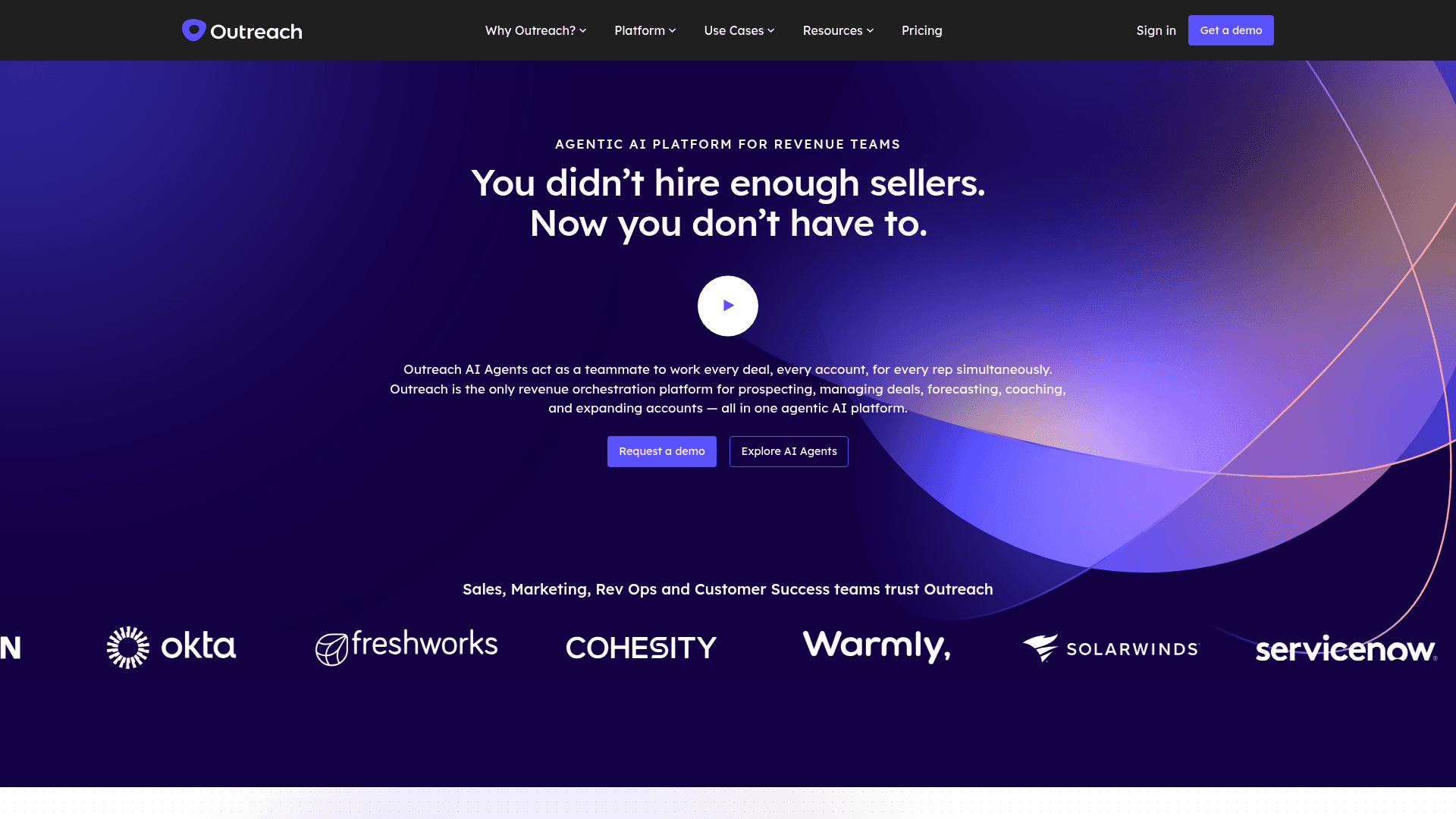
Outreach is a sales execution tool built for enterprise B2B revenue teams. At its core, Outreach combines multi-channel sales engagement with deal management, conversation intelligence, and forecasting, giving sales, marketing, revenue operations, and customer success teams a shared workspace for running and measuring pipeline.
Reps use Outreach to run structured, data-driven workflows across email, calls, social, and other touchpoints, while managers get visibility into engagement, pipeline health, and forecast risk. The product is organized around named capability areas: sales engagement (Engage), voice (Call), conversation intelligence (Meet/Kaia), deal management (Deal), forecasting (Forecast), and AI agents (Amplify).
Outreach is clearly built for larger organizations. There is no free plan, and pricing requires a direct sales conversation since no public tiers are listed. For teams that need a single system spanning prospecting sequences, call recording, pipeline forecasting, and deal inspection, Outreach delivers that breadth in one place.
Why Consider Outreach Alternatives?
Outreach earns its reputation in enterprise accounts, particularly for teams running complex CRM workflows in Salesforce. CRM field mappings and bi-directional sync work well at that scale, and for organizations whose primary need is structured multi-channel sequencing tied tightly to Salesforce pipeline, Outreach delivers.
The friction shows up when you zoom out. Outbound in 2026 requires data, deliverability, buying signals, AI SDR capabilities, and social automation, and Outreach covers little of that natively. You end up bolting together four to five additional tools, with costs up to $10,516 per user annually once that full stack is assembled.
Pricing lacks transparency, which makes budget forecasting unreliable before you've signed, and the learning curve is steep enough that getting full value requires substantial ramp time. Smaller or mid-market teams often pay enterprise prices for capabilities they haven't fully configured yet.
There's also a structural gap worth naming: Outreach was built for outbound sequencing. It has no inbound visitor deanonymization, no real-time on-site engagement, and no AI-driven qualification for website traffic. If a meaningful share of your pipeline comes from converting visitors before they speak to a rep, that motion requires yet another tool outside the Outreach ecosystem entirely.
Best Outreach Alternatives in August 2026
Breakout is one of the top inbound AI SDRs that deanonymizes website visitors, engages them on-site with personalized AI conversations, books meetings directly into the calendar, and pursues prospects who leave without converting via automated email and LinkedIn follow-up. Where Outreach depends on human reps to build and execute sequences, Breakout handles the full conversion arc autonomously.
What they offer:
Real-time visitor deanonymization with company, person, and buying committee identification before any form submission
AI SDR trained on your specific ICP and sales motion, with in-conversation objection handling and meeting booking
Multi-channel follow-up via email and LinkedIn triggered within minutes of a bounce
Native integrations for Salesforce, HubSpot, and Marketo with no mandatory onboarding fees
The Spoc Campaigns Agent for coordinating outbound GTM workflows across 200+ tools
Good for: CMOs, VP Sales, and Revenue Operations leaders at Series B+ B2B SaaS companies who need to stop leaking inbound pipeline and want a unified AI SDR covering both visitor conversion and outbound execution without growing headcount.
Bottom line: Outreach still depends on human reps to execute sequences. Breakout replaces that manual layer with an AI SDR that runs inbound and outbound simultaneously, with transparent pricing starting at $500/month and deployments that go live in days.
Unify
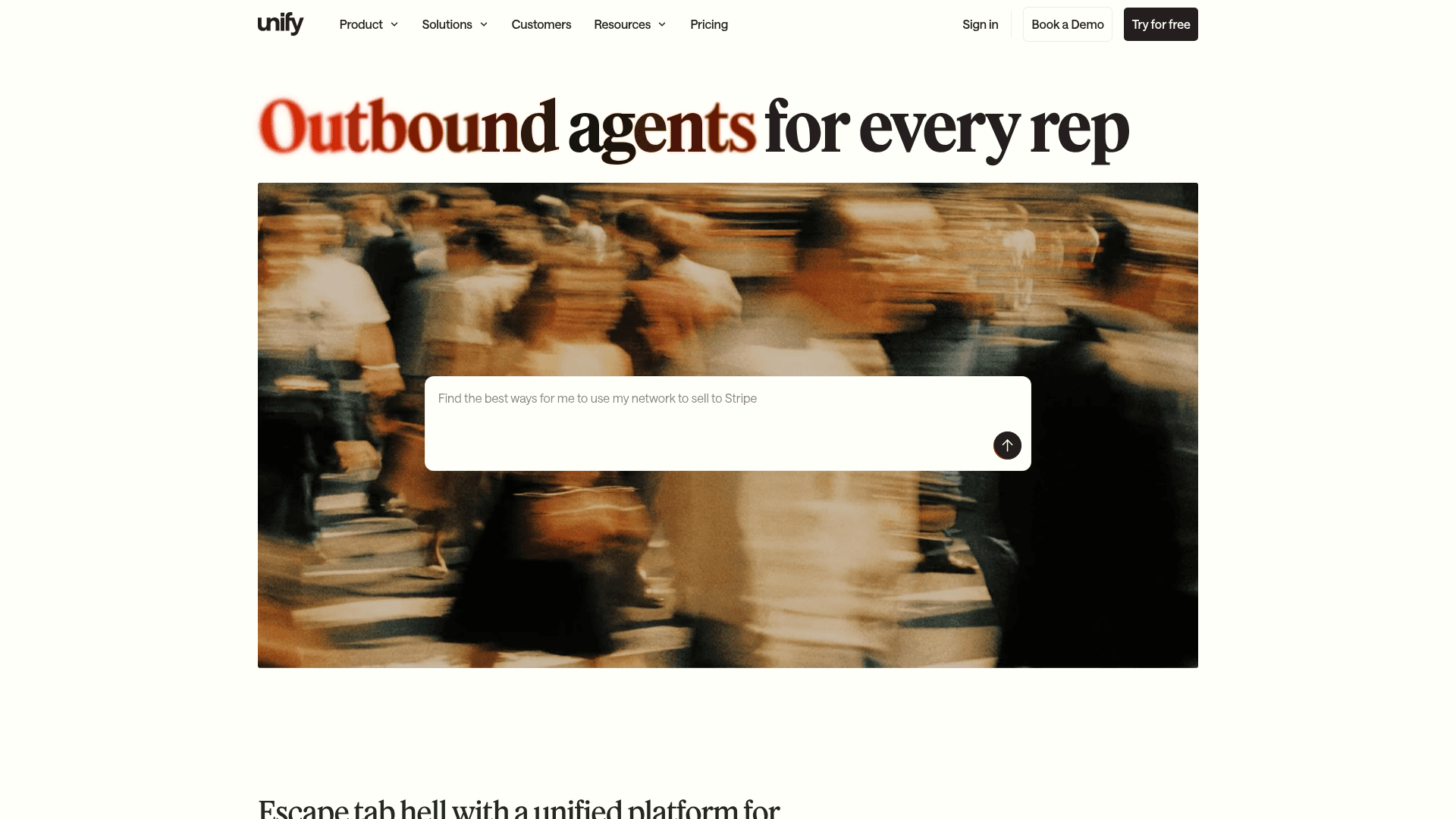
Unify is a warm outbound tool that aggregates intent signals and uses AI to generate personalized email sequences triggered by those signals. It targets teams wanting to move from cold outreach to signal-triggered outbound without assembling a separate data stack.
What they offer:
Intent signal aggregation across 25+ sources including job changes, funding rounds, and G2 reviews
AI-generated "Plays" that trigger personalized email sequences based on signal combinations
Salesforce and HubSpot CRM sync
Managed mailbox infrastructure for deliverability
Good for: B2B teams whose pipeline problem is purely outbound signal activation via email.
Key limitation: Unify has no AI chatbot and no real-time on-site engagement capability, meaning visitors identified by Unify cannot be engaged while still on the site. Setup typically runs two to four weeks.
Bottom line: Unify works for signal-triggered email outbound. It leaves real-time on-site engagement and post-bounce multi-channel follow-up unaddressed.
Artisan
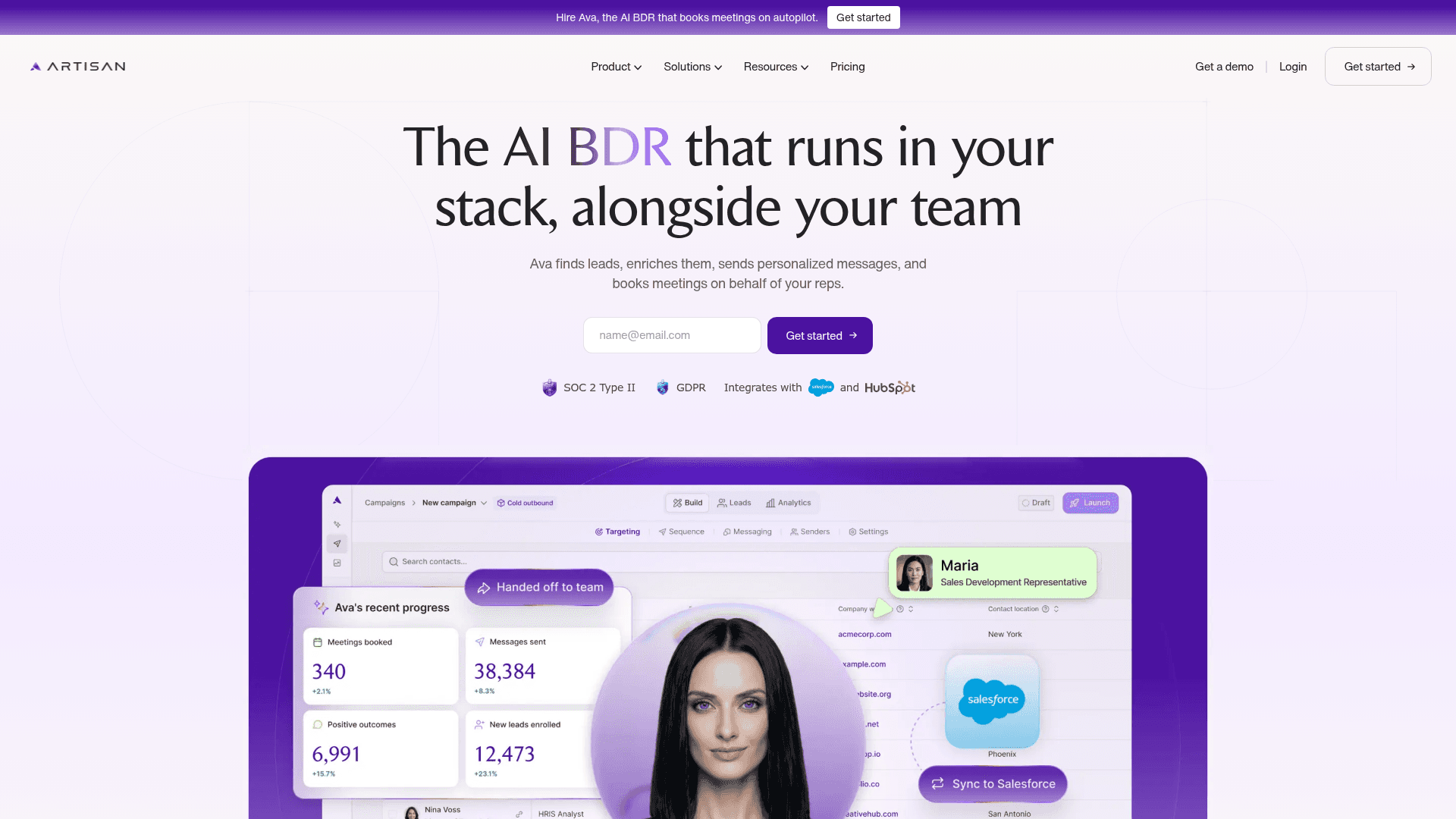
Artisan is an outbound AI SDR built around its AI agent Ava, which autonomously handles prospect research, email personalization, sequence execution, and meeting booking for cold outreach workflows.
What they offer:
Autonomous prospect research and outbound email sequencing
AI-generated personalization based on company signals and contact data
Meeting booking integrated into the outbound sequence
LinkedIn touchpoints, though Ava drafts LinkedIn messages instead of sending them autonomously
Good for: Teams running high-volume cold outbound who want to reduce SDR headcount on prospecting and sequence execution.
Key limitation: Artisan is a purely outbound tool with no inbound visitor deanonymization, no on-site engagement, and no post-bounce follow-up for website traffic. LinkedIn automation is semi-manual. Teams with a meaningful inbound motion will need separate tooling entirely.
Bottom line: Artisan handles cold outbound well at scale, but covers only one side of pipeline. If your motion includes any inbound volume, Artisan leaves that gap open.
What they offer:
Artisan covers the full outbound sequence through its AI agent Ava, who handles prospect research, personalized message writing, sequence execution, reply qualification, and meeting booking without a human SDR in the loop. A bundled contact database and managed email deliverability infrastructure are included, so teams do not need separate enrichment or sending tools on top. Salesforce and HubSpot CRM sync is native with bi-directional activity logging, keeping pipeline data current without manual exports. LinkedIn is part of Ava's outreach repertoire, though with an important caveat: Ava drafts LinkedIn messages for rep review instead of sending them autonomously, which means LinkedIn execution still requires a human touchpoint. For teams running high-volume cold outbound who want to consolidate prospecting, writing, and sequencing under one product, that tradeoff may be acceptable, but it is worth flagging if fully hands-off LinkedIn outreach is a requirement. Pricing is not publicly listed, and third-party estimates vary widely, making budget forecasting dependent on getting through a full sales conversation before any number is on the table.
Good for: Lean B2B outbound teams that want to automate high-volume cold outreach without managing separate prospecting, enrichment, and sequencing tools.
Key limitation: Artisan lacks deanonymization, inbound chat, and personalization, making it an outbound-only tool. Pricing is opaque, with third-party estimates ranging widely, which makes budget forecasting unreliable before you get on a sales call.
Bottom line: Artisan fits teams focused exclusively on scaling cold outbound volume, but if you're looking into Artisan alternatives, your biggest revenue leak may be inbound website traffic that never converts, or you want human-in-the-loop review before sequences go out, Artisan leaves both gaps open.
11X
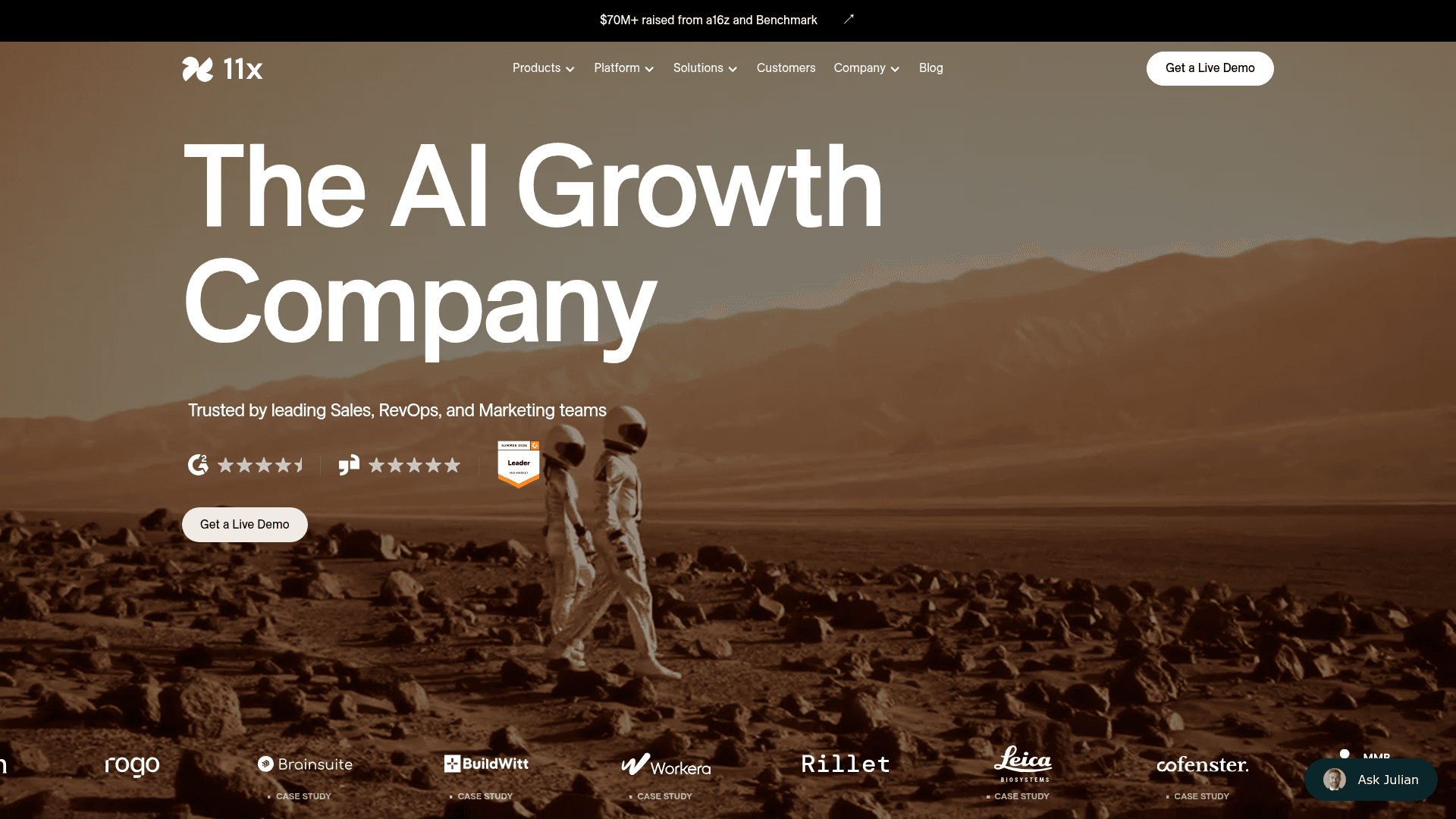
11X is a fully autonomous outbound AI SDR platform built around two AI agents: Alice for email and LinkedIn outreach, and Julian for phone-based prospecting. The platform handles the entire outbound workflow end-to-end, covering prospect research, personalized message writing, multi-touch sequence execution, reply classification, and meeting booking, without a human SDR in the loop at any stage. 11X targets enterprise sales organizations that want to scale cold outbound volume at pace without proportionally increasing headcount, positioning itself as a direct replacement for human SDRs instead of a tool that assists them. Unlike tools that offer human-in-the-loop review before sequences send, 11X operates on a fully autonomous model, meaning every outreach decision (who to contact, what to say, and when to follow up) is made and executed by the AI. That autonomy is the product's primary value proposition and its most notable trade-off for teams that want visibility into what is going out on their behalf.
What they offer:
11X builds its product around two specialized AI agents: Alice handles email and LinkedIn outreach from prospect identification through meeting booking, while Julian covers phone-based cold calling across target accounts. Every step of the outbound workflow, including prospect research, message writing, sequence execution, and reply handling, runs without a human SDR in the loop at any stage. Alice and Julian operate on a fully autonomous model, meaning the tool decides who to contact, what to say, when to follow up, and how to handle common objections, routing pricing and technical questions to human reps only when the conversation escalates beyond standard qualification. A bundled contact database and managed deliverability infrastructure are included, so teams do not need separate enrichment or email infrastructure tools to run high-volume outbound at scale. Salesforce and HubSpot CRM sync with real-time meeting booking closes the loop between AI-executed outreach and pipeline tracking.
Reply classification that detects buying signals and responds to simple objections, routing pricing or technical questions to human reps
Salesforce and HubSpot CRM sync with real-time meeting booking
Voice AI agent (Julian) for phone-based outreach
Good for: Enterprise sales organizations with structured outbound programs that need to scale volume without proportionally increasing headcount.
Key limitation: 11X lacks personalization, chat, and deanonymization, and every adjacent capability is a separate purchase. Pricing starts around $5,000 per month, making it inaccessible for most Series B teams before the conversation even starts.
Bottom line: 11X fits large organizations willing to commit to enterprise-priced annual contracts for fully autonomous outbound at volume. If you want human-in-the-loop review, inbound pipeline coverage, or transparent pricing, it leaves all three gaps open.
UserGems
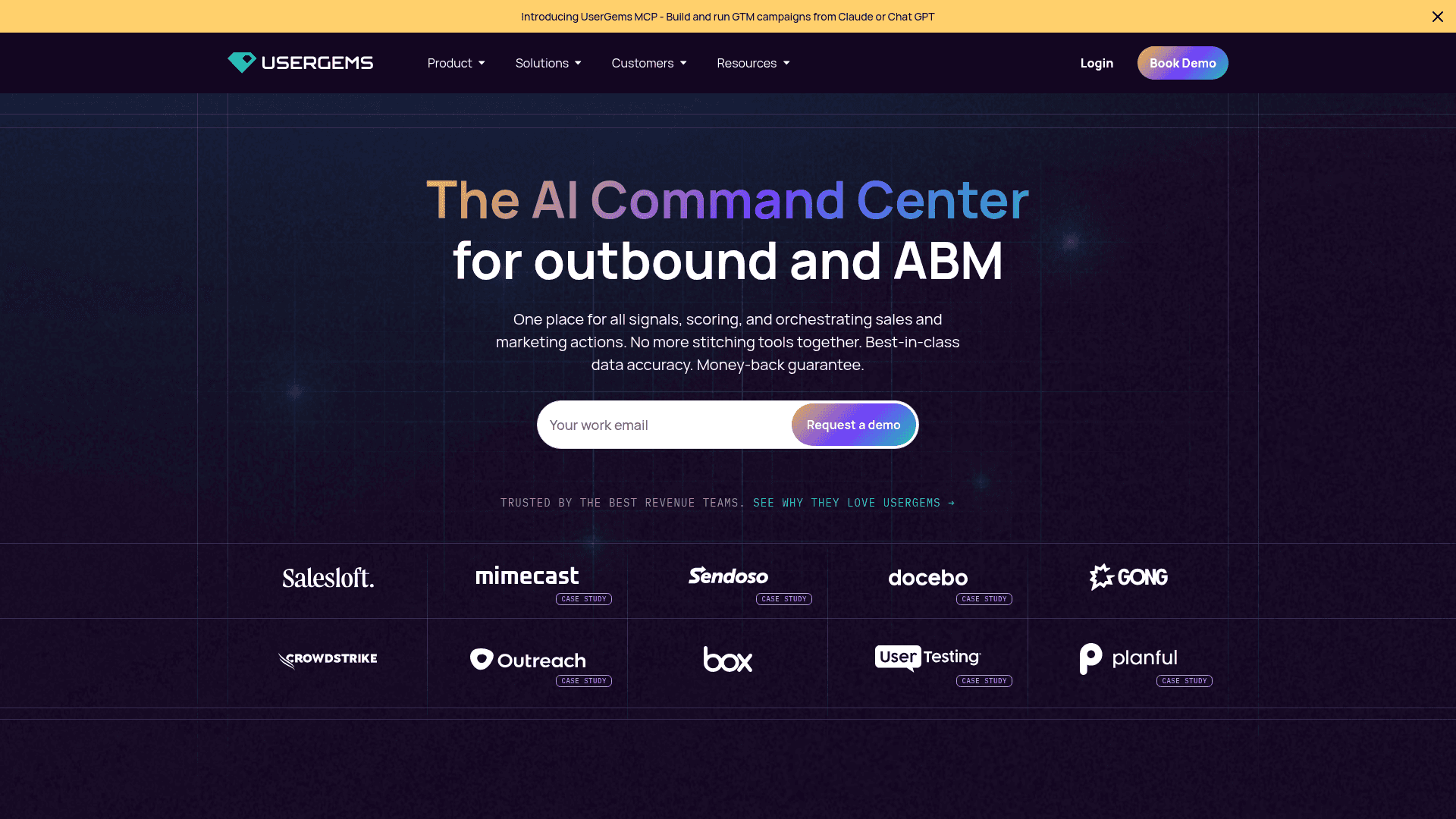
UserGems is a signal intelligence tool built around job change tracking and AI-driven outbound orchestration. It captures and unifies first-, second-, and third-party data signals to score accounts and contacts, then deploys AI agents to write personalized outreach and create ad audiences.
What they offer:
UserGems surfaces 21+ native contact- and account-level signals including job changes, contact-level intent, website visits, tech stack changes, hiring trends, funding announcements, M&A activity, and prior closed-lost context. The Gem-E AI agent drafts personalized email sequences, call scripts, and LinkedIn messages based on those signals, with ABM orchestration and advertising audience creation built into the workflow. Salesforce and HubSpot CRM integration is native, with bi-directional sync so signal-triggered outreach ties directly back to account records without manual export steps. The product is built around the assumption that past champions moving to new companies represent the highest-conversion outbound signal in a B2B pipeline, and it is architected to capture and act on that moment at scale. Job change tracking covers both inbound leads who previously engaged with your product and net-new contacts at target accounts, giving revenue teams coverage across warm and cold segments from a single signal layer.
Good for: B2B revenue teams running relationship-driven selling where past champion job changes represent a high-conversion outbound signal.
Key limitation: UserGems lacks a real-time AI chatbot to engage those visitors while they are on the site. It also lacks built-in smart scheduling tools, so calendar orchestration requires a separate Calendly or Chili Piper layer. pricing starts at $2,750/month, plus a one-time implementation fee of $3,000 to $10,000.
Bottom line: UserGems alternatives are worth reviewing since UserGems fits teams whose highest-signal play is job change tracking at scale, and real-time inbound engagement and in-conversation meeting scheduling both require additional tools.
Warmly
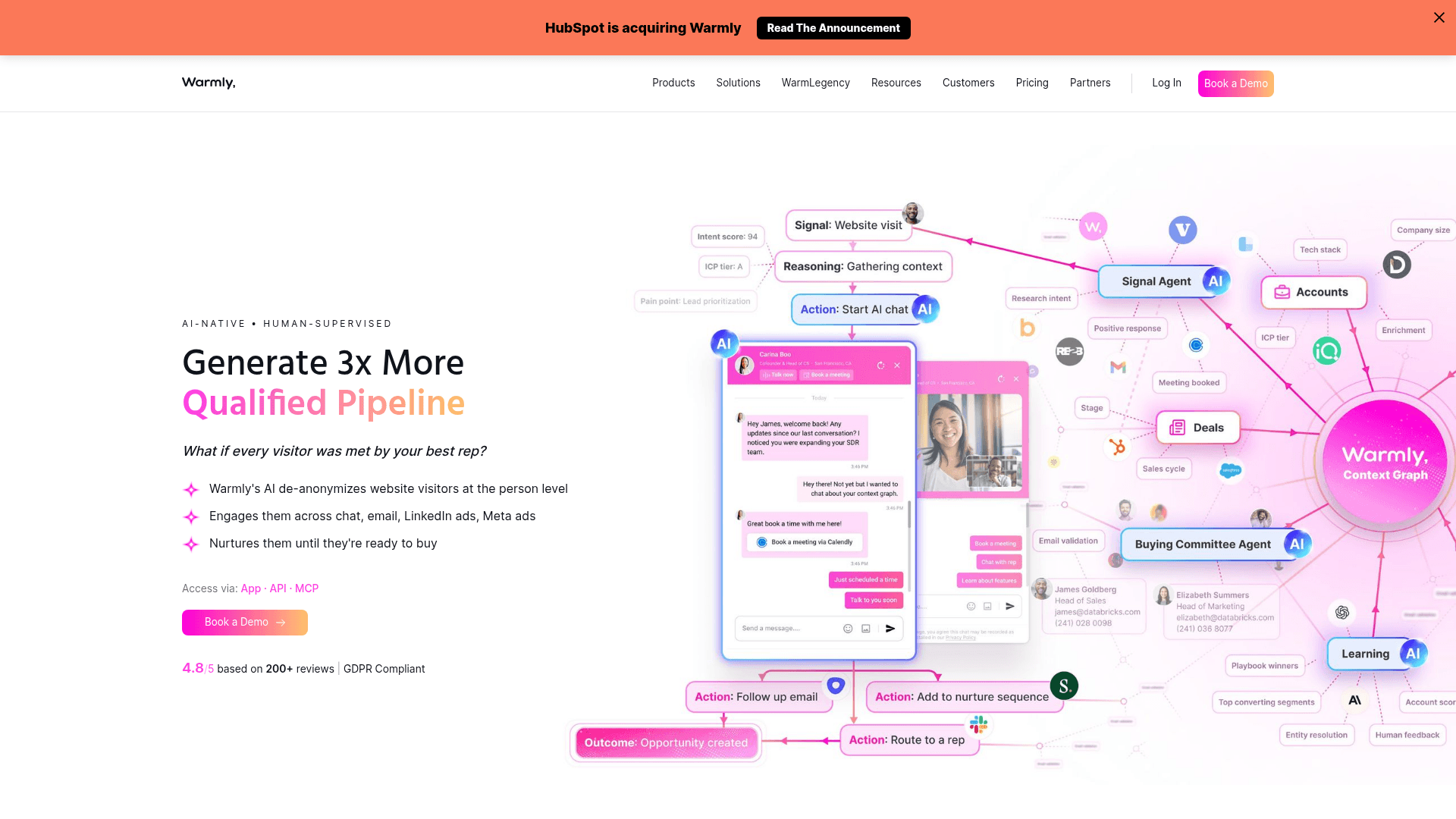
Warmly was acquired by HubSpot and is now being integrated into HubSpot's customer offering as a native capability. Its independent roadmap is frozen, with future development subordinated entirely to HubSpot's priorities.
What they offer:
Website visitor identification with Bombora and G2 intent data coverage
Text-based inbound chat with rule-based routing
Outbound TAM orchestration
HubSpot CRM integration, now a hard dependency post-acquisition
Good for: Teams already fully committed to HubSpot who want visitor identification and basic inbound chat within a single vendor relationship.
Key limitation: Warmly now requires HubSpot as a prerequisite, which rules it out for teams on Salesforce, Marketo, or any other CRM. Its chat interface is text-only with deterministic routing instead of full AI SDR automation. Teams considering Warmly alternatives post-HubSpot acquisition are, in effect, considering HubSpot's developing agentic capabilities with all the roadmap and pricing uncertainty that implies.
Bottom line: Warmly made sense as a standalone signal aggregation tool before the acquisition created vendor lock-in. For teams outside HubSpot's ecosystem, it is no longer a viable independent option.
Feature Comparison: Outreach vs Top Alternatives
Feature | Outreach | Breakout | Unify | Artisan | 11X | UserGems | Warmly |
|---|---|---|---|---|---|---|---|
Inbound visitor deanonymization | No | Yes, person and company level | No | No | No | Partial, signal only | Yes, firmographic |
On-site AI engagement | No | Yes, full AI SDR conversation | No | No | No | No | Text chat, rule-based |
Multi-channel follow-up automation | Email, calls, social via rep sequences | Automated email and LinkedIn post-bounce | Email only | Email, semi-manual LinkedIn | Email and LinkedIn, autonomous | Email, LinkedIn, call scripts | Limited, HubSpot-dependent |
Meeting scheduling | Rep-managed | In-conversation, direct calendar booking | Basic | Integrated into sequence | Real-time booking | Requires Calendly or Chili Piper | Basic booking |
CRM compatibility | Salesforce primary | Salesforce, HubSpot, Marketo | Salesforce, HubSpot | Salesforce, HubSpot | Salesforce, HubSpot | Salesforce, HubSpot | HubSpot only post-acquisition |
Transparent pricing | No | Yes, starts at $500/month | No | No | No, starts around $5,000/month | No, starts at $2,750/month plus implementation | Unclear post-acquisition |
Human-in-the-loop control | Yes, rep-driven | Yes, reviewable before send | Partial | No | No | Partial | Partial |
The table above is the fastest way to see where each tool fits and where it breaks down. Outreach covers sequencing and deal management for enterprise outbound, but every row tied to inbound engagement returns a blank. If your evaluation started because Outreach left a gap in your inbound motion, that gap will not close by choosing Unify, Artisan, or 11X either. Those tools solve different problems, as the leading outbound AI SDR platforms confirm. The only alternatives above with real inbound coverage are Breakout and, in a limited sense, Warmly, which now requires full HubSpot commitment to access even its basic visitor identification.
Why Breakout Is the Best Outreach Alternative
Outreach was built to help reps execute structured outbound sequences, and at enterprise scale it does that well. The problem is everything outside that scope: it has no way to identify who is already on your site, no mechanism to engage those visitors before they leave, and no automated follow-up across email and LinkedIn when a high-intent prospect bounces without booking. For a Series B+ revenue team, that gap is a structural leak in the most valuable part of the funnel.
Breakout handles the full inbound and outbound pipeline motion in a single AI SDR workflow, deploys in days without mandatory onboarding fees, and supports Salesforce, HubSpot, and Marketo without forcing a CRM migration. Transparent pricing starts at $500/month. If your evaluation started because Outreach left inbound pipeline on the table, Breakout is the architectural fix, not another sequencing tool asking you to hire more reps to operate it.
Final Thoughts on the Top Outreach Alternatives
Every tool in this comparison does something well, but most of them solve the same outbound sequencing problem Outreach already handles. If your gap is on the inbound side, that narrows your options quickly. Breakout covers visitor identification, on-site AI engagement, and post-bounce follow-up in one place, starting at $500/month.
FAQ
Why are revenue teams looking for Outreach alternatives in 2026?
Outreach works well for enterprise teams running structured outbound sequences in Salesforce, but the total cost of assembling the full stack around it (data, deliverability, AI personalization, and inbound engagement) reaches $7,424 to $10,516 per user per year. Teams also cite opaque pricing, a steep learning curve, and a complete absence of inbound visitor deanonymization or on-site engagement as the triggers that push them to look at other options.
What should you focus on when comparing Outreach alternatives for a mixed inbound and outbound pipeline?
Look for whether the tool covers both motions in a single workflow or forces you to buy separate tooling for each pipeline source. In particular, check for real-time visitor deanonymization, in-conversation meeting scheduling, post-bounce multi-channel follow-up, transparent pricing, and native CRM compatibility with your existing stack, including Salesforce, HubSpot, and Marketo.
When does switching from Outreach to Breakout make sense for a Series B+ revenue team?
The switch makes sense when a measurable share of your pipeline leak happens before a rep ever enters the picture: anonymous visitors who browse and leave without booking, high-intent accounts that submit nothing but a session. Breakout identifies those visitors, engages them on-site with a trained AI SDR, and follows up via email and LinkedIn within minutes, covering the gap Outreach structurally cannot close.
How does Breakout handle CRM compatibility compared to Outreach?
Breakout integrates natively with Salesforce, HubSpot, and Marketo out of the box, with no mandatory onboarding fees and deployments that go live in days. Outreach is primarily Salesforce-dependent, which creates a hard constraint for teams running HubSpot or multi-CRM environments and adds implementation overhead before the tool delivers any value.
How is Breakout different from the other Outreach alternatives like Artisan, 11X, and Unify?
Artisan, 11X, and Unify are outbound-only tools; none of them include real-time visitor deanonymization or on-site AI engagement. Breakout runs both inbound visitor conversion and outbound AI SDR execution in one workflow, with human-in-the-loop review before sequences send, transparent pricing starting at $500/month, and no requirement to bolt on additional tools to cover the inbound side of your pipeline.