All Blogs
A guide for B2B revenue leaders on how AI SDRs work, costs vs. human SDRs, inbound vs. outbound differences, and converting anonymous site visitors into pipeline.

Evan Marshall
Senior Growth AI Strategist
Published On

The gap between what AI SDRs are marketed as and what they actually do is wide enough to cost your team real pipeline if you get it wrong. Start with our AI SDR guide for a clear explanation of the category. Some of what’s being sold as an AI SDR is closer to a routing widget. The rest of this post walks through how the real ones work, what they cost compared to human SDRs, and where the model still has limits worth knowing about.
TLDR:
An AI SDR autonomously handles prospect research, outreach, qualification, and meeting booking, with your rep entering only after qualification is complete.
AI SDRs cost $6,000 to $36,000 annually versus $80,000 to $150,000 fully loaded for a human SDR, with the 2026 consensus favoring a hybrid model.
Inbound and outbound AI SDRs are architecturally different tools; buying the wrong one for your pipeline problem costs you quarters to unwind.
Between 97 and 98 percent of B2B visitors leave without filling a form, and AI SDRs with visitor deanonymization convert that anonymous traffic into named, scored accounts.
Breakout runs signals, inbound qualification, and follow-up campaigns across Salesforce, HubSpot, and Marketo with no CRM lock-in, starting at $500/month.
What Is an AI SDR? Definition and Meaning
An AI Sales Development Representative, or AI SDR, is an autonomous software agent that handles top-of-funnel sales work: prospect research, personalized outreach, lead qualification, objection handling, meeting scheduling, and CRM updates.
The key word is autonomous. This is not a chatbot that routes form submissions or a script that fires templated emails. A well-built AI SDR reads buyer signals, decides who to engage, crafts context-aware messaging, handles pushback in real time, and books the meeting without a rep involved until the handoff.
Human SDRs manage roughly 50 to 100 touches per day before fatigue cuts into quality. An AI SDR runs the same motion across thousands of prospects simultaneously, with response times measured in seconds. At $60,000 to $90,000 annually before benefits and management overhead, human SDRs are expensive by comparison, and that math is pushing revenue teams at Series B and beyond to rethink how they staff top-of-funnel pipeline generation.
How an AI SDR Works
The workflow follows a consistent arc regardless of whether the trigger is inbound or outbound.
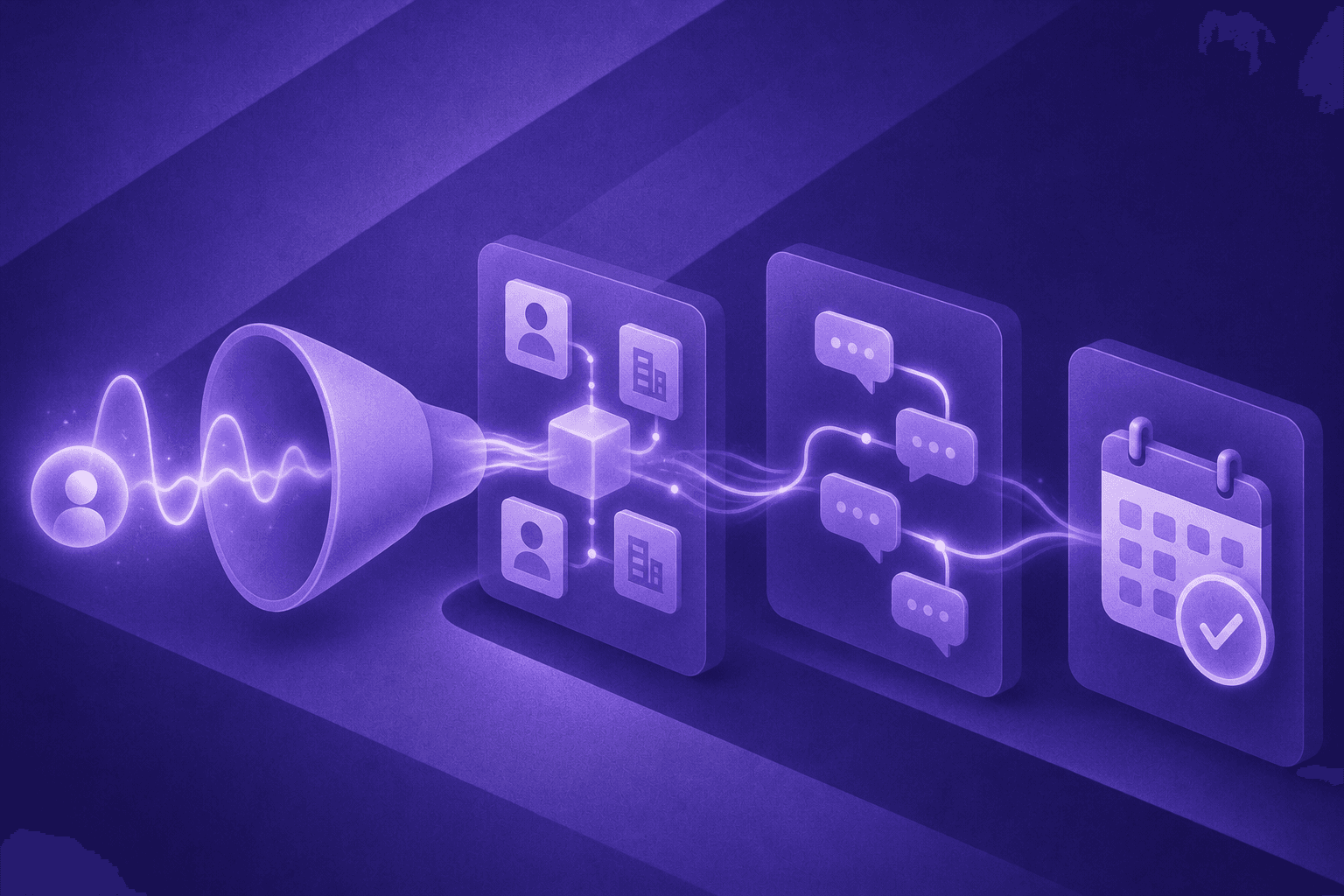
A buyer signal fires: a website visit, form submission, content download, or intent data hit
The AI enriches the record instantly, pulling firmographics, CRM history, and buying committee data
It generates personalized outreach based on that specific context, not a template
Multi-touch sequences run across email and LinkedIn, timed to engagement behavior
Replies are handled in real time, including objections, with qualification happening inside the conversation
Once intent is confirmed, the meeting books directly onto a rep’s calendar
The rep enters after the qualification arc is complete, not during it. That handoff point is what separates an AI SDR from a routing tool.
Inbound AI SDRs vs. Outbound AI SDRs
The distinction matters more than most teams realize when they start comparing tools.
Inbound AI SDRs activate on buyer signals. A prospect visits your pricing page, downloads a whitepaper, or submits a form, and the AI engages immediately. Speed is the entire game here: the faster the response, the higher the conversion. Outbound AI SDRs work in the opposite direction, sourcing cold prospects from databases, building lists, and launching sequences without any prior signal from the buyer.
These are architecturally different tools solving different pipeline problems. An inbound AI SDR is optimized for low latency and identity resolution. An outbound AI SDR is optimized for deliverability, personalization at scale, and list quality. Buying one when you need the other is an expensive mistake that takes quarters to unwind.
If your bottleneck is converting existing demand, you need inbound. If your bottleneck is generating demand from scratch, you need outbound. Many teams need both, which is why the more capable AI SDR tools now run both motions without requiring separate tooling.
AI SDR vs. Human SDR: Cost and Performance
A well-rounded human SDR runs $80,000 to $150,000 per year fully loaded, including benefits, management overhead, and ramp time. AI SDRs cost roughly $6,000 to $36,000 annually, often 5 to 40 percent of that figure.
The two approaches each have a clear home:
AI SDR | Human SDR | |
|---|---|---|
Annual Cost | $6,000 to $36,000 | $80,000 to $150,000 (fully loaded) |
Daily Outreach Capacity | Thousands of simultaneous touches | 50 to 100 touches before quality degrades |
Response Time | Sub-second | Minutes to hours |
Availability | 24/7 across all time zones | Business hours; gaps on nights and weekends |
Best For | High-volume top-of-funnel qualification; cost per qualified meeting | Complex enterprise deals above $25K ACV; multi-stakeholder relationship building |
Weakness | Ceiling on deep account research; brand risk if sequences are clumsy | Expensive; short average tenure (14 to 18 months); ramp time cost |
The 2026 consensus among revenue leaders is that the winning model is hybrid: AI handles high-volume top-of-funnel qualification, humans close. Learn why AI SDRs are replacing traditional SDR teams in the first place.
Benefits of Using an AI SDR
Four concrete advantages make the case for AI SDRs.
Round-the-clock coverage across time zones, with no nights, weekends, or holidays creating gaps in your inbound response window.
Consistent playbook execution at scale, since the AI runs the same qualification logic on the thousandth conversation as on the first.
Speed-to-lead measured in seconds instead of minutes or hours, which matters most when high-intent buyers are comparing multiple vendors simultaneously.
Lower cost per qualified meeting, freeing budget that would have gone to SDR headcount toward closing capacity instead.
The compounding effect is that human reps enter conversations later in the buying arc, when context is richer and intent is confirmed, which shortens deal cycles without requiring a larger team.
Limitations and Real Tradeoffs of AI SDRs
Four real limitations deserve your attention before you commit to an AI SDR.
Personalization has a ceiling. AI SDRs are good at synthesizing signals like job titles, funding rounds, and page visits into contextual outreach. They are less capable of the deep account research a senior human rep brings to a strategic account: reading between the lines of a prospect’s LinkedIn posts, catching a reference to an internal reorg buried in a quarterly call, or noticing a relationship angle that no enrichment provider surfaces. For accounts above $100K ACV, that gap tends to show, and it is a pattern worth keeping in mind when assessing an AI BDR for B2B sales.
Brand risk is real and growing. Buyers are getting better at recognizing AI-generated outreach, and a clumsy sequence hitting a decision-maker’s inbox can outlast the campaign itself. Human-in-the-loop review before sequences send is the practical mitigation, but it adds overhead that erodes some of the cost advantage.
Hallucination risk requires monitoring. AI SDRs occasionally fabricate prospect details, including wrong funding figures or references to news events that never happened. Audit output regularly, especially for high-value accounts where a factual error ends the conversation before it starts.
Deliverability headwinds are tightening the math. B2B cold-email reply rates are declining as inbox providers tighten filters and buyers ignore volume outreach. AI SDRs running at scale accelerate this problem if list quality and message relevance are not actively managed.
None of these limitations disqualify AI SDRs. They do mean that treating one as a fully autonomous, zero-oversight system is a mistake, particularly for complex enterprise motions.
AI SDR vs. AI Chat Agent: What Is the Actual Difference?
The confusion between these two categories is costing teams real pipeline.
An AI chat agent reacts. A visitor opens the chat widget, types a question, and the agent responds. When the visitor closes the tab, the interaction ends, with no CRM entry created and no follow-up queued. It is a customer service tool wearing a sales hat.
An AI SDR works differently at the architecture level. Before a visitor types a single word, the AI has already identified the company, matched the visitor to a CRM record, scored the account against your ICP, and decided how to engage. If the visitor leaves without booking, the system triggers a personalized email within minutes and queues a LinkedIn touchpoint the same day.
The practical gap comes down to two capabilities: identity resolution and downstream action. A chat agent has neither. It cannot tell you that a Series B fintech company in your target segment just spent eleven minutes on your pricing page, and it cannot pursue them after they bounce. An AI SDR can do both, which is why the output is a qualified meeting instead of a chat transcript.
Turning Anonymous Website Visitors into Pipeline with an AI SDR
Between 97 and 98 percent of B2B website visitors leave without filling out a form. Most revenue teams are optimizing for the 2 to 3 percent who self-identify, while the rest disappear into analytics dashboards as anonymous sessions.
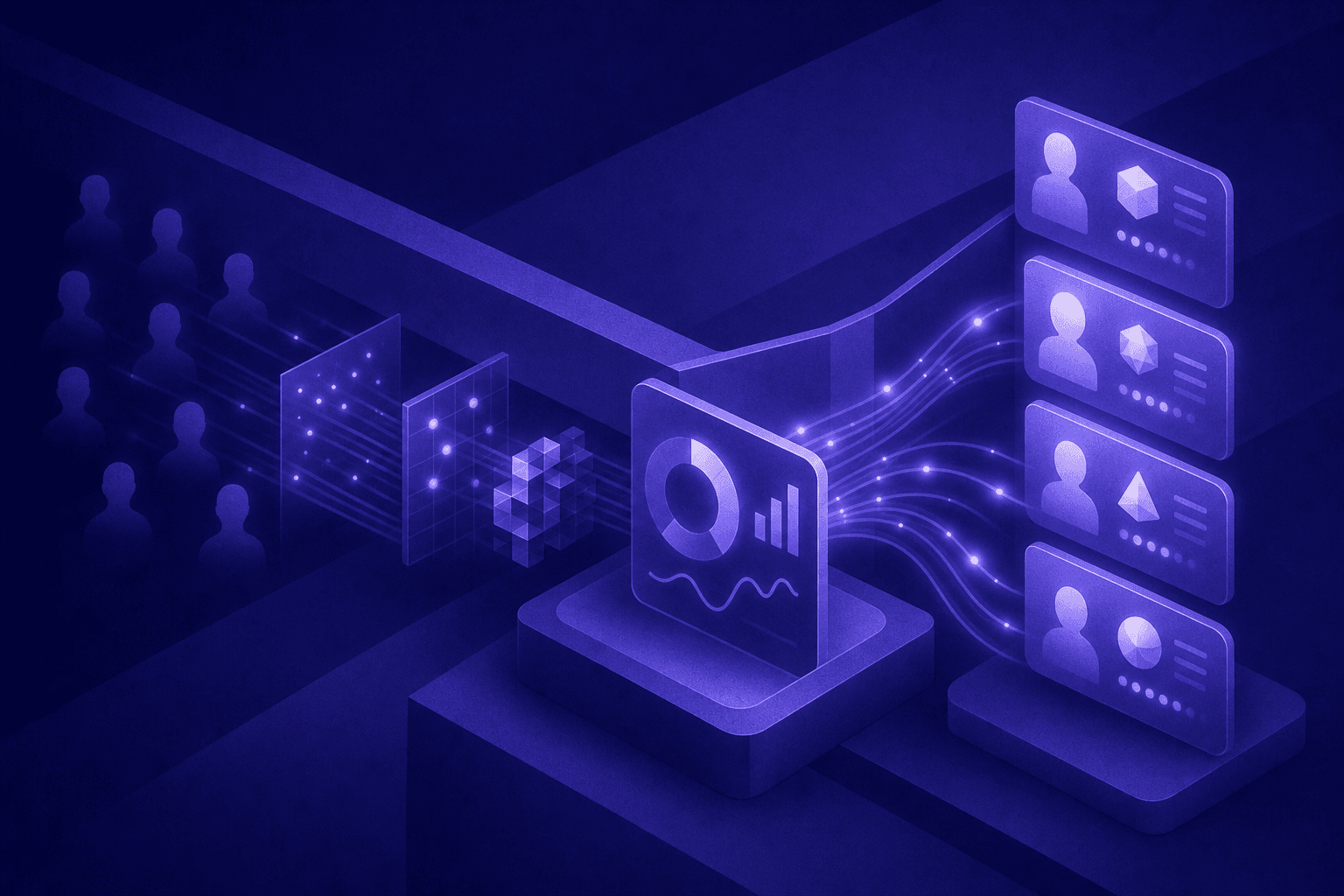
AI SDRs with website deanonymization work through four stages to close that gap:
Capture: The moment a visitor lands, the AI logs the session, resolves the IP against company databases, and cross-references firmographic data to identify the organization behind the visit.
Resolve: B2B website visitor identification tools pull LinkedIn profiles and CRM history, connecting the anonymous session to a specific contact when possible, with existing CRM context surfacing immediately.
Score: Page behavior feeds into intent scoring. Time on the pricing page, return visits, content downloads, and navigation path all signal where a buyer sits in their decision process.
Route: High-intent accounts trigger engagement in real time: the AI SDR opens a personalized conversation, Slack alerts fire to the right rep, or a follow-up sequence queues within minutes if the visitor bounces without booking.
The output is a list of named accounts, scored by intent, with context your reps can act on before competitors know the buyer was shopping.
The AI SDR Market in 2026: Key Context for Revenue Leaders
The global AI SDR market is projected to grow from $5.81 billion in 2026 to $17.58 billion by 2030, at a 31.9% CAGR, according to Research and Markets. Three forces are driving that growth: rising CAC, short SDR tenure averaging 14 to 18 months, and the compounding cost of rebuilding a B2B inbound lead generation motion every time a rep churns.
The consolidation story matters as much as the growth numbers. Salesforce acquired Qualified in April 2026, HubSpot acquired Warmly in June 2026, and Salesloft sunsetted Drift in March 2026. Within roughly seven months, the major CRM-agnostic visitor intelligence tools either disappeared or became extensions of a single CRM vendor’s roadmap.
For revenue leaders, this creates a clear fork. CRM-native tools like Agentforce and HubSpot’s expanding agentic layer offer deep integration but hard vendor dependency. Teams not exclusively on Salesforce or HubSpot are now structurally excluded from those products. CRM-agnostic AI SDR tools remain the only viable path for organizations running mixed CRM stacks or unwilling to accept single-vendor lock-in across their entire pipeline motion.
How Breakout Runs the Full AI SDR Motion
Breakout runs three agents in sequence, covering the full cycle most teams are still stitching together across four or five separate tools.
The Signals Agent fires the moment a visitor lands on your site. Before they type a word, Breakout has resolved the IP to a company, matched it against your CRM, surfaced firmographics, and identified the individual through person-level enrichment. No form required.
The Inbound Agent opens a conversation trained on your specific ICP, product, and qualification playbooks. Objections are handled in real time, and when intent is confirmed, the meeting books directly onto the right rep’s calendar inside the same conversation.
When visitors leave without booking, the Campaigns Agent (Spoc) queues a personalized email within minutes and a LinkedIn touchpoint the same day. It keeps running on any buyer signal, including form submissions, content downloads, and event attendance, even when site traffic is slow.
Breakout supports Salesforce, HubSpot, and Marketo natively with no CRM lock-in and no mandatory onboarding fees. Pricing starts at $500/month, compared to Qualified’s model, which starts at $40,000 to $68,000 per year and requires Salesforce as a hard prerequisite. If you want to see how it runs on your own traffic, there’s a free 30-day trial with no credit card required.
Final Thoughts on AI SDRs and the State of Top-of-Funnel Automation
The core case for an AI SDR is straightforward: faster response times, lower cost per qualified meeting, and coverage your human team simply cannot match at scale. The nuances around inbound versus outbound tooling, vendor lock-in after the 2026 acquisitions, and the real ceiling on AI personalization for enterprise accounts all deserve weight before you buy. When you’re clear on where your pipeline gap actually sits, a 30-day free trial gives you a concrete way to pressure-test the motion without committing budget upfront.
FAQs
What is the difference between an AI chat agent and an AI SDR for inbound lead qualification?
An AI chat agent reacts to visitor questions and stops when the tab closes. An AI SDR resolves identity before contact, scores the account against your ICP, and triggers follow-up autonomously, producing a qualified meeting instead of a chat transcript.
How do AI SDR tools handle real-time prospect discovery and handoff to human sales reps?
The best AI SDR tools run the full qualification arc autonomously, covering enrichment, personalized outreach, objection handling, and meeting scheduling, then hand off to a rep only after intent is confirmed and the meeting is booked. Breakout, for example, fires Slack alerts to the right rep the moment a high-value account visits, routes based on your ICP criteria, and syncs the full engagement history to Salesforce, HubSpot, or Marketo so the rep enters the conversation with complete context instead of a cold record.
What are the best AI SDR tools for converting website visitors into qualified leads in 2026?
The strongest tools in 2026 for converting anonymous visitors into pipeline combine person-level deanonymization, real-time intent scoring, and multi-channel follow-up in a single workflow. Breakout, Qualified (now Salesforce-native), and the former Warmly (now HubSpot-native) are the primary options, though Qualified requires Salesforce as a hard dependency and carries $40,000 to $68,000 annual pricing, while Warmly’s roadmap is now subordinated to HubSpot’s platform priorities, making Breakout the primary CRM-agnostic alternative starting at $500 per month.
Should I use an inbound AI SDR like Breakout or an outbound AI SDR like Artisan?
The right choice depends on where your pipeline gap sits: inbound for converting existing demand, outbound for generating demand from scratch. See the Inbound vs. Outbound section above for a full breakdown. Many Series B and beyond revenue teams need both motions, which is why tools that run inbound and outbound within a single workflow, instead of requiring separate tooling for each pipeline source, are becoming the dominant architecture.
How do I turn anonymous website visitors into pipeline without waiting for form fills?
Start with a tool that resolves IP signals to company-level identity and cross-references person-level data like LinkedIn profiles before any form submission occurs. From there, the workflow follows four steps: capture the session, resolve the individual contact against your CRM, score intent based on page behavior and return visits, and trigger engagement: either an AI-led conversation on-site or a personalized email and LinkedIn sequence within minutes of a bounce. Breakout’s 30-day free trial runs this full motion on your live traffic with no credit card required, so you can audit how many named accounts are already visiting without converting.