All Blogs
Compares top Reply.io alternatives for scaling sales teams on AI personalization, deliverability, and CRM sync, with Breakout as the top pick for autonomous outbound.

Evan Marshall
Senior Growth AI Strategist
Published On

If your outbound program has grown more complex than Reply.io was designed to handle, you're not alone. The sequence builder, AI writing tools, and CRM sync all start showing limits once your team scales past straightforward campaigns. Here's a look at the strongest alternatives right now, matched to different team sizes and real-world workflows.
TLDR:
Reply.io works for small teams running uniform sequences, but deliverability gaps, shallow CRM sync, and steep per-seat pricing create real friction at scale
Alternatives range from AI-native senders to full sales engagement suites, assessed on AI personalization, deliverability, CRM depth, and pricing transparency
Tools like Lemlist, Smartlead, and Instantly bundle inbox warmup natively, while Reply.io requires a separate add-on that compounds deliverability risk at volume
Reply.io's one-way CRM sync forces revenue operations teams into manual reconciliation, which grows more costly as pipeline complexity increases
Breakout runs two-way AI conversations across email and LinkedIn that qualify and book meetings, with every signal syncing bi-directionally to your CRM automatically
What Is Reply.io and How Does It Work?
Reply.io is a sales engagement tool built around multichannel outreach, letting teams run sequences across email, LinkedIn, WhatsApp, and calling from a single workspace. It sits in the broader category of outbound sales tools for automating prospecting without requiring a fully custom tech stack.
The workflow follows a familiar pattern: you import contacts, build a sequence of touchpoints, and let the tool execute outreach on a schedule. Reply.io layers in AI writing assistance and a B2B contact database to reduce the manual lift on prospecting and first drafts.
Where teams tend to hit friction is at scale. The sequence builder works well for straightforward linear campaigns, but more complex branching logic based on prospect behavior requires more configuration than the UI suggests. Reporting gives you open and reply rates, but won't tell you which step in your funnel caused drop-off at the account level, which makes diagnosing underperforming campaigns harder than it should be. If you're comparing options, knowing how to choose AI SDR tools for your GTM stack can sharpen the comparison.
Why Consider Reply.io Alternatives?
Reply.io has earned its reputation as a solid outreach tool, particularly for teams running multichannel sequences across email, LinkedIn, and calls. But as your revenue operation scales past Series B, the gaps that felt minor early on start creating real friction.
The most common frustrations reported by users center on deliverability inconsistencies that surface at higher sending volumes, a sequence builder that becomes harder to manage as campaign complexity grows, and AI writing features that feel more like autocomplete than a genuine personalization engine.
Pricing is another sticking point. Reply.io's per-seat model scales steeply as your SDR team grows, and the features most relevant to mature outbound programs, like advanced analytics and API access, are gated behind higher tiers. A detailed Reply.io cost breakdown shows a 25-seat team can hit over $56,000 annually once LinkedIn and calling add-ons are factored in. Teams moving toward fully automated prospecting may also want to review AI BDR for B2B sales as an adjacent model. That makes budget forecasting harder than it should be.
If your team has outgrown the tool or your use case was never quite the right fit, the alternatives below cover a wide range of approaches, from AI-native senders to full sales engagement suites.
Best Reply.io Alternatives in August 2026
Reply.io has built a genuine following among sales teams that want multi-channel sequencing across email, LinkedIn, and SMS from a single workspace. For teams running high-volume outbound with relatively straightforward segmentation, it works. The frustrations tend to surface when teams scale: deliverability inconsistencies, a sequence builder that becomes brittle at volume, and pricing that climbs faster than the value it returns.
The seven alternatives below are organized to match different team realities. Some are built for teams that need tighter AI personalization at scale, others for revenue operations leaders who need deeper CRM fidelity, and a few for leaner teams that need to move fast without a dedicated ops hire to maintain the tooling. For a broader view, see the ranked list of outbound AI SDR platforms relevant in 2026.
How to Read This List
Each alternative is assessed on the same criteria: AI capabilities, multi-channel coverage, CRM integration depth, deliverability infrastructure, and pricing transparency. Teams handling inbound volume should also review the best inbound AI SDRs ranked and rated separately. Where a tool has a real trade-off, we name it so you can filter against your own priorities instead of chasing a feature list that looks good on paper but misses your actual workflow.
What they offer:
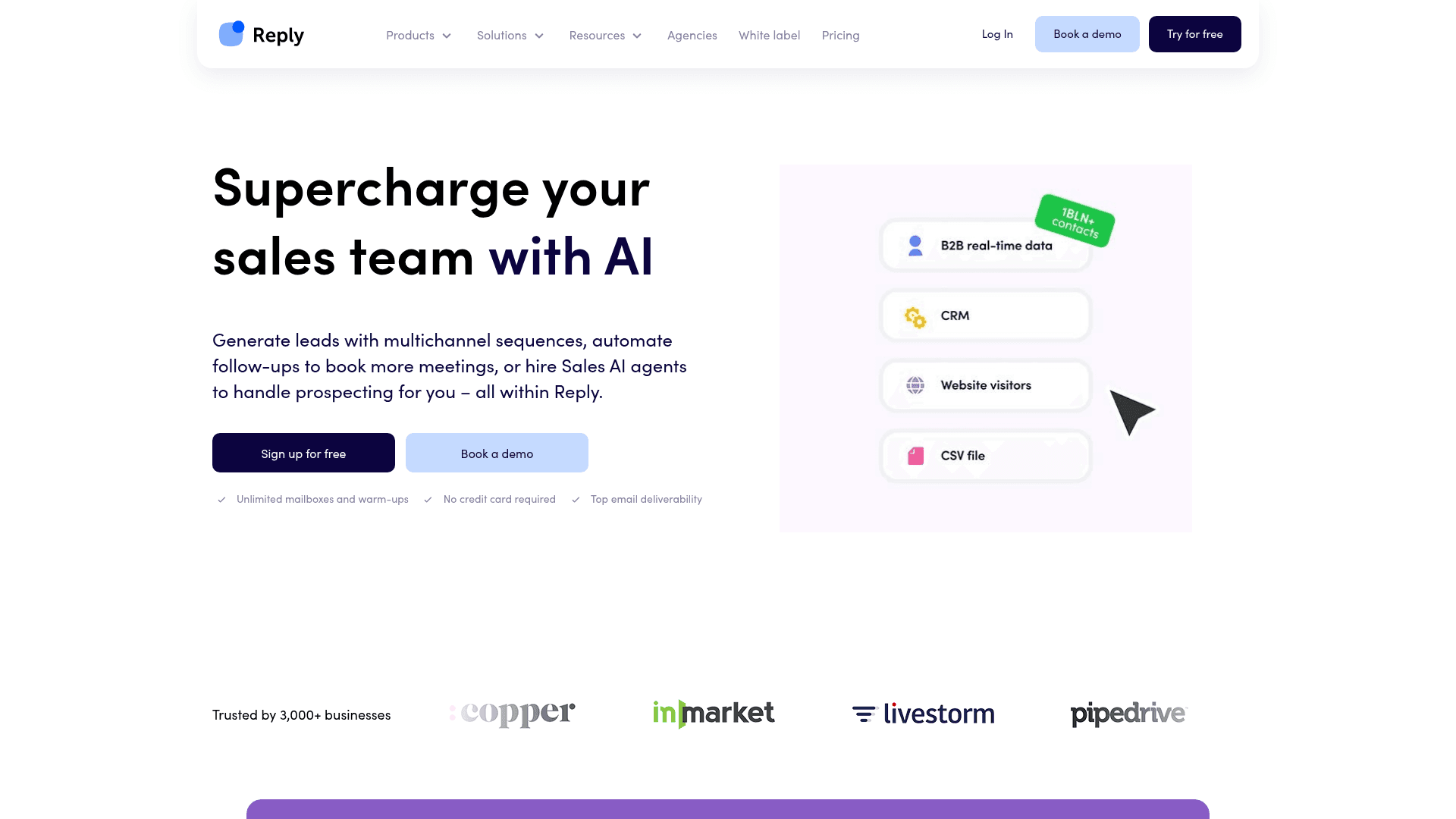
Reply.io covers the core bases you'd expect from a sales engagement tool: multichannel outreach across email, LinkedIn, WhatsApp, and calls, a built-in AI assistant for writing and reply handling, and a B2B contact database with over 1 billion records. You also get meeting scheduling, CRM sync with major tools like HubSpot and Salesforce, and a basic agency mode for managing multiple client accounts. The built-in contact database lets you filter prospects by job title, industry, company size, and geography, which reduces the gap between list building and sequence launch for teams that don't have a dedicated data provider. Reply.io's AI writing layer generates first drafts and suggested replies, though the output runs closer to template-based suggestions than signal-driven personalization at the individual prospect level. Inbox warmup is available through the platform as a separate add-on, not a native capability, which adds cost and configuration overhead for teams managing deliverability at scale. Pricing follows a per-seat model starting at $49 per month, with advanced features like API access and detailed analytics locked behind higher tiers.
It works well enough for small teams that need a single tool to run outbound without stitching together separate systems. The breadth is genuinely useful at that stage.
Where it starts to strain is when your sequencing logic gets complex, your reporting needs go deeper than surface-level metrics, or your team grows large enough that seat-based pricing becomes a budget line worth questioning. At that point, the trade-off between convenience and capability becomes a real strategic question worth pressure-testing against the top AI SDR tools for 2026.
What they offer:
Reply.io covers the core mechanics
The gaps show up under the hood. Users frequently report that the AI writing tools produce generic copy that requires heavy editing before it's usable in any real campaign. Deliverability has also drawn consistent criticism, with contacts landing in spam at rates that undercut whatever volume advantage the sequences create. And while Reply.io markets itself as an all-in-one tool, the CRM integrations tend to be shallow enough that revenue operations teams end up maintaining manual workarounds to keep data in sync.
Who Reply.io Is Built For
Reply.io suits smaller sales teams that want a single tool covering outreach across channels without a complex setup. If your sequences are largely uniform and your CRM needs are light, the breadth of features works in your favor. But if personalization at scale, deliverability, or deep CRM sync are central to how your team runs pipeline, those structural limitations will create friction that compounds as volume grows.
Feature Comparison: Reply.io vs. Top Alternatives
Reply.io gives you a solid multichannel sequencing engine, but once your team scales past basic outbound, the gaps show up fast. The table below maps how the top alternatives stack up across the capabilities that matter most to revenue teams.
Tool | Best For | AI Personalization | Inbox Deliverability | CRM Sync | Starting Price |
|---|---|---|---|---|---|
Breakout | AI-led outbound at scale | Native, signal-based | Built-in warmup | Bi-directional | Custom |
Reply.io | SMB multichannel sequences | Template-based | Add-on required | One-way | $49/mo |
Outreach | Enterprise sales execution | Limited | External tools | Deep | $100+/mo |
Coaching-focused teams | Moderate | External tools | Deep | $75+/mo | |
Lemlist | Visual email personalization | Image-based | Built-in warmup | Limited | $39/mo |
Data + outreach combined | Basic | Add-on required | Moderate | $49/mo | |
Smartlead | High-volume cold email | Minimal | Built-in warmup | Limited | $39/mo |
Instantly | Deliverability-first sending | Minimal | Built-in warmup | Minimal | $37/mo |
A few things worth calling out. Deliverability tooling is where Reply.io loses ground most visibly: competitors like Lemlist, Smartlead, and Instantly bundle inbox warmup natively, while Reply.io treats it as a separate add-on. According to B2B cold email deliverability best practices, warming every new inbox for at least three weeks before launching live campaigns is non-negotiable; skipping it burns domains fast. CRM sync depth also varies, and for revenue operations teams managing multi-touch attribution, one-way syncs create reconciliation overhead that compounds over time.
Why Breakout Is the Best Reply.io Alternative
Breakout is built for revenue teams that need AI to handle the full conversation cycle, from the first message through the booked meeting. Where Reply.io sequences emails and tracks opens, Breakout runs two-way AI conversations across email and LinkedIn that qualify, nurture, and book meetings without a rep touching the thread.
The core difference is autonomy. Breakout's AI reads each reply in context, decides the right next step, and responds accordingly. There is no branching logic to map out, no fallback steps to maintain, and no conditional rules that break when a prospect says something unexpected. The AI handles it.
For Revenue Operations leaders managing lean teams, that distinction matters. You get pipeline activity without the overhead of building and babysitting sequences. Breakout connects to your CRM so every conversation, qualification signal, and booked meeting syncs automatically, keeping sales and marketing aligned without manual exports or reconciliation. Pairing this with the right lead routing tools means booked meetings reach the correct rep instantly.
If Reply.io's rule-based sequencing has created maintenance debt on your team, Breakout is the alternative built to remove that constraint entirely.
Final thoughts on the Best Alternatives to Reply.io
The alternatives above cover a wide range of trade-offs, so the useful filter is your actual bottleneck, whether that's deliverability, CRM fidelity, or the overhead of maintaining complex sequences. Reply.io works well enough for straightforward outbound, but the teams that outgrow it tend to do so fast once volume picks up. If sequence maintenance and AI personalization are the friction points, Breakout is built to remove both.
FAQ
Why do revenue teams switch away from Reply.io as they scale past Series B?
The friction points that surface most often are deliverability inconsistencies at higher sending volumes, a sequence builder that becomes brittle as campaign complexity grows, and per-seat pricing that climbs faster than the value it returns. Teams that need deep CRM fidelity or genuine AI personalization tend to hit Reply.io's ceiling before they expect to.
What features should you focus on when assessing Reply.io alternatives for a mature outbound program?
Focus on four areas: native inbox warmup and deliverability infrastructure (not an add-on), bi-directional CRM sync that keeps sales and marketing aligned without manual reconciliation, AI personalization that responds to actual prospect behavior instead of template logic, and pricing structured around usage or outcomes instead of per-seat headcount.
When does switching from Reply.io to Breakout make sense for your team?
The right moment is when your team is spending more time maintaining sequence logic and fixing data sync gaps than actually running pipeline, or when your AI writing tools are producing copy that requires heavy editing before every send. Breakout removes the branching-logic maintenance entirely by running two-way AI conversations that qualify and book meetings autonomously, which is a meaningful trade-off in favor of speed over manual control.
How does Breakout handle CRM sync differently than Reply.io?
Breakout offers bi-directional CRM sync natively with Salesforce, HubSpot, and Marketo, meaning every conversation, qualification signal, and booked meeting writes back automatically without manual exports. Reply.io's CRM integrations are largely one-directional, which creates reconciliation overhead for Revenue Operations teams managing multi-touch attribution across a growing pipeline.
Can Breakout run both inbound and outbound pipeline motions without separate tooling?
Yes. Breakout activates across any buyer signal, including website visits, form submissions, content downloads, event attendance, and outbound triggers, so the pipeline engine runs regardless of whether traffic volume is high or low. This makes it a practical fit for revenue teams managing a mixed pipeline of warm inbound leads and cold outbound prospects within a single workflow, without requiring separate tools or separate team coverage for each motion.