All Blogs
Compares top ZoomInfo alternatives for B2B revenue teams, covering data quality, intent signals, pricing, and GDPR compliance to help teams find the best fit.

Evan Marshall
Senior Growth AI Strategist
Published On

Renewing a B2B data contract without shopping the market first is one of those decisions that feels fine until it isn't. If your reps are bouncing emails, your intent signals feel like old news, or your contract just auto-renewed at a number that hurt, this breakdown of the strongest ZoomInfo alternatives right now is a good place to start.
TLDR:
ZoomInfo contracts run $15,000 to $50,000 per year, with opaque pricing that makes budget forecasting hard before you sign.
The strongest alternatives solve different problems: data quality, outbound execution, or intent coverage.
Only ZoomInfo, Cognism, and Breakout offer meaningful intent data; only Apollo and Breakout offer AI-powered outreach.
Cognism and Lusha carry the strongest GDPR posture, while ZoomInfo and Apollo remain only partially compliant.
Breakout is the strongest fit for teams who want to act on inbound and handraiser signals from accounts already showing buying intent, instead of building cold contact lists from scratch.
What Is ZoomInfo and How Does It Work?
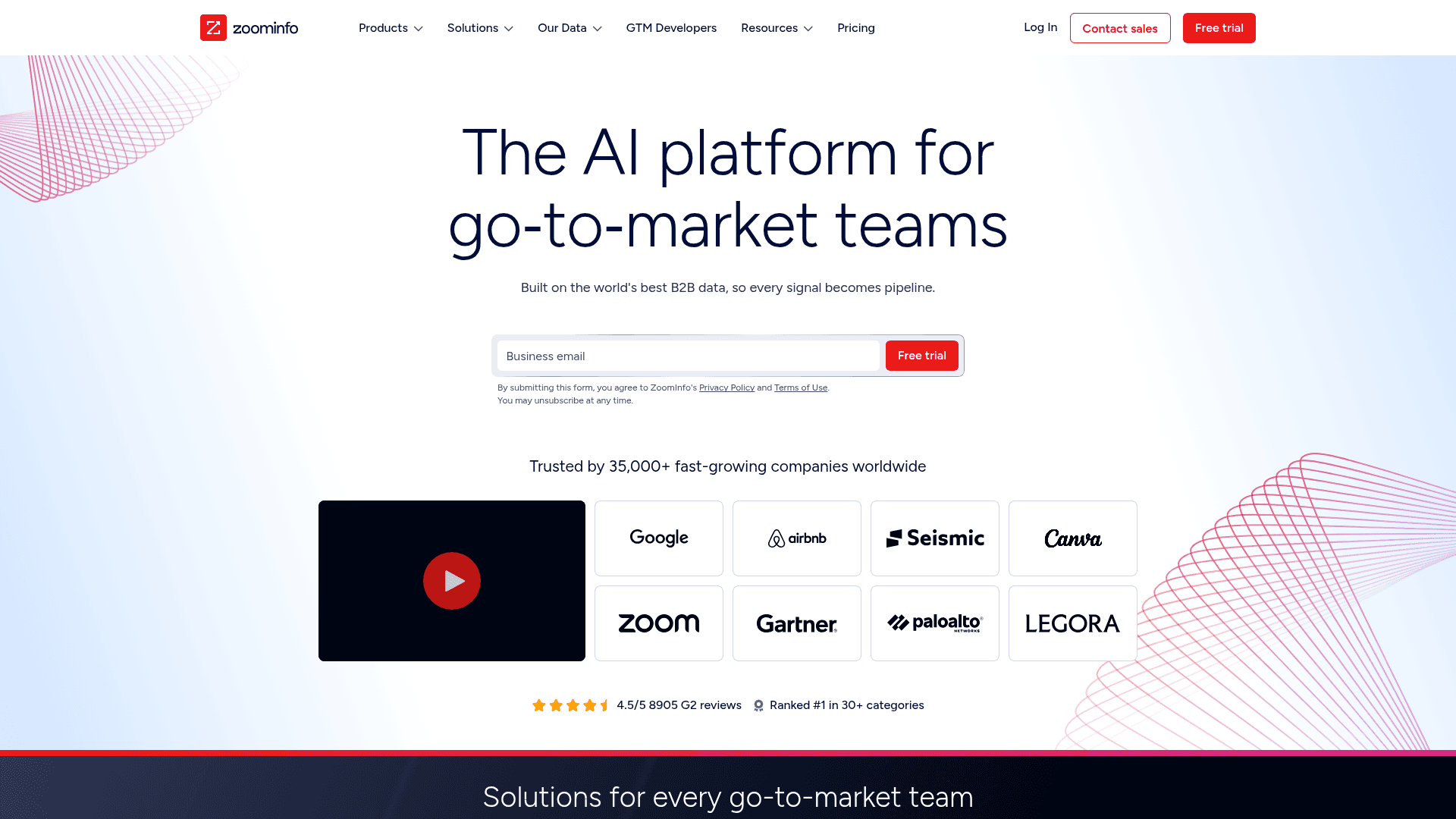
ZoomInfo is a B2B intelligence database that gives sales and marketing teams access to contact and company data, including direct dials, email contacts, org charts, and firmographic filters. The core use case is straightforward: you search for buyers who match your ideal customer profile, export a list, and push those contacts into your CRM or sequencing tool.
The product has expanded well beyond a simple database over the years. ZoomInfo now includes intent data signals, website visitor identification, conversation intelligence through Chorus, and a recruiting module. For large enterprise teams running high-volume outbound, that breadth of data under one contract can be genuinely useful.
The trade-offs are real, though. Data accuracy is inconsistent, especially for contacts outside North America or at smaller companies where job changes happen faster than ZoomInfo's crawlers update records. ZoomInfo pricing is notoriously opaque, with annual contract values regularly running into five or six figures before teams have negotiated add-on credits; independent analyses put the real cost at 100-126% above the quoted price once add-ons are factored in. And the sheer size of the product means many teams pay for features they never touch.
That gap between what ZoomInfo promises and what mid-market and growth-stage teams actually get from it is exactly why so many revenue leaders are shopping for ZoomInfo alternatives. The sections below cover the strongest options available right now.
Why Consider ZoomInfo Alternatives?
ZoomInfo has long been the default choice for B2B data, but its reputation has shifted among revenue teams over the past few years. Complaints cluster around a few consistent themes: contracts that are difficult to exit, data quality that degrades in fast-moving verticals, and pricing that makes it hard to forecast spend quarter over quarter.
The core issue for most teams isn't the data itself. It's the value equation. ZoomInfo's enterprise pricing assumes broad usage across large sales teams, which means smaller or more focused revenue organizations often pay for coverage they never touch. When you're running a tight ICP with a defined set of target accounts, paying for a database of hundreds of millions of contacts starts to feel like overhead.
There's also a meaningful shift happening in how teams think about prospecting data. Static contact lists are losing ground to intent signals, buying committee mapping, and AI-assisted prioritization. ZoomInfo has responded with product additions, but many users report that those layers feel bolted on instead of built into the core workflow.
Here's where the alternatives conversation gets interesting for ops and marketing leaders: the tools that have gained the most ground aren't necessarily cheaper versions of ZoomInfo. Several of them are built around fundamentally different assumptions about what prospecting data should do, including Cognism alternatives, which is worth understanding before you commit to a replacement.
Best ZoomInfo Alternatives in August 2026
The B2B data space has never had more options, and that's both good and bad news for revenue teams. More choices mean more pressure to get the evaluation right, especially when contracts tend to run $15,000 to $50,000 per year or more, and tools like Apollo.io pricing carry their own hidden costs.
The seven alternatives below cover a range of use cases, from AI-native outbound to deep contact intelligence to intent data, and if Apollo is your current baseline, Apollo.io alternatives are worth a close look. Each entry covers what the tool does well, where it falls short, and who it actually fits.
How to Read These Comparisons
These aren't ranked by prestige or market share. They're ordered by how well each tool serves a specific buyer profile. Before reading, it helps to know which of these three problems you're actually trying to solve:
Contact and company data quality, because your reps are wasting time on bounced emails and outdated titles
Outbound execution, because you have the data but your sequencing and personalization aren't converting
Intent and signal coverage, because you want to reach accounts before competitors do
Most tools in this category claim to do all three. In practice, each one makes real trade-offs across depth, freshness, and workflow integration. The sections below will show you where each tool wins and where you'll feel the ceiling.
1. Apollo.io

Apollo.io is the most frequently cited ZoomInfo alternative for one straightforward reason: it bundles a large B2B contact database with built-in sequencing, making it possible to find a prospect and reach out to them without switching tools. For revenue teams that are paying separately for a data provider and a sales engagement platform, the consolidation argument is genuinely compelling.
The database covers over 275 million contacts, and Apollo's free tier gives smaller teams a low-friction entry point before committing to a paid plan. Pricing is also meaningfully more transparent than ZoomInfo's, with published plans that don't require a call with a sales rep to understand what you'll actually pay.
The trade-offs show up at scale. Data accuracy outside North America and for contacts at smaller companies is inconsistent. This is a problem you'll surface quickly once reps start pulling lists and hitting bounce rates. G2 reviewers consistently flag that intent data is limited compared to ZoomInfo or Cognism, which matters if your motion depends on reaching accounts before competitors do. Apollo also sits only partially compliant on GDPR, which is a hard stop for teams selling into the EU. And while the sequencing layer covers the basics, high-complexity outbound motions with tight personalization requirements tend to hit the ceiling faster than teams expect.
Best fit: Growth-stage teams consolidating their data and sequencing stack on a single budget, particularly those running primarily North American outbound where data freshness is more reliable.
2. Lusha
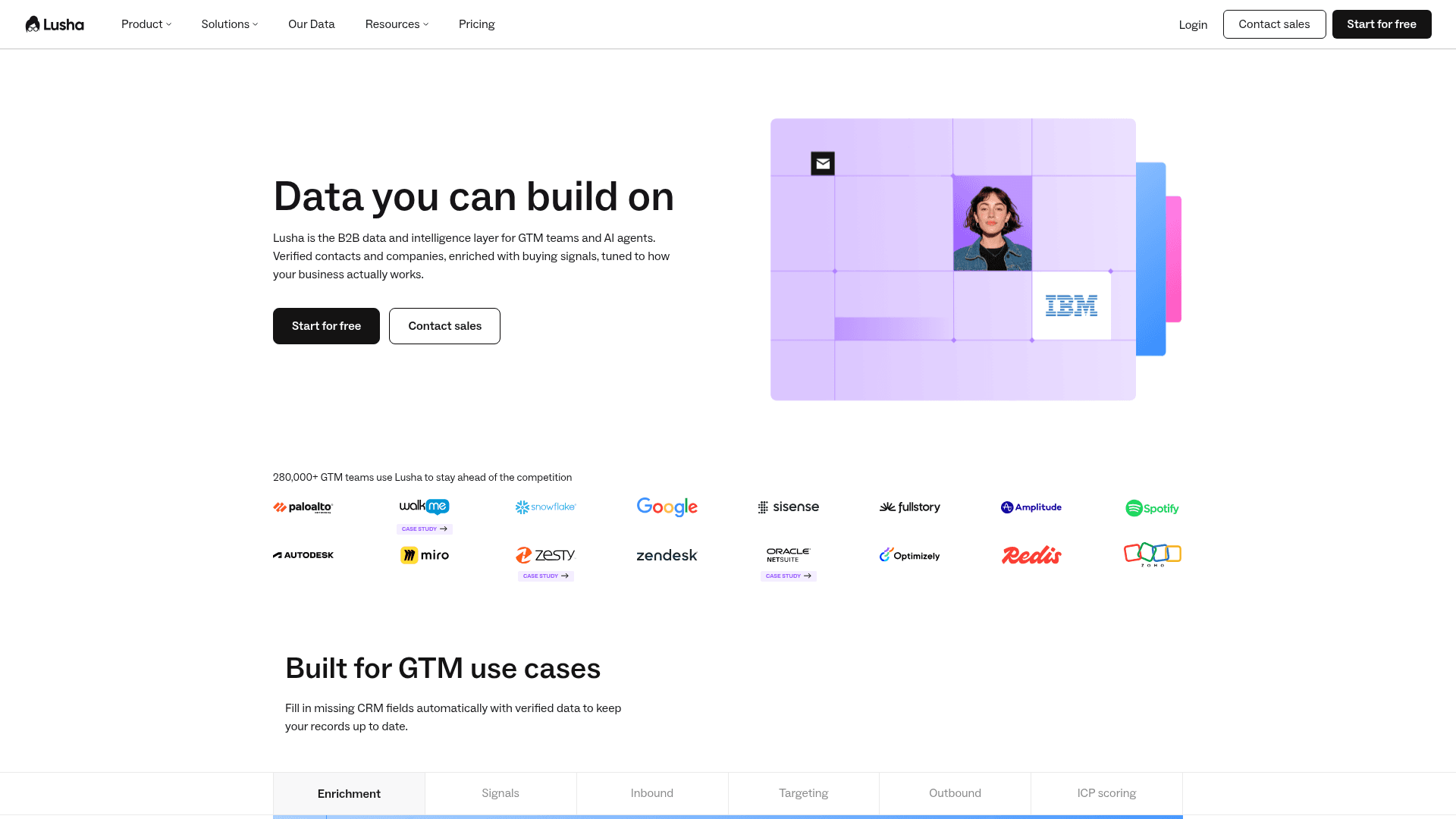
Lusha's core strength is data accuracy for direct dials and mobile numbers, built on a crowdsourced model where users contribute and verify contact information in exchange for credits. For teams whose primary frustration with ZoomInfo is bounced emails and outdated titles, Lusha's accuracy on verified phone data is a legitimate differentiator.
The compliance posture is also worth noting. Lusha holds GDPR, CCPA, and ISO 27701 certifications, which makes it one of the cleaner options for revenue teams operating across European markets. Pricing is transparent, with published plans and a free tier that lets you test quality before committing.
Where Lusha falls short is scope. There's no intent data, no AI-powered outreach layer, and the database skews toward individual contact records instead of deep firmographic coverage. If your motion requires account-level intelligence, buying committee mapping, or signals that tell you when an account is actively in a buying window, Lusha won't close that gap. It gives you the contact, but not the context around whether now is the right time to reach out.
Best fit: Sales teams whose primary need is accurate direct dials and mobile numbers for outbound calling, particularly those selling into compliance-sensitive markets where GDPR posture is non-negotiable.
3. Cognism
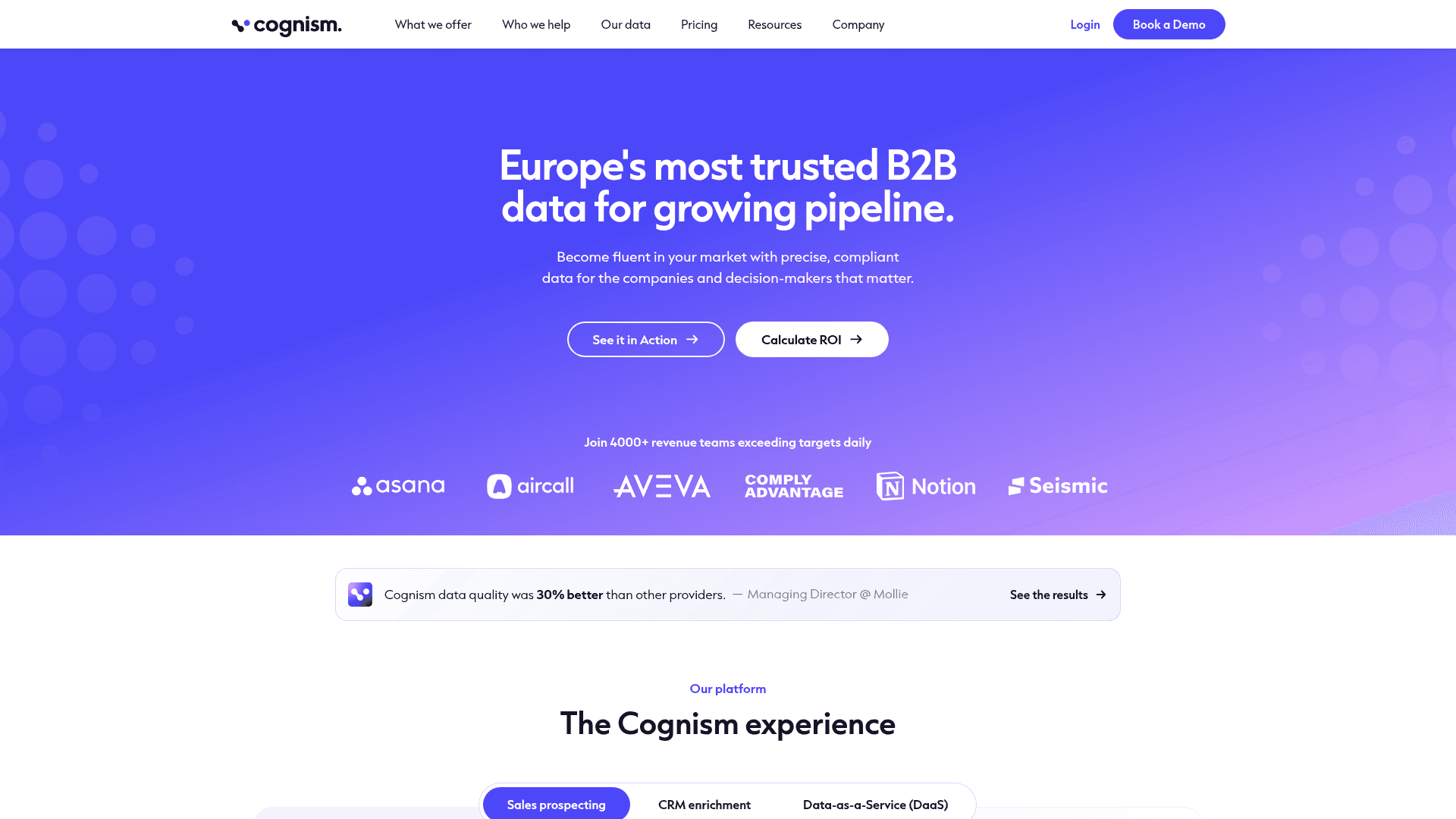
Cognism is the strongest ZoomInfo alternative for teams selling into European markets. Its GDPR compliance posture is structural, not bolted on. The platform maintains CCPA compliance alongside a verified mobile data set called Diamond Data, where phone numbers are manually verified instead of algorithmically sourced. For enterprise sales teams running phone-first outbound into EMEA, that distinction translates directly into more conversations and fewer legal exposure points.
Cognism also offers intent data through a Bombora integration, which puts it in a narrower group of tools (alongside ZoomInfo and Breakout) that can surface account-level buying signals instead of just contact records. The platform integrates cleanly with Salesforce, HubSpot, and the major sequencing tools, so the workflow from signal to outreach is manageable without heavy ops overhead.
The trade-offs are pricing opacity and geographic depth. Cognism's contract structures are not published, which creates the same forecasting challenge as ZoomInfo for finance and ops leaders trying to model spend. And while its European data quality is strong, teams running primarily North American outbound often find the coverage thinner than what they can pull from Apollo or ZoomInfo. There's also no native AI-powered outreach layer, so you're still relying on a separate sequencing tool to execute on the signals Cognism surfaces.
Best fit: Enterprise and mid-market teams with substantial EMEA pipeline targets that need verified mobile data and a defensible GDPR compliance posture.
4. Clearbit
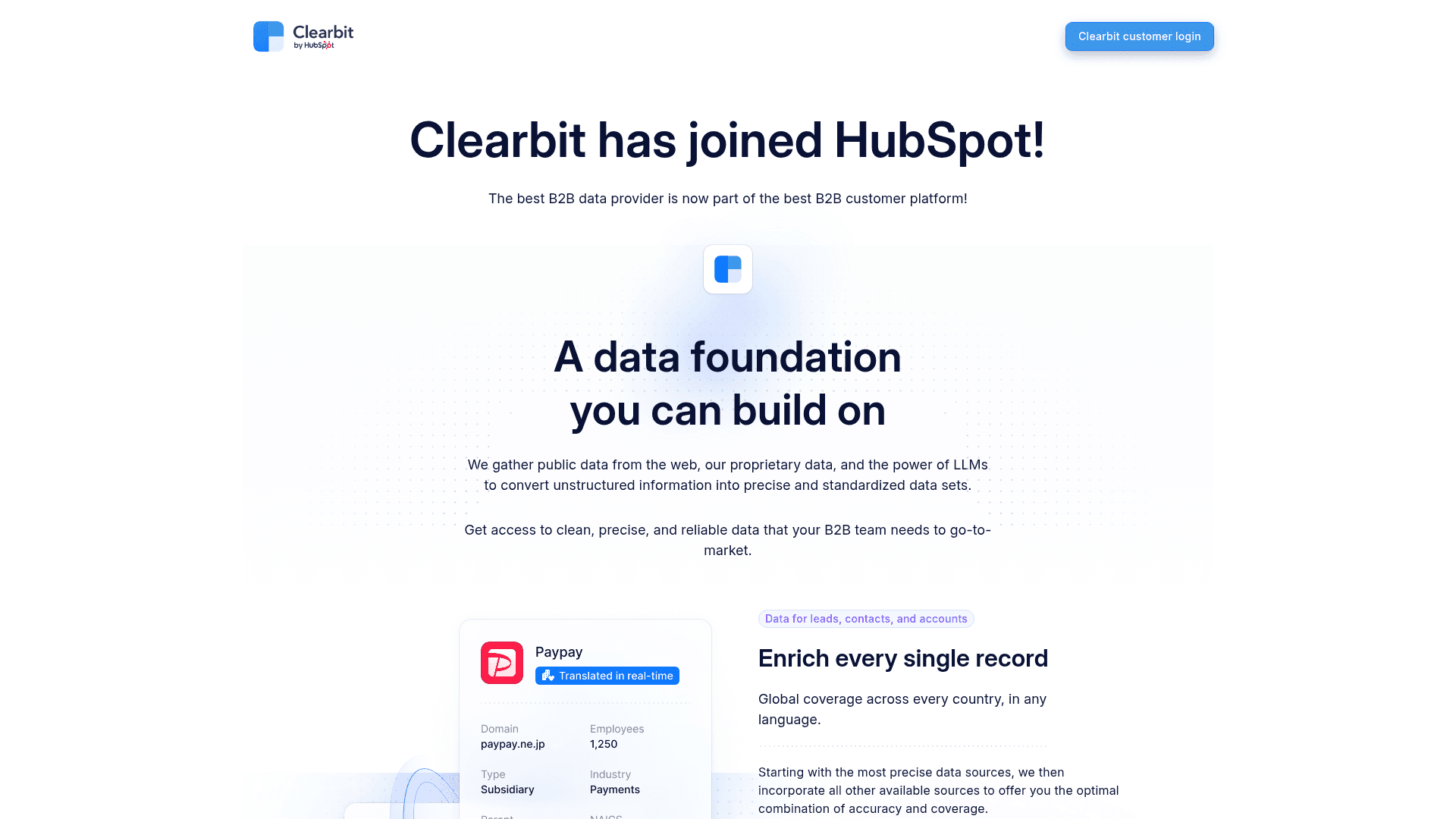
Clearbit, now part of HubSpot's data platform, is built around enrichment instead of prospecting. Its core value is appending firmographic and technographic data to records that already exist in your CRM or land on your website, not generating net-new contact lists for outbound. For revenue teams whose primary pain is working with incomplete or stale records in Salesforce or HubSpot, Clearbit's enrichment quality is strong.
The acquisition by HubSpot in 2023 has made Clearbit increasingly native to that ecosystem, which is an advantage if HubSpot is your CRM of record and a meaningful constraint if it isn't. The product has deep integration into HubSpot workflows, but teams on Salesforce or other CRMs will find the experience more fragmented and the roadmap less aligned with their platform direction.
Clearbit isn't a direct ZoomInfo replacement for outbound-heavy motions. There's no contact prospecting database to query for net-new leads, no intent signal layer that identifies accounts in an active buying window, and no sequencing capability. Its partial GDPR posture also warrants scrutiny for teams operating in compliance-sensitive markets. Teams reviewing compliant enrichment options should assess Clearbit alternatives before committing to a contract renewal.
Best fit: HubSpot-native revenue teams whose primary need is enriching inbound leads and existing CRM records, not building net-new prospecting lists.
5. LinkedIn Sales Navigator
LinkedIn Sales Navigator sits in a category of its own because its data advantage is structural: every contact record is self-maintained by the person it describes. Job changes, title updates, and company moves are reflected in near real time, which makes it the most accurate source for current professional information available at scale. For revenue teams that have burned pipeline on ZoomInfo contacts who moved roles six months ago, that freshness advantage is real.
The platform's filtering and account mapping capabilities are also strong. Building lists by seniority, function, growth signals, and account activity is faster and more intuitive than most alternatives. And for teams running relationship-based or enterprise sales motions, the social proof and warm introduction pathways that Sales Navigator surfaces are genuinely distinctive.
The gaps are execution and depth. Sales Navigator gives you accurate contacts and account intelligence, but there's no intent data beyond LinkedIn's own engagement signals, no AI-powered outreach layer, and no direct CRM sync that pushes actionable tasks to reps automatically. The tool is priced transparently, but at $99 to $179 per seat per month, it stacks up quickly across a full sales team, especially when you still need a separate sequencing tool to execute outreach. GDPR compliance is solid, but the data you're working with is limited to what LinkedIn members have made available.
Best fit: Enterprise and mid-market teams running relationship-driven or account-based sales motions where contact freshness and buying committee mapping matter more than intent signals or outreach automation.
6. Breakout
Breakout is built for a different use case than the rest of this list. Where ZoomInfo, Apollo, and Cognism are optimized for building cold contact lists at scale, Breakout is built around inbound and handraiser signals: the accounts already visiting your site, filling out forms, attending your events, or otherwise indicating they are in a buying window. The Signals Agent deanonymizes anonymous website visitors at the individual level, identifies buying committee members at each account, and surfaces which contacts are actively researching your product right now.
That signal layer is the core differentiator. Instead of starting from a cold database and filtering toward an ICP, Breakout starts from accounts already raising their hand and works backward to identify every relevant contact at that company. The Campaigns Agent handles personalized multi-channel follow-up across email and LinkedIn without requiring a separate engagement tool. When a high-intent signal fires, a rep receives an actionable task directly inside their CRM, with no manual export step and no lag between signal and action.
Pricing is transparent and usage-based, starting at $500 per month for the Signals plan, and a free 30-day trial is available with no credit card required.
Best fit: Series B+ revenue teams whose primary pipeline gap is converting inbound intent and handraiser signals into booked meetings, not sourcing net-new cold contacts from a static database.
Feature Comparison: ZoomInfo vs. Top Alternatives
Feature | ZoomInfo | Apollo.io | Lusha | Cognism | Clearbit | LinkedIn Sales Navigator | Breakout |
|---|---|---|---|---|---|---|---|
B2B Contact Data | ✓ | ✓ | ✓ | ✓ | ✓ | ✓ | ✓ |
Intent Data | ✓ | Limited | ✗ | ✓ | Limited | Limited | ✓ |
AI-Powered Outreach | ✗ | ✓ | ✗ | ✗ | ✗ | ✗ | ✓ |
GDPR Compliance | Partial | Partial | ✓ | ✓ | Partial | ✓ | ✓ |
CRM Integration | ✓ | ✓ | ✓ | ✓ | ✓ | ✓ | ✓ |
Pricing Transparency | ✗ | ✓ | ✓ | ✗ | ✗ | ✓ | ✓ |
Free Trial / Tier | ✗ | ✓ | ✓ | ✗ | ✗ | ✗ | ✓ |
Each of these tools covers the basics of B2B contact data and CRM integration, but the gaps appear quickly once you look past those core capabilities. ZoomInfo lacks transparent pricing and has no free trial, which makes budget forecasting harder before you've even signed a contract. Intent data coverage separates the field further, with only ZoomInfo, Cognism, and Breakout offering it in a meaningful way. AI-powered outreach narrows the field to Apollo and Breakout. For teams operating in compliance-sensitive markets, Cognism and Lusha carry the strongest GDPR posture, while ZoomInfo and Apollo remain only partially compliant; teams using enrichment tools should also review Clearbit alternatives for compliant options.
Why Breakout Is the Right ZoomInfo Alternative for Inbound-Led Teams
The case for Breakout is not that it's a better contact database or a cheaper ZoomInfo contract. It's built for a different problem: converting accounts that have already shown buying intent, instead of cold-sourcing contacts from a static list.
ZoomInfo's model assumes your pipeline starts from a cold database query. You filter by firmographic criteria, export a list, and push it into a sequencing tool. Breakout inverts that motion. With built-in B2B website visitor identification, the Signals Agent identifies who is already on your site, which company they work for, and who else on the buying committee you should reach. Your reps start working accounts that have already raised their hand instead of cold-filtering a database and hoping the timing is right.
The practical difference shows up in pipeline quality. Accounts that self-select into your funnel through a site visit, a form fill, a content download, or an event registration convert at materially higher rates than cold outbound contacts. Where ZoomInfo gives you scale across a broad universe of contacts, Breakout gives you precision across the accounts most likely to close. Those are different problems, and the right tool depends on which one you actually have.
The signal coverage goes deeper than a single visit. Breakout's website deanonymization tools work in conjunction with technographic changes and hiring patterns, surfacing a complete picture of account activity instead of a single data point. That combined signal is what powers the B2B visitor intelligence personalization tools layer, which lets your team see why a specific account is relevant right now, going beyond the raw visit data.
Breakout integrates directly with Salesforce, HubSpot, and Marketo, so there is no manual export step, no reconciliation overhead, and no lag between a high-intent signal firing and a rep receiving an actionable task inside the CRM they already work in.
For Series B+ revenue teams whose biggest pipeline gap is converting inbound intent and handraiser signals instead of sourcing net-new cold contacts, Breakout is a more direct fit than any database-first ZoomInfo replacement.
Final Thoughts on the Best ZoomInfo Competitors
Your evaluation should start with a clear read on what ZoomInfo is actually failing to do for your team, and go beyond what its contract costs. Most revenue teams have either a data freshness problem, an intent coverage gap, or a pricing structure that makes scaling painful. Running a short pipeline audit before you sign anything new will tell you which bucket you're in. If the audit shows that converting inbound intent and handraiser signals is the gap instead of cold contact sourcing at scale, Breakout is worth testing directly.
FAQs
Why are revenue teams at Series B+ companies moving away from ZoomInfo in 2026?
The core frustration is the value equation, not the data itself. ZoomInfo's enterprise pricing assumes broad usage across large teams, so focused revenue organizations end up paying for coverage they never touch, while opaque annual contracts make budget forecasting unreliable quarter over quarter. Teams running tight ICPs with defined target accounts are finding that intent-signal-forward tools deliver more actionable pipeline at a fraction of the total contract value.
What features should you focus on when comparing ZoomInfo alternatives for an outbound-heavy GTM motion?
Focus on three things: data freshness and verification frequency (beyond raw database size), real-time intent signal coverage at the account level, and native CRM sync that eliminates manual exports. Tools that require a separate sequencing layer or batch contact refreshes introduce the same data-lag problem you likely experienced with ZoomInfo, so the replacement has to close those gaps structurally, and actually deliver on that promise.
When does it make sense to switch from ZoomInfo to Breakout for inbound and outbound pipeline?
The switch makes sense when your team is losing deals because contacts have changed roles between data refreshes, when intent signals arrive too late to act before a competitor does, or when your current contract forces reps to ration seat access and export credits. Breakout runs continuous verification and surfaces buying signals in real time, which solves the freshness and prioritization problems that ZoomInfo's batch-update model creates for high-velocity sales teams.
How does Breakout handle CRM integration differently from ZoomInfo?
Breakout integrates natively with Salesforce, HubSpot, and Marketo without requiring manual exports or data reconciliation steps. When a high-intent signal fires, a rep receives an actionable task directly inside the CRM they already work in, with no lag and no separate sync job to manage. ZoomInfo requires additional steps between signal detection and rep action, which means your team is consistently slower to engage accounts that are actively in a buying window.
Can Breakout replace ZoomInfo for teams that need both inbound visitor identification and outbound prospecting in a single workflow?
Yes. Breakout runs both motions inside one unified workflow: the Signals Agent deanonymizes website visitors and identifies buying committee members, while the Campaigns Agent handles outbound research, personalized sequencing, and multi-channel follow-up across email and LinkedIn. Pipeline generation does not pause when inbound traffic slows, because the outbound motion operates in parallel across job change signals, intent data, and event attendance triggers without requiring separate tooling for each source.