All Blogs
A plain-English look at Warmly and Chili Piper so you can see which one fits better.

Evan Marshall
Senior Growth AI Strategist
Published On

When you compare Warmly vs Chili Piper, you're really deciding whether your bigger problem is invisible demand or slow speed-to-lead. Warmly tells you who's on your site right now and what they're looking at, even if they never submit a form. Chili Piper takes over after someone raises their hand and makes sure they get routed to the right rep and into a calendar immediately. Both matter for revenue teams, but they work at opposite ends of your funnel. The right choice depends on where your pipeline is actually breaking down.
TLDR:
Warmly identifies anonymous website visitors and converts intent into pipeline before form fills.
Chili Piper routes inbound leads and books meetings after prospects have already raised their hands.
The tools serve different funnel stages and aren't substitutes for each other.
Teams with high inbound volume benefit from Chili Piper's speed-to-lead routing.
Some organizations run both to capture intent at the top and manage scheduling further down.
Warmly vs Chili Piper: Core Capabilities, Integrations, and Pricing
Warmly and Chili Piper solve different problems for revenue teams, and that distinction matters more than most buyers realize. Warmly is built around identifying anonymous website visitors and converting that intent data into pipeline before a prospect ever fills out a form. Chili Piper, by contrast, is a meeting scheduling and inbound lead routing tool that kicks in after a prospect has already raised their hand.
Understanding where each tool fits in your funnel is the first step to making the right call.
What Warmly Does
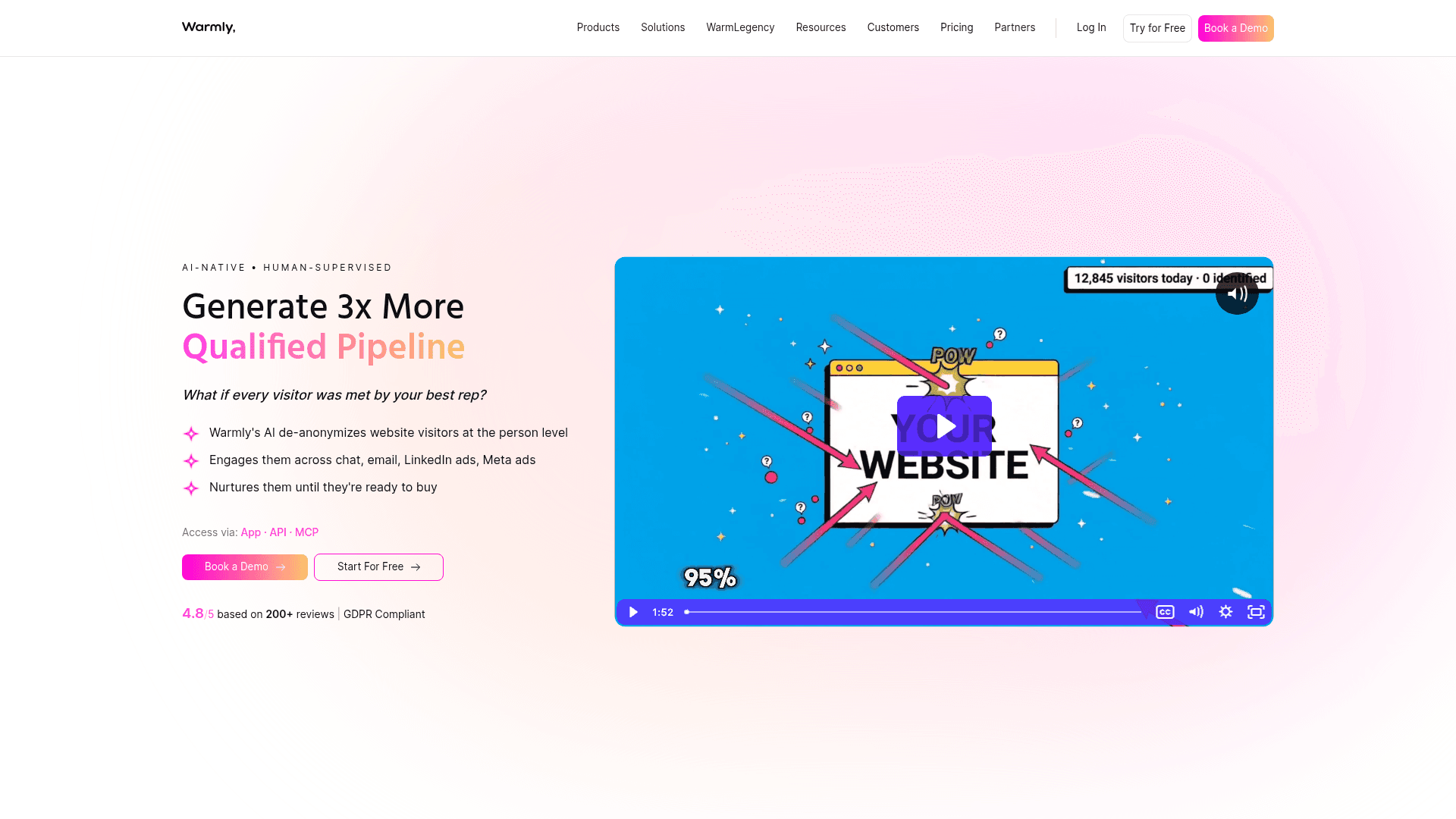
Warmly uses a combination of IP resolution, identity graphs, and first-party signals to tell you who is on your website right now and what they are looking at. It then surfaces that information to your sales team through Slack alerts, CRM enrichment, and an AI-powered chat widget that engages visitors automatically.
Important context for 2026 buyers: Warmly has entered into an agreement to be acquired by HubSpot. As of today, existing contracts, pricing, and account team relationships remain unchanged. Over time, the product roadmap will increasingly align with HubSpot's broader customer journey ecosystem. For teams not currently on HubSpot, or those evaluating Warmly as a long-term standalone investment, that acquisition context belongs in your buying decision.
The core use case is prospecting and pipeline creation at the top of the funnel:
Warmly identifies companies and individual contacts visiting your site, even when they haven't submitted any form, or started a conversation, giving your team a real-time view of in-market accounts.
Its AI agent can initiate conversations with visitors on your behalf, ask qualifying questions, and route hot leads to a rep or book a meeting directly, without requiring a human to be online and watching a dashboard.
It layers in third-party intent data from providers like Bombora and G2 alongside your own website activity, so you can focus your outreach based on a fuller picture of where an account is in their buying process.
CRM enrichment happens automatically, so visitor sessions get logged against the right contact and company records without manual entry.
Warmly is well suited to demand generation and ABM programs where identifying anonymous demand is the primary challenge. A practical example: if a target account from your ICP starts visiting your pricing page repeatedly over three days without submitting a form, Warmly can surface that signal to the owning rep with enriched contact data and trigger an automated outreach sequence — all before your competitor even knows that account is in-market. That kind of early-stage visibility is what separates teams who respond to intent from teams who respond to forms.
What Chili Piper Does
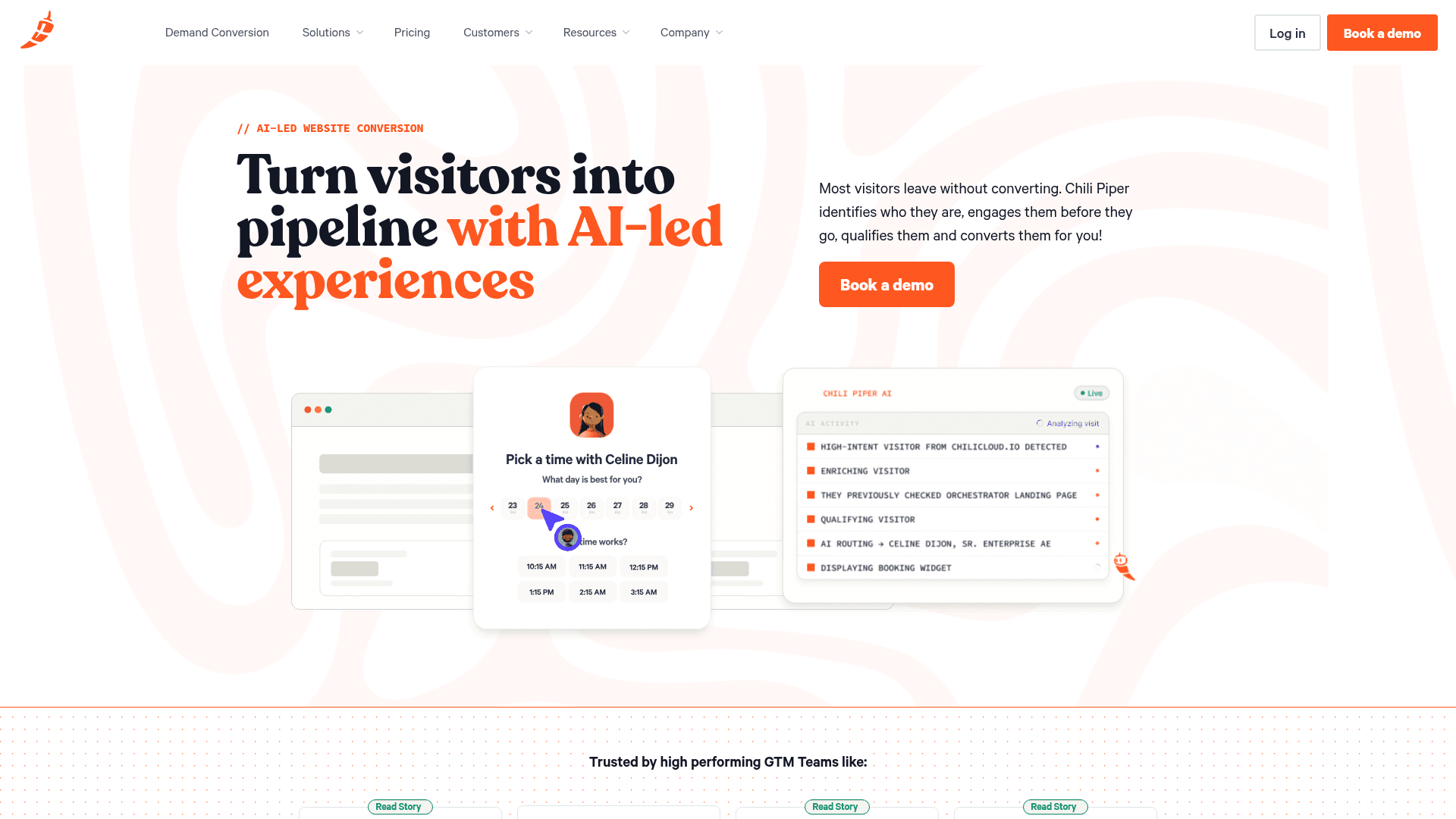
Chili Piper operates further down the funnel. It is designed to eliminate the friction that kills conversion between a form submission and a booked meeting. Its flagship product, Concierge, routes inbound leads in real time and lets prospects book a meeting the moment they submit a form on your site.
The core use case is speed-to-lead and meeting conversion:
Chili Piper routes leads instantly based on rules you define, including territory, account ownership, round-robin assignment, and custom criteria, so the right rep gets notified and the prospect gets a calendar in seconds.
Its scheduling infrastructure supports complex meeting types including multi-stakeholder meetings, handoffs between SDR and AE, and automated reminders that reduce no-shows.
Distro, its lead distribution product, handles the routing logic separately from scheduling, which gives operations teams more granular control over how leads flow through the funnel.
It integrates natively with Salesforce, HubSpot, and Marketo, and the routing rules can pull from CRM data fields to make intelligent assignment decisions automatically.
Chili Piper is typically the right fit for teams with strong inbound volume who are losing deals in the gap between form fill and first conversation.
How They Compare Side by Side
These tools share very little overlap in their actual functionality, but they are frequently compared together because both appear in the category of "lead engagement." The table below clarifies where each one plays.
Capability | Warmly | Chili Piper |
|---|---|---|
Anonymous visitor identification | Yes | No |
Real-time website intent signals | Yes | No |
AI-powered chat and engagement | Yes | Limited |
Inbound lead routing | Basic | Yes, core product |
Meeting scheduling | Yes | Yes, core product |
Form-to-calendar conversion | Limited | Yes |
CRM enrichment | Yes | Partial |
ABM and account targeting | Yes | No |
Third-party intent data | Yes | No |
Pricing model | Usage and seat-based | Per seat |
The most important takeaway from this comparison is that the two tools are not substitutes for each other. A team with a heavy inbound motion and SDR-to-AE handoff complexity will get far more value from Chili Piper. A team focused on identifying and converting anonymous demand, running ABM programs, or building pipeline from website traffic will find Warmly more relevant.
Some organizations run both, using Warmly to capture intent and initiate engagement at the top of the funnel and Chili Piper to manage the scheduling and routing logic once a lead has self-identified. In practice, the handoff looks like this: Warmly's AI chat engages an anonymous visitor, qualifies their intent, and collects contact information — at which point that lead enters your CRM and triggers Chili Piper's routing rules, which assign the lead to the right rep and present an instant booking link. The two tools don't overlap; they hand off. Whether that combination makes financial sense depends on your team size, inbound volume, and how much of your pipeline comes from form submissions versus proactive outbound triggered by intent signals. For most teams under 20 reps, the cost of running both is only worth it if you have enough inbound volume for Chili Piper to meaningfully move the needle and enough anonymous traffic for Warmly to surface actionable intent.
Final Thoughts on Picking Between These Two Tools
The right answer depends entirely on your funnel and where conversions break down. Warmly solves for invisible demand and early engagement, while Chili Piper solves for speed and routing once a lead is already warm.
If your form submission volume is strong but your response times are slow or your routing is inconsistent, Chili Piper is the higher-leverage investment. If your site gets meaningful traffic from your ICP but most of it leaves without ever raising a hand, Warmly will unlock pipeline that your current stack is missing entirely. The harder case is when both are true — in that scenario, pick the problem that's costing you more measurable revenue right now and solve it first before adding the second layer.
You can run both if you have the volume and budget to support it, but most teams get better ROI by tackling their highest-impact problem first. A useful test: look at your last 90 days of pipeline. If the majority of lost deals stalled between form fill and first meeting, start with Chili Piper. If most of your target accounts never submitted a form at all, start with Warmly.
A Third Option: Multi-Channel AI SDR Outreach, Ready in Days
If your evaluation of Warmly and Chili Piper reveals that you need both signal identification and multi-channel follow-through, but your team can't absorb months of onboarding, complex routing configuration, and ongoing playbook maintenance, Breakout is worth serious consideration.
Breakout is an AI SDR built for fast-growing B2B teams. It deploys in days, carries no mandatory onboarding fees, and runs the full inbound motion in one product: identify who is on your site, engage them with a personalized AI conversation, qualify their intent, and automatically trigger follow-up across email and LinkedIn when they don't book immediately.
The signal model goes beyond website visits. Any buying signal can activate outreach: form submissions, content downloads, event attendance, intent data from third-party sources, or any other indicator that a prospect has raised their hand. Website visits are one input among many. For teams whose pipeline doesn't flow entirely through inbound web traffic, that breadth matters.
Where Warmly identifies anonymous demand and Chili Piper routes and schedules after form submission, Breakout covers the arc from first signal to booked meeting inside a single workflow. There is no separate routing tool, no separate scheduling layer, and no maintenance overhead from managing fragile decision trees. The AI SDR handles qualification and objection handling autonomously, with your reps stepping in at the point of confirmed meeting intent.
Breakout offers a 30-day free trial with no credit card required, making it a low-risk way to test signal-based engagement before committing to a more involved tool evaluation.
FAQ
What's the main difference between Warmly and Chili Piper?
Warmly identifies anonymous website visitors and engages them before they fill out a form, while Chili Piper routes and schedules meetings after someone has already submitted their information. Warmly operates at the top of your funnel for demand generation, and Chili Piper optimizes speed-to-lead conversion after prospects self-identify.
Which tool is better for ABM programs?
Warmly is the better choice for account-based marketing because it identifies target accounts visiting your website, layers in third-party intent data, and can trigger automated engagement before any form submission. Chili Piper doesn't offer anonymous visitor identification or ABM-specific capabilities.
Can you use Warmly and Chili Piper together?
Yes, many teams run both tools in sequence: Warmly captures and engages anonymous visitors at the top of your funnel, then Chili Piper handles routing and scheduling once a lead submits a form. This combination works best if you have strong inbound volume and need both demand identification and meeting conversion optimization.
How do their pricing models differ?
Warmly uses a usage and seat-based pricing model that scales with your conversation volume and team size, while Chili Piper charges per seat. Your total cost will depend on how many reps need access and how much website traffic or inbound volume you're managing.
Which tool should you choose if your main problem is low form conversion rates?
Choose Chili Piper if you're getting strong form submission volume but struggling to convert those leads into booked meetings quickly. Its real-time routing and instant scheduling capabilities directly target the gap between form fill and first conversation where most deals stall out.